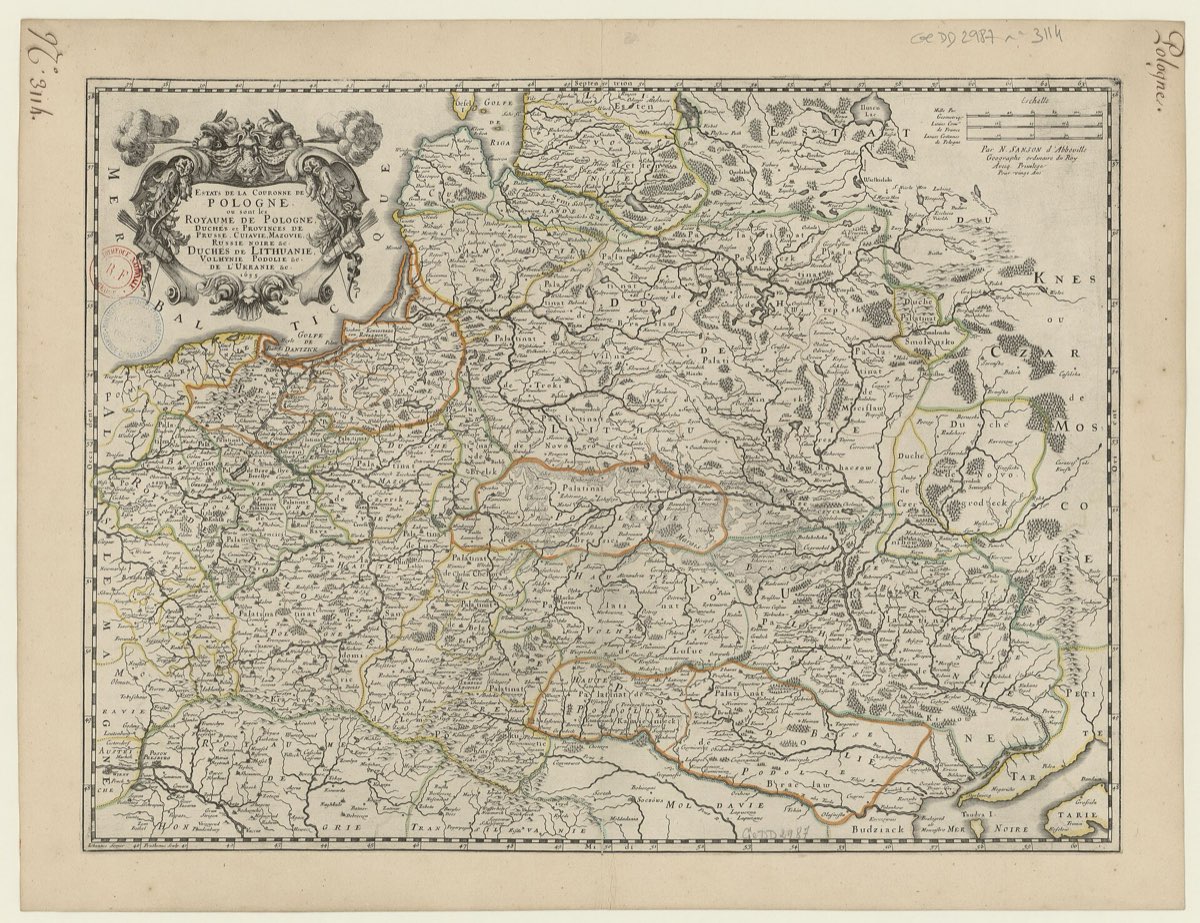
Map: Nicolas Sanson · Engraver: Johannes Somer · 1655 · BnF
Potop / Archive
Maps
A map from 1655, an old plan of Warsaw and a present-day map of Deluge events year by year.
See how a cartographer working during the Deluge pictured the Commonwealth, examine an old plan of Warsaw, then locate documented events year by year. Old maps are historical sources: they show the knowledge and conventions of their time.
1655 · period map
The Commonwealth through a cartographer’s eyes in 1655
Nicolas Sanson mapped the Crown, Lithuania and neighbouring lands together. Its dense network of old place names shows how this region was described in the year of the Swedish invasion.
How to read this map
Sanson’s cartouche names Prussia, Kuyavia, Mazovia, Lithuania, Volhynia, Podolia and Ukraine, among other regions. Look for old spellings of towns and rivers; the coloured lines show divisions as drawn by a seventeenth-century cartographer.
This is neither an exact snapshot of borders on one day in 1655 nor a map of the front line. Names and boundaries reflect the maker’s knowledge and choices.
1655 / 1900 · later reproduction
Warsaw at the time of Swedish occupation
The plan shows the old city, the Vistula, walls, gates and buildings. Its title gives two dates for the occupation: 30 August and 8 September 1655, reflecting different calendars.
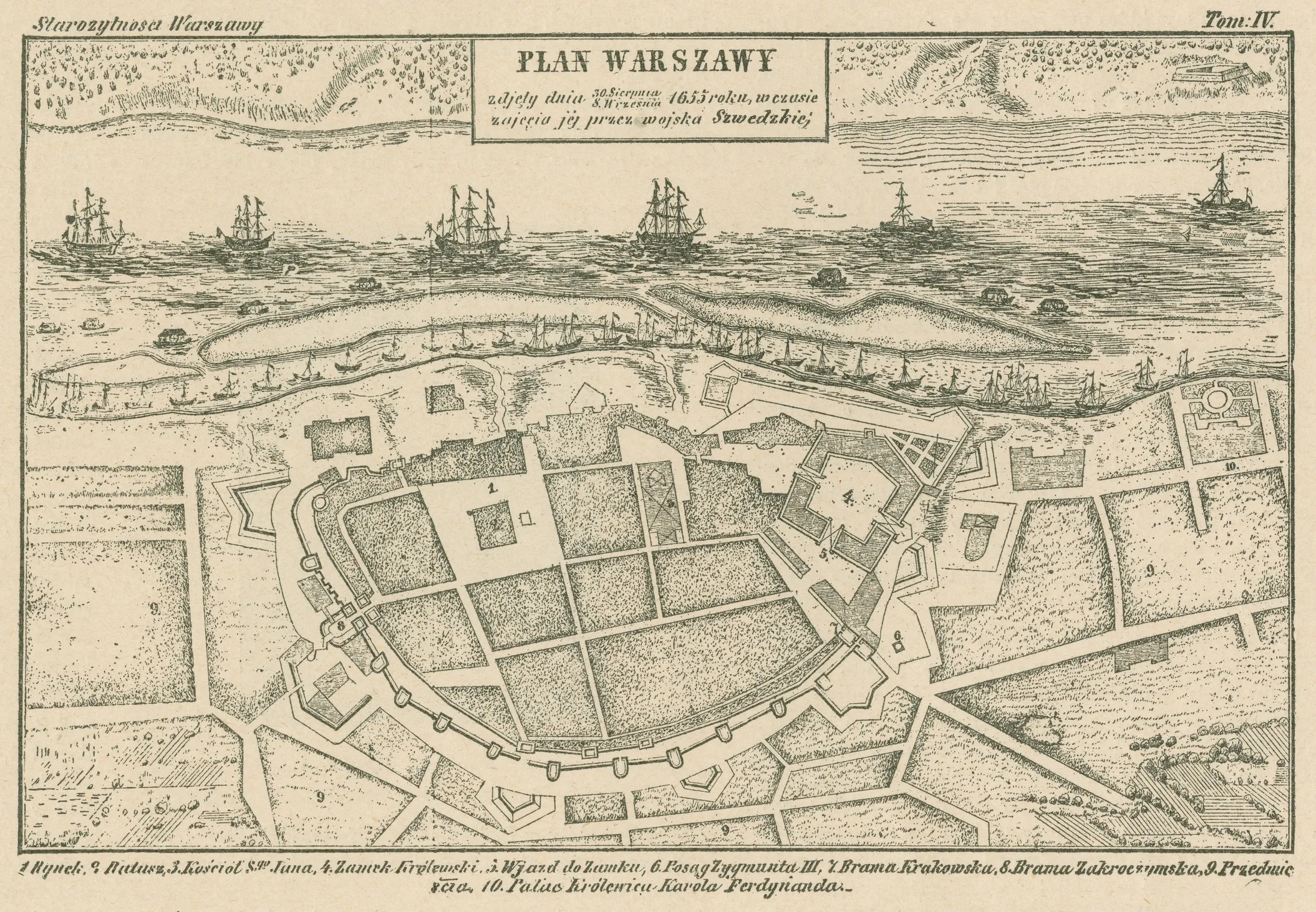
This image was published in 1900 as a reproduction of a plan referring to 1655. It is a later edition of an old plan, not a print made during the Deluge.
1655–1660 · event locations
The war, year by year
Choose a year to locate documented events on a present-day map. Each point leads to its article and a source.
Markers locate the present-day town or area of an event. Their sequence is not a troop route, and the background does not show seventeenth-century borders.
- Capitulation at Ujście (1655)
In July 1655 the general levy of the nobility of the Poznań and Kalisz voivodeships, gathered on the Noteć, surrendered without a decisive battle to Arvid Wittenberg's Swedish army.
Check the source - Capitulation of Kėdainiai (1655)
In August 1655, near Kėdainiai, the Grand Hetman of Lithuania Janusz Radziwiłł proclaimed the act submitting the Grand Duchy of Lithuania to the protection of the King of Sweden; in October the Union of Kėdainiai was signed here.
Check the source - Swedish forces occupy Warsaw
On 8 September 1655, Warsaw surrendered to Charles X Gustav's army without a battle. Behind that brief notice lies a story of a municipal decision, occupation taxes and a map bearing two dates.
Check the source - Skirmish at Inowłódz
Stefan Czarniecki’s troops defeated the rearguard of Arvid Wittenberg’s Swedish army. The action was an early instance of armed resistance in the 1655 campaign.
Check the source - Battle of Żarnów
John II Casimir’s forces were defeated by the Swedes at Żarnów. The royal army continued its retreat after the battle.
Check the source - Siege of Kraków (1655)
In the autumn of 1655 Stefan Czarniecki defended Kraków for more than three weeks against the army of Charles X Gustav, then surrendered the city under a capitulation and led the garrison out under arms.
Check the source - Defeat at Nowy Dwór
The Swedish army routed the Mazovian noble levy at Nowy Dwór. Another force raised to defend the Commonwealth failed to halt the invasion.
Check the source - Battle of Wojnicz
The Swedish army defeated Crown forces at Wojnicz. The defeat further weakened the position of Kraków’s defenders.
Check the source - Resistance at Kościan
Krzysztof Żegocki attacked and defeated the Swedish garrison at Kościan. The action showed that resistance continued in Greater Poland despite earlier capitulations.
Check the source - Crown hetmans submit at Wiśnicz
The Crown hetmans accepted Charles X Gustav’s authority at Wiśnicz. Their later return to John Casimir’s side marked a political reversal in the campaign.
Check the source - Siege of Jasna Góra (1655)
For nearly six weeks the defenders of Jasna Góra refused to admit a Swedish garrison. Meet the decision makers, explore the fortress and learn why its defence became the defining image of the Deluge.
Check the source - The Opole proclamation
John II Casimir issued a proclamation at Opole calling for resistance to the Swedes. He made the appeal while outside the Commonwealth.
Check the source - Death of Janusz Radziwiłł
Janusz Radziwiłł died during the war, soon after the Kėdainiai agreements. His political choices remained among the most contested episodes of the invasion.
Check the source - Battle of Krosno
Forces loyal to John Casimir under Wojniłłowicz defeated Swedish troops at Krosno. The victory was one of several local actions against Swedish units and garrisons.
Check the source - Tyszowce Confederation (1655)
At the end of December 1655 the Crown hetmans, the army and the nobility formed a confederation at Tyszowce which renounced allegiance to Charles X Gustav and called for war against the Swedes.
Check the source - Battle of Gołąb
Charles X Gustav defeated Stefan Czarniecki’s forces at Gołąb. Polish troops nevertheless continued operations against the Swedish army.
Check the source - Battle of Janów
Paweł Jan Sapieha’s Lithuanian forces fought Bogusław Radziwiłł’s troops at Janów. The action formed part of the fighting in Lithuania alongside the Crown campaign.
Check the source - Battle of Jarosław
Stefan Czarniecki defeated the vanguard of Charles X Gustav’s army at Jarosław. The engagement took place during manoeuvres in the south of the Commonwealth.
Check the source - Battle of Warka (1656)
In April 1656 Stefan Czarniecki's army defeated, on the Pilica between Warka and Czersk, the corps of the Margrave of Baden, which was marching to the aid of Charles X Gustav.
Check the source - John Casimir’s Lwów vows
John II Casimir made his vows in Lwów Cathedral. The act had both religious and political meaning as resistance to Sweden revived.
Check the source - Recapture of Lublin
Lithuanian troops under Paweł Jan Sapieha retook Lublin from the Swedes. The city’s recovery formed part of operations against scattered occupation garrisons.
Check the source - Battle of Kłecko
Forces led by Stefan Czarniecki and Jerzy Sebastian Lubomirski fought the Swedes at Kłecko. The Polish Army Museum assesses the outcome as a Swedish victory.
Check the source - Vows outside Warsaw
Outside besieged Warsaw, John II Casimir renewed the promises he had made at Lwów. The king was with the forces seeking to recover the capital.
Check the source - Treaty of Malbork
Charles X Gustav concluded an agreement at Malbork with Frederick William, Elector of Brandenburg. In exchange for military aid, the elector was promised territory in the Commonwealth.
Check the source - Swedish garrison surrenders in Warsaw
The Swedish garrison in Warsaw surrendered after a siege by Commonwealth forces. The capital’s recovery preceded a major field battle outside the city later that month.
Check the source - Three-day Battle of Warsaw
From 28 to 30 July, Commonwealth troops fought a combined Swedish-Brandenburg army. The allies won the field battle, but the war continued.
Check the source - Battle of Łowicz
Stefan Czarniecki’s forces won an engagement at Łowicz. Operations against Swedish forces continued after the July defeat near Warsaw.
Check the source - Recapture of Łęczyca
John II Casimir’s army captured Łęczyca from its Swedish garrison. The recovery of towns and fortresses gradually reduced the area under Swedish control.
Check the source - Battle of Prostki
Wincenty Gosiewski’s Polish, Lithuanian and Tatar force defeated Swedish-Brandenburg troops. The battle was fought in Ducal Prussia.
Check the source - Battle of Filipów
Swedish-Brandenburg forces defeated Wincenty Gosiewski’s corps at Filipów. The defeat came two weeks after his victory at Prostki.
Check the source - Truce of Niemieża
The Commonwealth and Russia concluded a truce in their war that had begun in 1654. The agreement reflected the changed situation created by Swedish advances.
Check the source - Agreement with the Habsburgs in Vienna
The Commonwealth and Austrian Habsburgs signed an agreement in Vienna on aid against Sweden. The war was drawing in a growing number of European states.
Check the source - Treaty of Radnot
Charles X Gustav and his allies agreed on a proposed division of Commonwealth territory. The planned partition was not carried out.
Check the source - John II Casimir arrives in Gdańsk
The king arrived in Gdańsk, which had not surrendered to the Swedes. The port remained an important centre of resistance and contact with allies.
Check the source - Battle of Chojnice
Commonwealth and Swedish forces fought at Chojnice. Fighting in Prussia continued after the 1656 campaign.
Check the source - Warsaw falls to Transylvanian and Swedish forces
George II Rákóczi’s troops and their Swedish allies forced Warsaw to capitulate. The capital was again held by John Casimir’s opponents.
Check the source - Battle of Magierów
Commonwealth forces fought the retreating Transylvanian army at Magierów. The campaign against George II Rákóczi was nearing its end.
Check the source - George II Rákóczi capitulates
After defeats suffered by Transylvanian forces, George II Rákóczi capitulated. His Swedish-backed campaign did not bring about the planned partition of the Commonwealth.
Check the source - Treaties of Wehlau and Bromberg
The agreements with Elector Frederick William ended his alliance with Sweden. The Commonwealth recognized his sovereignty in Ducal Prussia.
Check the source - Blockade of the Swedish garrison in Toruń
Commonwealth and imperial forces began a blockade of Toruń, held by a Swedish garrison. The operation formed part of the recovery of fortresses in Royal Prussia.
Check the source - Crossing to the island of Als
Stefan Czarniecki’s corps joined the allied crossing to the Danish island of Als. The Danish campaign took Commonwealth soldiers far beyond their own borders.
Check the source - Swedish garrison of Toruń surrenders
The Swedish garrison of Toruń surrendered to Polish and imperial forces. This ended a months-long siege of a major Swedish stronghold in Prussia.
Check the source - Recapture of Grudziądz
During the 1659 campaign, Jerzy Sebastian Lubomirski’s troops retook Grudziądz from the Swedes. The city had been occupied since late 1655.
Check the source - Treaty of Oliva (1660)
The treaty concluded on 3 May 1660 in the monastery at Oliva ended the war between the Commonwealth and Sweden; Sweden returned Royal Prussia but kept the greater part of Livonia.
Check the source
PRESENT-DAY MAP
Where is it today?
This map gathers all described places and events for which we have modern coordinates. The OpenStreetMap background shows today’s geography, not the Commonwealth’s seventeenth-century borders.
- Siege of Zbarazh 49.66336, 25.78536
- Battle of Berestechko 50.35, 25.1167
- Capitulation at Ujście (1655) 53.0532, 16.7324
- Capitulation of Kėdainiai (1655) 55.2887, 23.9758
- Swedish forces occupy Warsaw 52.2494, 21.0122
- Skirmish at Inowłódz 51.523697, 20.222885
- Battle of Żarnów 51.247993, 20.17205
- Siege of Kraków (1655) 50.0619, 19.9369
- Defeat at Nowy Dwór 52.430651, 20.715471
- Battle of Wojnicz 49.95735, 20.836405
- Resistance at Kościan 52.086325, 16.645
- Crown hetmans submit at Wiśnicz 49.915267, 20.462168
- Siege of Jasna Góra (1655) 50.8128, 19.0971
- The Opole proclamation 50.678793, 17.929884
- Battle of Krosno 49.693804, 21.765146
- Tyszowce Confederation (1655) 50.6172, 23.6982
- Death of Janusz Radziwiłł 53.207646, 22.773019
- Battle of Gołąb 51.487472, 21.876229
- Battle of Janów 52.19712, 23.207884
- Battle of Jarosław 50.039977, 22.657372
- Battle of Warka (1656) 51.7851, 21.1834
- John Casimir’s Lwów vows 49.841952, 24.031592
- Recapture of Lublin 51.218195, 22.554678
- Battle of Kłecko 52.632425, 17.428291
- Vows outside Warsaw 52.233374, 21.071149
- Treaty of Malbork 54.035836, 19.03685
- Swedish garrison surrenders in Warsaw 52.233374, 21.071149
- Three-day Battle of Warsaw 52.233374, 21.071149
- Battle of Łowicz 52.107683, 19.944787
- Recapture of Łęczyca 52.059386, 19.201643
- Battle of Prostki 53.700586, 22.432423
- Battle of Filipów 54.179629, 22.621591
- Truce of Niemieża 54.634395, 25.349526
- Agreement with the Habsburgs in Vienna 48.208354, 16.372504
- Treaty of Radnot 46.45019, 24.23067
- John II Casimir arrives in Gdańsk 54.348291, 18.654023
- Battle of Chojnice 53.699917, 17.570346
- Warsaw falls to Transylvanian and Swedish forces 52.233374, 21.071149
- Battle of Magierów 50.109105, 23.699079
- George II Rákóczi capitulates 49.436723, 27.404104
- Treaties of Wehlau and Bromberg 53.121965, 18.000253
- Blockade of the Swedish garrison in Toruń 53.014536, 18.596583
- Crossing to the island of Als 54.971637, 9.924009
- Swedish garrison of Toruń surrenders 53.014536, 18.596583
- Recapture of Grudziądz 53.472512, 18.761894
- Treaty of Oliva (1660) 54.411, 18.5587
- Berestechko 50.35, 25.1167
- Bydgoszcz 53.121965, 18.000253
- Częstochowa 50.812, 19.1132
- Gdańsk 54.348291, 18.654023
- Grudziądz 53.472512, 18.761894
- Jasna Góra 50.8128, 19.0971
- Kėdainiai 55.2887, 23.9758
- Kościan 52.086325, 16.645
- Kraków 50.0619, 19.9369
- Lublin 51.218195, 22.554678
- Lviv 49.841952, 24.031592
- Malbork 54.035836, 19.03685
- Mir 53.451083, 26.472722
- Oliwa 54.411, 18.5587
- Poznań 52.4089, 16.9336
- Radnot 46.45019, 24.23067
- Toruń 53.014536, 18.596583
- Tyszowce 50.6172, 23.6982
- Ujście 53.0532, 16.7324
- Warka 51.7851, 21.1834
- Warsaw 52.2494, 21.0122
- Vilnius 54.687, 25.293
- Wiśnicz 49.915267, 20.462168
- Wojnicz 49.95735, 20.836405
- Zbarazh 49.66336, 25.78536