
AI illustration
Imagined nineteenth-century printing workshop.
Novel
The Deluge: the novel
DocumentedThe second part of Henryk Sienkiewicz's Trilogy, serialised in the press in 1884–1886: plot, letters about writing, inspirations, the Trilogy’s purpose, manuscripts, publication history and the actual Nobel Prize citation.
- Names and variants
- pl „Potop” – powieść
The Deluge (Potop) is the second part of the Trilogy by Henryk Sienkiewicz, between With Fire and Sword and Pan Wołodyjowski1. The action takes place in the first years of the war with Sweden, 1655–16572. This page describes the novel as a literary work. The historical events that appear in the novel have separate pages comparing the sources with the text.
What is The Deluge about?
The following guide also discusses the ending.
The central character is Andrzej Kmicic, a soldier who must repair the harm he has caused and regain the trust of Oleńka Billewiczówna. Alongside his story, the Commonwealth moves from surrender and division towards resistance to invasion. The novel can therefore be read on two levels: personal reform and a community’s attempt to recover its capacity to act3.

Lauda: love, violence and a ruined reputation
Herakliusz Billewicz’s will links Oleńka’s future to Kmicic. Their initial affection is challenged by the conduct of his companions and his own violence. After local nobles kill his companions, Kmicic burns Wołmontowicze; Oleńka rejects him. He subsequently abducts her and is defeated by Wołodyjowski in a duel. These events establish the harm that he will have to put right4.
Kiejdany: to whom is loyalty owed?
At Kiejdany, Kmicic swears an oath to Janusz Radziwiłł. The announcement of an agreement with Sweden brings him into conflict with officers who reject the hetman’s decision. A conversation with Bogusław Radziwiłł, who describes the Commonwealth as cloth being torn apart by its neighbours, undermines his belief in that service. Kmicic attempts to abduct the prince and is shot5.
Babinicz: achievements under an assumed name
Kmicic adopts the name Babinicz. He warns Jasna Góra, participates in its defence and destroys a Swedish gun. He subsequently reaches John II Casimir’s entourage, saves the king and discloses his identity. Within the plot, trust returns gradually: his earlier reputation does not disappear with his first good deed6.
The ending: public restoration of his name
Babinicz’s further service takes place during the war, while Oleńka remains caught up in Bogusław’s actions and events at Taurogi. The severely wounded Kmicic returns to Lauda before a royal letter is read in church at Upita. Only then does Oleńka learn what he achieved under his assumed name. The ending joins his public vindication with the couple’s reconciliation7.
Structure
The post-war edition published by Państwowy Instytut Wydawniczy (the State Publishing Institute) in 1972, edited by Julian Krzyżanowski, on which the Wolne Lektury text is based, divides the novel into three volumes2. The first volume begins with an introduction and has 26 chapters, the second 40 and the third 308.
The introduction presents the Samogitian family of the Billewiczes and the will of Herakliusz Billewicz, which destines his granddaughter Aleksandra to be the wife of Andrzej Kmicic9. The first chapter opens with the sentence „Przyszedł nowy rok 1655.” ("The new year 1655 came.")10. The fortunes of the novel's heroes – the fictional Oleńka Billewiczówna and Andrzej Kmicic, to whose historical prototype the PSB refers11 – are interwoven in the novel with historical events. The novel shows the agreement at Kėdainiai12 (see Capitulation of Kėdainiai (1655)), the defence of Jasna Góra13 (see Siege of Jasna Góra (1655)) and the march on Warka14 (see Battle of Warka (1656)). Other events the novel only mentions: Stanisław Skrzetuski tells of the capitulation at Ujście15 (see Capitulation at Ujście (1655)), and Anusia Borzobohata brings the news of the Tyszowce Confederation to Taurogi16 (see Tyszowce Confederation (1655)). The Wolne Lektury note observes that in the novel „fakty historyczne przeplatają się z fabularną fikcją, a postaci rzeczywiste z nierzeczywistymi” ("historical facts are interwoven with the fiction of the plot, and real characters with unreal ones")2.
When did he conceive the novel?
The title and subject were settled before serialisation began. In a letter to Stanisław Tarnowski dated 14 January 1884, Sienkiewicz announced that after completing With Fire and Sword and resting, he would turn to the period of the Swedish, Muscovite and Tatar wars and Rákóczi’s invasion. He explicitly named the planned novel Potop17.
The calendar of his life and work connects the start of writing in autumn 1884 with his letter to Józef Mien of 1 October: he declined another publishing undertaking because he was occupied with a new work18.
Publication history
Like the other novels of the Trilogy, The Deluge first appeared in instalments in the press. According to the Polski Słownik Biograficzny (Polish Biographical Dictionary, PSB), three dailies began printing it at Christmas 1884: the Warsaw Słowo, Czas and Kurier Poznański. Publication continued until September 18861. The publisher's note of Wolne Lektury gives the same three titles and the years 1884–18862. Sienkiewicz was at that time editor-in-chief of Słowo; he had taken up the post at the end of 18811.
The Poznań first printing can be checked directly: Kuryer Poznański, no. 297 of 25 December 1884, prints an instalment marked “(1)” on page 2, headed Potop, with Sienkiewicz’s name and the opening of the Introduction19. The NPLP calendar’s publication list names Dziennik Poznański20; the surviving masthead establishes the newspaper for the verified instalment.
The book edition appeared in Warsaw in 18861; Wolne Lektury call it the first book edition2. A copy of the 1886 Warsaw edition in the National Library of Poland, printed at Noskowski's press, runs to six volumes21.
A chronology of writing and publication
The manuscript, newspaper instalments and printed volumes have separate dates. Each marks a different stage.
- 18 November 1884:Sienkiewicz’s letter to Stanisław Smolka discusses sending manuscript pages and preparing the serial publication.22
- 23–25 December 1884:
- 21 August 1886:Sienkiewicz tells Jadwiga Janczewska that he has finished the novel; the final pages still needed checking and sending.24
- 2 and 10 September 1886:the serial ends in Czas, then Słowo, according to NPLP’s chronology.25
- 1886:the Warsaw first book edition consists of six volumes, preserved in the National Library.21
Compare history, novel and film
Two examples distinguish historical evidence from the characters’ adventures.
Samuel and Andrzej Kmicic
History. Samuel Kmicic was a real soldier described in the Polish Biographical Dictionary.11
Novel. Andrzej, his relationship with Oleńka and his transformation as Babinicz are part of Sienkiewicz’s literary construction.2
Film. Daniel Olbrychski was cast as the fictional Andrzej.26 Read about his preparation in his profile.
The cannon at Jasna Góra
History. Kordecki describes a cannon bursting during the siege.27
Novel. Sienkiewicz gives Babinicz responsibility for blowing it up.28
Film. FINA’s synopsis of Potop Redivivus retains that fictional episode.29 The complete comparison also discusses differences between historical accounts.
Writing a serial: deadlines, manuscript and revisions
The novel reached readers before Sienkiewicz finished it. His letter of 18 November 1884 to Stanisław Smolka, editor of Czas, records practical preparations: he promised a substantial part of the manuscript so publication could begin at Christmas and arranged simultaneous printing in Słowo. He was still unsure whether the story would fit into four volumes30. Those projected volumes should not be equated with the three volumes of the modern edition: the first book edition ultimately comprised six21.
On 13 December 1884, Maria Sienkiewiczowa wrote to her sister about her husband’s hurried copying and revision of the text before the planned publication launch. Her testimony documents manuscript revision and the intention that the newspapers should start together. That intention does not establish that the first instalments actually appeared on the same day31.
What did his working day look like?
In a letter of 26 November 1884, Maria described her husband’s routine: morning writing, a walk after breakfast, caring for her in the evening and writing again at night. She also praised the new novel’s passages that she had read, while observing that the author himself remained dissatisfied32.
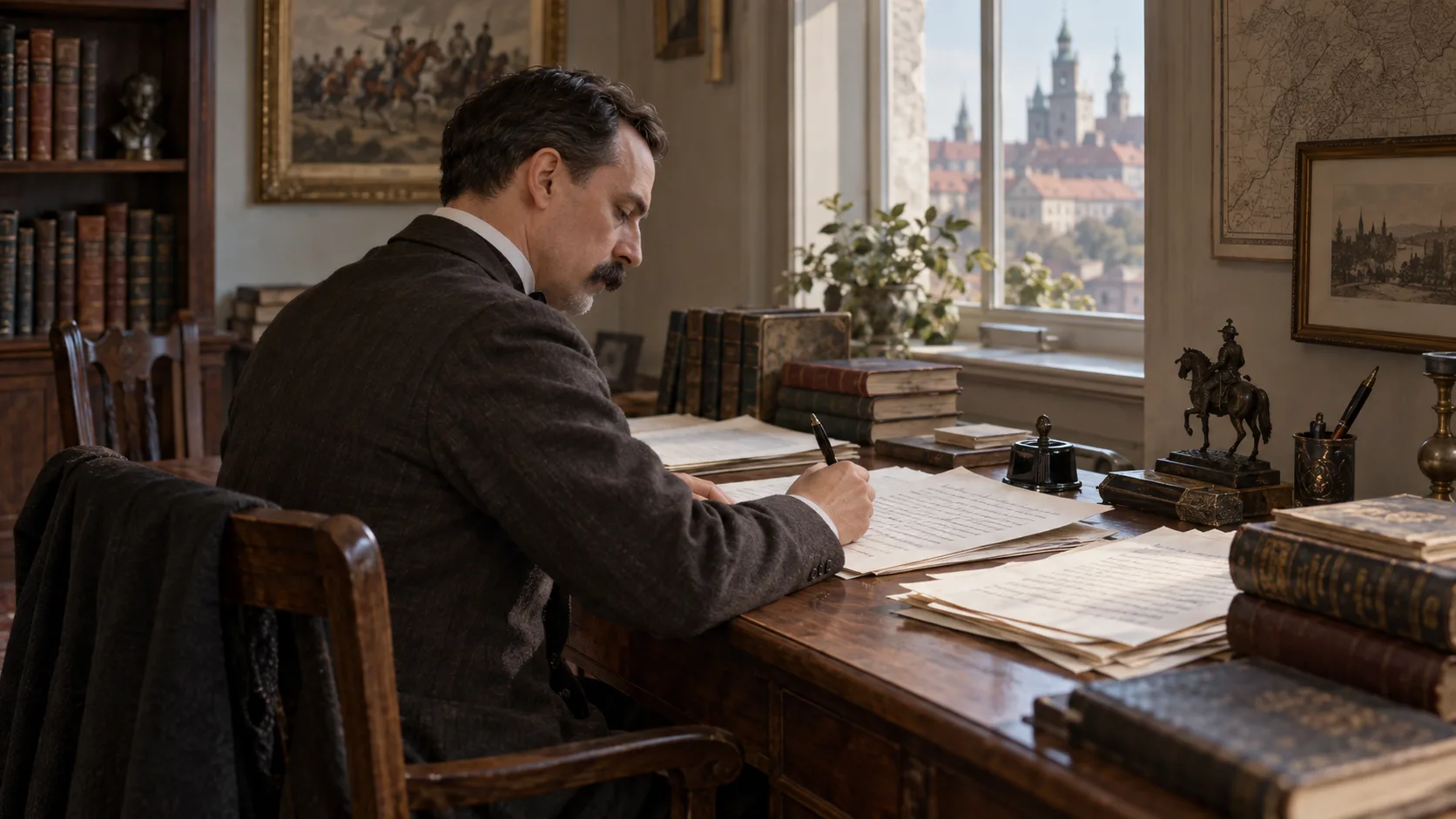
The writing coincided with his wife’s illness and death. Sienkiewicz accompanied Maria to health resorts abroad; she died at Falkenstein on 19 October 18851. His letter announcing the novel’s completion records a personal aspect of the work: he said that Potop had kept painful thoughts at bay for hours at a time33. This does not make bereavement the original reason for choosing the subject: he had announced the idea in January 1884.
What did Sienkiewicz read while writing?
In correspondence with Antoni Robert Wolff during work on the novel, he requested Jan Chryzostom Pasek’s Memoirs and Homer’s Iliad in Popiel’s translation. He distinguished their uses: Pasek was needed for writing; Homer was a regular companion when he undertook a larger work34.
In February 1885 he asked the same recipient for Henryk Rzewuski’s Rycerz Lizdejko, which he remembered from school. He wanted to reread this novel about the Swedish-war period and examine its portrayal of the Radziwiłłs, which differed from his own35.
Scholars also identify historical materials. Jolanta Sztachelska lists memoirs by Pasek, Bogusław Radziwiłł, Mikołaj Jemiołowski and Jakub Łoś, as well as Kordecki’s Nova Gigantomachia, among the Trilogy’s sources36. For The Deluge, Tadeusz Bujnicki additionally identifies the chronicle histories of Wawrzyniec Rudawski and Wespazjan Kochowski37. A participant’s account, a later memoir and a historical study provide different kinds of evidence; none automatically supplies an impartial account of the war.
Kubala: history made visible
Sienkiewicz also studied historians’ ways of telling a story. Reviewing the first series of Ludwik Kubala’s Historical Sketches, he praised descriptions that made readers feel they were witnessing past events. He described the period as a novel that writes itself38.
Yet the same review disputed Kubala’s assessment of John II Casimir: Sienkiewicz argued that the young prince’s portrait did not explain the later king’s actions39.
How did he create the language of the old Commonwealth?
Sztachelska discusses stylisation through older syntax and forms of expression. She quotes Sienkiewicz’s letter to Mścisław Godlewski of 1 September 1880, in which he emphasised the flow of language, reading Latin authors and old translations, and reconstructing the concepts familiar to people of the period40. This earlier statement about his craft helps explain the later Trilogy; it was not a declaration written specifically for The Deluge.
While reading, distinguish the narrator’s language from the characters’ speech. Kmicic’s oath, Radziwiłł’s persuasion and Zagłoba’s verbal manoeuvres perform different tasks in the action. Their voices can be compared in the banquet and imprisoned-officers scenes41.
Why write “to strengthen hearts”?
Sienkiewicz’s best-known declaration closes Pan Wołodyjowski, the third part of the cycle:
Na tym kończy się ten szereg książek pisanych w ciągu kilku lat i w niemałym trudzie – dla pokrzepienia serc.
The epilogue’s final sentence says that this series of books, written over several years and with considerable effort, was intended “to strengthen hearts”42. It refers to the whole Trilogy and was published after The Deluge. The familiar Polish wording ku pokrzepieniu serc is a shortened formulation; the cited text uses dla.
His 1889 lecture O powieści historycznej (On the Historical Novel) also helps explain his purpose. He defended the possibility of reconstructing people of the past from the evidence they left. He assigned imagination the task of bringing figures to life and filling gaps between known events in a manner consistent with the period’s plausibility43.
The National Museum in Kielce dates the Warsaw lecture to 9 April 1889 and explains its polemical context in debates about historical fiction44. The statement illuminates the author’s artistic conception after completing the Trilogy.
The seventeenth century seen from partitioned Poland
Tadeusz Bujnicki reads The Deluge through two contexts: seventeenth-century warfare and the situation of Polish readers under the partitions. In his interpretation, survival after catastrophe sustains historical memory and hope within a community deprived of its state. He also connects the language of historical discussion with censorship45.
Themes
The main axis of the plot is Kmicic's path from the oath he swore to Janusz Radziwiłł12 to serving the king under an assumed name and the confession of his true name before John II Casimir46. The background is a country in which the Lithuanian hetman makes an agreement with the Swedes12 and the nobility flock to the Swedish commandants to swear allegiance to a new master47. Sienkiewicz devotes eight chapters of the second volume to the defence of the Jasna Góra monastery13 (see Father Kordecki).
Henryk Markiewicz writes in the PSB of the Trilogy as a whole that Sienkiewicz drew his material from „starannie opanowanych źródeł i opracowań historycznych” ("carefully mastered historical sources and studies"), but used them freely in matters of detail. He brought to the fore episodes of military, or at least moral, victory1. In the world of the Trilogy, Markiewicz writes, a model of the Pole came to life whose traits were patriotic self-sacrifice, valour in war and knightly honour. Alongside them stood „powierzchowna religijność, upodobanie w brawurowym geście, przewaga żywiołowych emocji nad krytyczną refleksją” ("superficial religiosity, a liking for the bravura gesture, the predominance of elemental emotions over critical reflection")1. The novel's relation to historical fact was examined by the historian Adam Kersten in his book Sienkiewicz – "Potop" – historia (1966)48.
How does the novel lead its reader through the war?
The narrator does not restrict the story to what Kmicic sees. Political information also arrives through conversations and messages: Stanisław Skrzetuski reports the capitulation at Ujście, while Anusia brings news of the Tyszowce Confederation4950. Readers therefore encounter the war through a changing circulation of knowledge. Ask who knows an event’s outcome, who has only a rumour and who must act without a full understanding of the situation.
The double identity Andrzej Kmicic–Babinicz creates a difference between what readers and other characters know. Revealing his identity to the king and the later public reading of a royal letter mark separate stages in recovering his reputation5152. Reading can distinguish an actual change in the hero’s conduct from the moment when others accept it.
Oleńka participates in the conflict by judging Kmicic’s actions. Her opposition to violence and rejection of him after the burning of Wołmontowicze precede his service under a new name53. The ending returns to this personal judgement after his services have been made public52. This structure invites a reading of the romance alongside questions of responsibility, rather than simply as a series of meetings interrupted by wartime adventures.
Are Kmicic and all his adventures historical?
The fictional Andrzej Kmicic is a literary creation. The PSB describes Samuel Kmicic, the historical figure identified as his prototype11. A prototype’s existence does not authenticate the novel’s romance, the assumed name Babinicz or the hero’s subsequent adventures.
The siege of Jasna Góra belongs to the history of the war; Babinicz’s participation belongs to the plot. The destruction of the gun offers a particularly clear example: Kmicic destroys it in the novel, whereas Kordecki’s account describes a heavy gun bursting5427. The separate Jasna Góra guide compares documents, novel and adaptation in detail.
Historical names require the same care. Janusz Radziwiłł, Bogusław Radziwiłł and John II Casimir existed, but conversations with them in the novel are Sienkiewicz’s text. A person’s biography and their function within the plot require different questions and evidence.
The day he finished: 21 August 1886
Sienkiewicz completed the novel at Kaltenleutgeben near Vienna on 21 August 1886. Writing that day to Jadwiga Janczewska, he reported having added “The End” an hour earlier; the final thirteen sheets remained to be checked and sent. He described exhaustion and the absence of the satisfaction he had expected3355.
Finishing the manuscript, ending newspaper publication and issuing the book were separate moments. The calendar dates the final newspaper instalments to September 1886: 2 September in Czas and 10 September in Słowo25.
What survives of the manuscript?
Trilogy manuscripts are held at the Ossolineum. The Pamięć Polski collection record explains that the sheets were used by typesetters and retain evidence of printing work and revisions56.
Agnieszka Kuniczuk shows that the drafts also document the planning of instalments. Sienkiewicz marked their endings in red pencil and added the instruction “end of instalment”. The manuscript therefore permits study of both textual development and preparation for newspaper publication57.
Reading the book after watching the film
Begin with four passages: the duel in volume I, chapter VII; the Kėdainiai banquet in volume I, chapter XIII; the destruction of the cannon in volume II, chapter XVII; and the royal letter in volume III, chapter XXX58596052. This numbering follows Wolne Lektury’s three-volume text. In each passage compare narration, conversation, motivation and what a film can convey through images or sound.
A departure from the book is not automatically a historical error: rain in the screen duel is a staging choice applied to a literary scene61. A different question arises when Babinicz’s fictional exploit at Jasna Góra is compared with an account of a heavy cannon bursting27. Our film guide examines production, adaptation and historical evidence in detail; the Jasna Góra comparison explores the siege documents.
What was Sienkiewicz’s Nobel Prize awarded for?
Sienkiewicz received the Nobel Prize in Literature in 1905. Its official motivation is “because of his outstanding merits as an epic writer”62. The prize recognised his writing, including The Deluge. Its motivation does not single out one book.
NobelPrize.org’s discussion of nomination records notes a proposal to share the 1905 prize between Sienkiewicz and Eliza Orzeszkowa63. Sienkiewicz ultimately received the prize alone62.
Reception
The Trilogy brought Sienkiewicz the greatest popularity of any Polish writer of his day. One sign of it was a gift of 15,000 roubles from an anonymous donor who signed himself „Michał Wołodyjowski”. Sienkiewicz did not accept it and passed it to the Academy of Learning (Akademia Umiejętności) for a scholarship for writers and artists suffering from tuberculosis1. After 1945 Sienkiewicz became an author published in mass print runs. By 1994 The Deluge had reached 3,319,000 copies, more than With Fire and Sword (2,607,000) and fewer than The Knights of the Cross (Krzyżacy; 3,580,000)1. Markiewicz observes that Sienkiewicz's vision of Polish history shaped popular consciousness to a considerable degree and was only rarely challenged (Olgierd Górka)1.
In 1974 the novel was adapted for the screen by Jerzy Hoffman26: see The Deluge (1974).
Read the novel and consult the evidence
The complete Polish text is freely available at Wolne Lektury. The 1886 first edition in Polona allows comparison of volume divisions. The Kuryer Poznański scan of 25 December 1884 lets readers check the Poznań newspaper’s name and publication date themselves.
The NPLP calendar of his life and work reproduces letters, while On the Historical Novel sets out his views of the genre. Footnotes on this page identify whether a claim comes from the novel, correspondence, an institutional document or scholarship.
Explore the characters
Read separate profiles of Kmicic, Oleńka, Zagłoba and Wołodyjowski. The literary portraits of Janusz and Bogusław Radziwiłł link to separate historical biographies. Each profile identifies episodes in the novel and the actor in the adaptation.
Notes
- Henryk Markiewicz, Sienkiewicz Henryk Adam Aleksander Pius (1846–1916), Polski słownik biograficzny, t. 37, Warszawa–Kraków: Instytut Historii Polskiej Akademii Nauk, 1996–1997
- Henryk Sienkiewicz, Potop, Fundacja Nowoczesna Polska (Wolne Lektury), 2009–2010
- Henryk Sienkiewicz, Potop, Fundacja Nowoczesna Polska (Wolne Lektury), 2009–2010, t. I, rozdz. V–VII i XIII; t. II, rozdz. XXVI; t. III, rozdz. XXX
- Henryk Sienkiewicz, Potop, Fundacja Nowoczesna Polska (Wolne Lektury), 2009–2010, t. I, Wstęp i rozdz. I–VII
- Henryk Sienkiewicz, Potop, Fundacja Nowoczesna Polska (Wolne Lektury), 2009–2010, t. I, rozdz. XIII i XXVI
- Henryk Sienkiewicz, Potop, Fundacja Nowoczesna Polska (Wolne Lektury), 2009–2010, t. II, rozdz. XI–XIX i XXIII–XXVI
- Henryk Sienkiewicz, Potop, Fundacja Nowoczesna Polska (Wolne Lektury), 2009–2010, t. III, rozdz. XX–XXX
- Henryk Sienkiewicz, Potop, Fundacja Nowoczesna Polska (Wolne Lektury), 2009–2010, t. I–III
- Henryk Sienkiewicz, Potop, Fundacja Nowoczesna Polska (Wolne Lektury), 2009–2010, t. I, Wstęp
- Henryk Sienkiewicz, Potop, Fundacja Nowoczesna Polska (Wolne Lektury), 2009–2010, t. I, rozdz. I
- Tadeusz Wasilewski, Kmicic Samuel h. Radzic odm. (zm. 1692), Polski słownik biograficzny, t. 13, Wrocław–Warszawa–Kraków: Zakład Narodowy im. Ossolińskich – Wydawnictwo Polskiej Akademii Nauk, 1967–1968
- Henryk Sienkiewicz, Potop, Fundacja Nowoczesna Polska (Wolne Lektury), 2009–2010, t. I, rozdz. XIII
- Henryk Sienkiewicz, Potop, Fundacja Nowoczesna Polska (Wolne Lektury), 2009–2010, t. II, rozdz. XII–XIX
- Henryk Sienkiewicz, Potop, Fundacja Nowoczesna Polska (Wolne Lektury), 2009–2010, t. III, rozdz. IX
- Henryk Sienkiewicz, Potop, Fundacja Nowoczesna Polska (Wolne Lektury), 2009–2010, t. I, rozdz. XI
- Henryk Sienkiewicz, Potop, Fundacja Nowoczesna Polska (Wolne Lektury), 2009–2010, t. III, rozdz. XX
- Henryk Sienkiewicz, Listy o pracy nad Potopem (wybór w kalendarzu życia i twórczości), Nowa Panorama Literatury Polskiej, IBL PAN, 1884–1886, letter to Stanisław Tarnowski, 14 January 1884
- Julian Krzyżanowski; opracowanie i uzupełnienia Maria Bokszczanin, Henryk Sienkiewicz: kalendarz życia i twórczości – 1876–1886, Nowa Panorama Literatury Polskiej, IBL PAN, 1884, “Praca nad Potopem”
- Henryk Sienkiewicz, Kuryer Poznański, nr 297, 25 grudnia 1884 – Potop, odcinek 1, Drukarnia Kuryera Poznańskiego; skan PAN Biblioteki Kórnickiej w WBC, 1884, 2–3, pp. 1–3
- Julian Krzyżanowski; opracowanie i uzupełnienia Maria Bokszczanin, Henryk Sienkiewicz: kalendarz życia i twórczości – 1876–1886, Nowa Panorama Literatury Polskiej, IBL PAN, 1884, “Druk Potopu”
- Henryk Sienkiewicz, Potop: powieść historyczna, Warszawa: [s.n.] (druk. Noskowski), 1886
- Henryk Sienkiewicz, Listy o pracy nad Potopem (wybór w kalendarzu życia i twórczości), Nowa Panorama Literatury Polskiej, IBL PAN, 1884–1886, letter to Smolka, 18 November 1884
- Henryk Sienkiewicz, Kuryer Poznański, nr 297, 25 grudnia 1884 – Potop, odcinek 1, Drukarnia Kuryera Poznańskiego; skan PAN Biblioteki Kórnickiej w WBC, 1884, 2–3, no. 297, p. 2
- Henryk Sienkiewicz, Listy o pracy nad Potopem (wybór w kalendarzu życia i twórczości), Nowa Panorama Literatury Polskiej, IBL PAN, 1884–1886, letter to Janczewska, 21 August 1886
- Julian Krzyżanowski; opracowanie i uzupełnienia Maria Bokszczanin, Henryk Sienkiewicz: kalendarz życia i twórczości – 1876–1886, Nowa Panorama Literatury Polskiej, IBL PAN, 1886, “Powstawanie Potopu”
- Potop, Łódź: Państwowa Wyższa Szkoła Filmowa, Telewizyjna i Teatralna im. Leona Schillera w Łodzi (filmpolski.pl)
- Augustyn Kordecki; przeł. Józef Łepkowski, (Nowa Gigantomachia): pamiętnik oblężenia Częstochowy roku 1655, Warszawa: S. Orgelbrand, 1858, p. 97
- Henryk Sienkiewicz, Potop, Fundacja Nowoczesna Polska (Wolne Lektury), 2009–2010, vol. II, chapter XVII
- Potop Redivivus, Repozytorium Cyfrowe Filmoteki Narodowej, Warszawa: Filmoteka Narodowa – Instytut Audiowizualny
- Henryk Sienkiewicz, Listy o pracy nad Potopem (wybór w kalendarzu życia i twórczości), Nowa Panorama Literatury Polskiej, IBL PAN, 1884–1886, letter to Stanisław Smolka, 18 November 1884
- Maria Sienkiewiczowa z Szetkiewiczów, Listy Marii Sienkiewiczowej o powstawaniu Potopu, Nowa Panorama Literatury Polskiej, IBL PAN, 1884, letter to her sister, 13 December 1884
- Maria Sienkiewiczowa z Szetkiewiczów, Listy Marii Sienkiewiczowej o powstawaniu Potopu, Nowa Panorama Literatury Polskiej, IBL PAN, 1884, letter to her sister, 26 November 1884
- Henryk Sienkiewicz, Listy o pracy nad Potopem (wybór w kalendarzu życia i twórczości), Nowa Panorama Literatury Polskiej, IBL PAN, 1884–1886, letter to Jadwiga Janczewska, 21 August 1886
- Henryk Sienkiewicz, Listy o pracy nad Potopem (wybór w kalendarzu życia i twórczości), Nowa Panorama Literatury Polskiej, IBL PAN, 1884–1886, letter to Antoni Robert Wolff, quoted in the calendar under 1884
- Henryk Sienkiewicz, Listy o pracy nad Potopem (wybór w kalendarzu życia i twórczości), Nowa Panorama Literatury Polskiej, IBL PAN, 1884–1886, letter to Antoni Robert Wolff, Menton, 19 February 1885
- Jolanta Sztachelska, Pamiętnikarstwo. Z dziejów terminu i gatunku w XIX w., Studia Podlaskie XXI, Uniwersytet w Białymstoku, 2013, 149–179, p. 166
- Tadeusz Bujnicki, Dwie perspektywy „Potopu” Sienkiewicza. Historia i współczesność, Wydawnictwo PRYMAT / Wydział Filologiczny Uniwersytetu w Białymstoku, 2024, pp. 25–27
- Henryk Sienkiewicz, Mieszaniny literacko-artystyczne, część II, XI: Szkice Kubali, Redakcja Tygodnika Illustrowanego; transkrypcja Wikiźródeł, 1902, 11–31, part II, XI, p. 28
- Henryk Sienkiewicz, Mieszaniny literacko-artystyczne, część II, XI: Szkice Kubali, Redakcja Tygodnika Illustrowanego; transkrypcja Wikiźródeł, 1902, 11–31, pp. 20–22
- Jolanta Sztachelska, Pamiętnikarstwo. Z dziejów terminu i gatunku w XIX w., Studia Podlaskie XXI, Uniwersytet w Białymstoku, 2013, 149–179, p. 167
- Henryk Sienkiewicz, Potop, Fundacja Nowoczesna Polska (Wolne Lektury), 2009–2010, t. I, rozdz. XIII–XVI
- Henryk Sienkiewicz, Pan Wołodyjowski, Fundacja Nowoczesna Polska (Wolne Lektury), 2009, Epilogue
- Henryk Sienkiewicz, O powieści historycznej, Wikiźródła – transkrypcja ze skanu Pism ulotnych (1881–1889), 1889, discussion of imagination’s task
- „O powieści historycznej”, rękopis odczytu Henryka Sienkiewicza, Muzeum Narodowe w Kielcach
- Tadeusz Bujnicki, Dwie perspektywy „Potopu” Sienkiewicza. Historia i współczesność, Wydawnictwo PRYMAT / Wydział Filologiczny Uniwersytetu w Białymstoku, 2024, pp. 12–21
- Henryk Sienkiewicz, Potop, Fundacja Nowoczesna Polska (Wolne Lektury), 2009–2010, t. II, rozdz. XXVI
- Henryk Sienkiewicz, Potop, Fundacja Nowoczesna Polska (Wolne Lektury), 2009–2010, t. II, rozdz. IX
- Adam Kersten, Sienkiewicz – „Potop” – historia, Warszawa: Państwowy Instytut Wydawniczy, 1966
- Henryk Sienkiewicz, Potop, Fundacja Nowoczesna Polska (Wolne Lektury), 2009–2010, vol. I, ch. XI
- Henryk Sienkiewicz, Potop, Fundacja Nowoczesna Polska (Wolne Lektury), 2009–2010, vol. III, ch. XX
- Henryk Sienkiewicz, Potop, Fundacja Nowoczesna Polska (Wolne Lektury), 2009–2010, vol. II, ch. XXVI
- Henryk Sienkiewicz, Potop, Fundacja Nowoczesna Polska (Wolne Lektury), 2009–2010, vol. III, ch. XXX
- Henryk Sienkiewicz, Potop, Fundacja Nowoczesna Polska (Wolne Lektury), 2009–2010, vol. I, ch. V–VII
- Henryk Sienkiewicz, Potop, Fundacja Nowoczesna Polska (Wolne Lektury), 2009–2010, t. II, rozdz. XVII
- Julian Krzyżanowski; opracowanie i uzupełnienia Maria Bokszczanin, Henryk Sienkiewicz: kalendarz życia i twórczości – 1876–1886, Nowa Panorama Literatury Polskiej, IBL PAN, 1886, “Ukończenie Potopu”
- Henryk Sienkiewicz: Trylogia – autografy powieści (1882–1888), Pamięć Polski / Archiwa Państwowe
- Agnieszka Kuniczuk, Stare i nowe… Ossolińskie zbiory spuścizny Henryka Sienkiewicza, Acta Universitatis Lodziensis. Folia Litteraria Polonica 2(67), 2023, discussion of the Trilogy drafts
- Henryk Sienkiewicz, Potop, Fundacja Nowoczesna Polska (Wolne Lektury), 2009–2010, vol. I, ch. VII
- Henryk Sienkiewicz, Potop, Fundacja Nowoczesna Polska (Wolne Lektury), 2009–2010, vol. I, ch. XIII
- Henryk Sienkiewicz, Potop, Fundacja Nowoczesna Polska (Wolne Lektury), 2009–2010, vol. II, ch. XVII
- Potop – Analiza sceny pojedynku, Fundacja Katarynka / Adapter
- The Nobel Prize in Literature 1905, NobelPrize.org, Nobel Prize Outreach
- The Nobel Prize in Literature: Nominations and reports 1901–1950, NobelPrize.org, 2004
Explore further
Related
Depicts
- Capitulation of Kėdainiai (1655) t. I, rozdz. XIII Documented
- Siege of Jasna Góra (1655) t. II, rozdz. XII–XIX Documented
Related
- Henryk Sienkiewicz autor powieści Documented
- Bogusław Radziwiłł in the novel Historical figure, fictionalized
- Jan Onufry Zagłoba Fictional character
- Janusz Radziwiłł in the novel Historical figure, fictionalized
- Michał Wołodyjowski Fictional character
- The Deluge (1974): Jerzy Hoffman's film ekranizacja powieści Documented
Sources for this page
- Henryk Markiewicz, Sienkiewicz Henryk Adam Aleksander Pius (1846–1916), Polski słownik biograficzny, t. 37, Warszawa–Kraków: Instytut Historii Polskiej Akademii Nauk, 1996–1997 (Reference work)
- Henryk Sienkiewicz, Potop, Fundacja Nowoczesna Polska (Wolne Lektury), 2009–2010 (Primary source)
- Tadeusz Wasilewski, Kmicic Samuel h. Radzic odm. (zm. 1692), Polski słownik biograficzny, t. 13, Wrocław–Warszawa–Kraków: Zakład Narodowy im. Ossolińskich – Wydawnictwo Polskiej Akademii Nauk, 1967–1968 (Reference work)
- Henryk Sienkiewicz, Listy o pracy nad Potopem (wybór w kalendarzu życia i twórczości), Nowa Panorama Literatury Polskiej, IBL PAN, 1884–1886 (Primary source)
- Julian Krzyżanowski; opracowanie i uzupełnienia Maria Bokszczanin, Henryk Sienkiewicz: kalendarz życia i twórczości – 1876–1886, Nowa Panorama Literatury Polskiej, IBL PAN (Academic study)
- Henryk Sienkiewicz, Kuryer Poznański, nr 297, 25 grudnia 1884 – Potop, odcinek 1, Drukarnia Kuryera Poznańskiego; skan PAN Biblioteki Kórnickiej w WBC, 1884, 2–3 (Primary source)
- Henryk Sienkiewicz, Potop: powieść historyczna, Warszawa: [s.n.] (druk. Noskowski), 1886 (Primary source)
- Potop, Łódź: Państwowa Wyższa Szkoła Filmowa, Telewizyjna i Teatralna im. Leona Schillera w Łodzi (filmpolski.pl) (Reference work)
- Augustyn Kordecki; przeł. Józef Łepkowski, (Nowa Gigantomachia): pamiętnik oblężenia Częstochowy roku 1655, Warszawa: S. Orgelbrand, 1858 (Primary source)
- Potop Redivivus, Repozytorium Cyfrowe Filmoteki Narodowej, Warszawa: Filmoteka Narodowa – Instytut Audiowizualny (Institution)
- Maria Sienkiewiczowa z Szetkiewiczów, Listy Marii Sienkiewiczowej o powstawaniu Potopu, Nowa Panorama Literatury Polskiej, IBL PAN, 1884 (Primary source)
- Jolanta Sztachelska, Pamiętnikarstwo. Z dziejów terminu i gatunku w XIX w., Studia Podlaskie XXI, Uniwersytet w Białymstoku, 2013, 149–179 (Academic study)
- Tadeusz Bujnicki, Dwie perspektywy „Potopu” Sienkiewicza. Historia i współczesność, Wydawnictwo PRYMAT / Wydział Filologiczny Uniwersytetu w Białymstoku, 2024 (Academic study)
- Henryk Sienkiewicz, Mieszaniny literacko-artystyczne, część II, XI: Szkice Kubali, Redakcja Tygodnika Illustrowanego; transkrypcja Wikiźródeł, 1902, 11–31 (Primary source)
- Henryk Sienkiewicz, Pan Wołodyjowski, Fundacja Nowoczesna Polska (Wolne Lektury), 2009 (Primary source)
- Henryk Sienkiewicz, O powieści historycznej, Wikiźródła – transkrypcja ze skanu Pism ulotnych (1881–1889), 1889 (Primary source)
- „O powieści historycznej”, rękopis odczytu Henryka Sienkiewicza, Muzeum Narodowe w Kielcach (Academic study)
- Adam Kersten, Sienkiewicz – „Potop” – historia, Warszawa: Państwowy Instytut Wydawniczy, 1966 (Academic study)
- Henryk Sienkiewicz: Trylogia – autografy powieści (1882–1888), Pamięć Polski / Archiwa Państwowe (Academic study)
- Agnieszka Kuniczuk, Stare i nowe… Ossolińskie zbiory spuścizny Henryka Sienkiewicza, Acta Universitatis Lodziensis. Folia Litteraria Polonica 2(67), 2023 (Academic study)
- Potop – Analiza sceny pojedynku, Fundacja Katarynka / Adapter (Institution)
- The Nobel Prize in Literature 1905, NobelPrize.org, Nobel Prize Outreach (Institution)
- The Nobel Prize in Literature: Nominations and reports 1901–1950, NobelPrize.org, 2004 (Institution)