
AI illustration
Imagined scene inspired by Daniel Schultz’s portrait.
Monarch
John II Casimir Vasa
b. 22 III 1609, d. 16 XII 1672
Historical figureKing of Poland from 1648 to 1668; during the Deluge he took refuge in Silesia, and after his return he made his vows in Lwów and led the war against Sweden up to the Peace of Oliva.
- Names and variants
- pl Jan II Kazimierz Waza
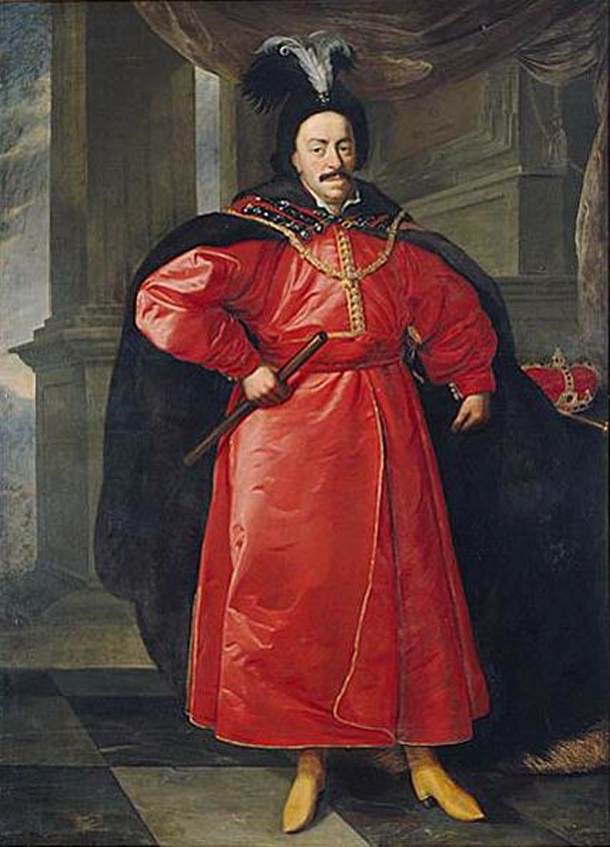
Painter: Daniel Schultz (the Younger) · c. 1649 · Nationalmuseum, Sztokholm / Wikimedia Commons · Public domain
Life
John Casimir was born on 22 March 1609 in Kraków, the son of King Sigismund III and Constance of Austria (Konstancja z Habsburgów)1. During the reign of his brother, Władysław IV, he fought against Russia in 1633, and two years later as an imperial colonel in the Thirty Years' War1. In 1638, on his way to Spain, he was arrested in France and released only in February 16401. In 1643 he entered the Society of Jesus at Loreto; in 1645 he left the order and received a cardinal's hat, which he soon renounced1.
He was elected king on 20 November 1648 and crowned in Kraków on 17 January 16491. In May 1649 he married the widowed queen, Marie Louise Gonzaga (Ludwika Maria)1. After the wars with Sweden and Muscovy he lived through the rokosz (armed rebellion) of Jerzy Lubomirski; he formally abdicated on 16 September 16681. He left for France, where Louis XIV provided him with income from abbeys, among them Saint-Germain-des-Prés1. He died on 16 December 1672 at Nevers, and on 31 January 1676 he was buried in Wawel Cathedral1.
During the Deluge
At the start of the war the king placed himself at the head of the general levy of the nobility (pospolite ruszenie) of the central voivodeships1. After the defeat at Żarnów he arrived in Kraków on 19 September 1655, entrusted the defence of the city to Stefan Czarniecki and left on 25 September2. After the defeats, and after whole voivodeships had gone over to the Swedes, he took refuge in Silesia, at Głogówek (17 October 1655)1. He declared Janusz Radziwiłł a traitor and appointed Radziwiłł's rival Sapieha commander-in-chief of the Lithuanian army3.
He summoned the senators to Opole for 15 November4. After this council the king and the primate issued a proclamation (uniwersał) calling on the nobility to gather and await the king5; Czapliński dates this proclamation to 20 November1. In the second half of December he set out for home1. Kubala states that he left Silesia on 18 December, travelled by way of Lubowla, Dukla, Krosno and Łańcut among other places, and arrived in Lwów (today Lviv) on 9 February 16566. The Tyszowce Confederation was formed without him. The senators and nobles of his entourage joined it, with his consent, in a new league7 (see Tyszowce Confederation).
In Lwów Cathedral on 1 April 1656 he made vows in which he proclaimed the Mother of Christ Queen of Poland8. According to Czapliński he also vowed in them to ease the lot of the peasants; the vows were meant to win over the peasantry more widely1. This promise, as Czapliński writes, he never seriously intended to carry out1. In the later course of the war he took part in the siege of Warsaw (30 May – 1 July 1656), commanded at the Battle of Warsaw (28–30 July 1656), took part in the sieges of Kraków in 1657 and Toruń in 1658, and finally oversaw the peace negotiations at Oliva1. He signed the ratification of the treaty on 26 June 16609 (see Treaty of Oliva). Under the peace he renounced his rights to Sweden and undertook not to use the Swedish title or arms in letters to Sweden10.
In the novel
Sienkiewicz gives the Lwów vows in the form of the king's prayer:
– Wielka człowieczeństwa boskiego Matko i Panno! Ja, Jan Kazimierz, Twego Syna, Króla królów i Pana mojego, i Twoim zmiłowaniem się król, do Twych najświętszych stóp przychodząc, tę oto konfederację czynię: Ciebie za Patronkę moją i państwa mego Królową dzisiaj obieram.
Henryk Sienkiewicz, The Deluge (Potop)11
(Our translation: "Great Mother of the God-Man, and Virgin! I, John Casimir, king by the mercy of Thy Son, the King of kings and my Lord, and by Thine, coming to Thy most holy feet, make this confederation: I choose Thee this day as my Patroness and as Queen of my realm.")
The novel sums up the king's route home in one sentence: „Z Lubowli jechał król do Dukli, Krosna, Łańcuta i Lwowa” ("From Lubowla the king travelled to Dukla, Krosno, Łańcut and Lwów")12. In its main points this agrees with the route described by Kubala13.
In the film
In Jerzy Hoffman's film John II Casimir was played by Piotr Pawłowski. According to the description of the film's second part in the filmpolski.pl database, Kmicic nearly loses his life defending the king during a battle in a ravine, after which he confesses his past to him and is rehabilitated14.
Notes
- Władysław Czapliński, Jan II Kazimierz (Waza), Polski słownik biograficzny, t. 10, Wrocław: Zakład Narodowy im. Ossolińskich – Wydawnictwo Polskiej Akademii Nauk, 1962–1964
- Ludwik Kubala, Wojna szwecka w roku 1655 i 1656, Szkice historyczne, serya IV (Biblioteka Historyczna Altenberga), Lwów; Warszawa: H. Altenberg, G. Seyfarth, E. Wende i Sp.; E. Wende i Sp., 1913, s. 110–112, 117
- Ludwik Kubala, Wojna szwecka w roku 1655 i 1656, Szkice historyczne, serya IV (Biblioteka Historyczna Altenberga), Lwów; Warszawa: H. Altenberg, G. Seyfarth, E. Wende i Sp.; E. Wende i Sp., 1913, s. 91
- Ludwik Kubala, Wojna szwecka w roku 1655 i 1656, Szkice historyczne, serya IV (Biblioteka Historyczna Altenberga), Lwów; Warszawa: H. Altenberg, G. Seyfarth, E. Wende i Sp.; E. Wende i Sp., 1913, s. 232
- Ludwik Kubala, Wojna szwecka w roku 1655 i 1656, Szkice historyczne, serya IV (Biblioteka Historyczna Altenberga), Lwów; Warszawa: H. Altenberg, G. Seyfarth, E. Wende i Sp.; E. Wende i Sp., 1913, s. 232, 234
- Ludwik Kubala, Wojna szwecka w roku 1655 i 1656, Szkice historyczne, serya IV (Biblioteka Historyczna Altenberga), Lwów; Warszawa: H. Altenberg, G. Seyfarth, E. Wende i Sp.; E. Wende i Sp., 1913, s. 180, 261
- Ludwik Kubala, Wojna szwecka w roku 1655 i 1656, Szkice historyczne, serya IV (Biblioteka Historyczna Altenberga), Lwów; Warszawa: H. Altenberg, G. Seyfarth, E. Wende i Sp.; E. Wende i Sp., 1913, s. 264–265
- Ludwik Kubala, Wojna szwecka w roku 1655 i 1656, Szkice historyczne, serya IV (Biblioteka Historyczna Altenberga), Lwów; Warszawa: H. Altenberg, G. Seyfarth, E. Wende i Sp.; E. Wende i Sp., 1913, s. 307
- Ludwik Kubala, Wojny duńskie i pokój oliwski 1657–1660, Szkice historyczne, serja VI (Biblioteka Historyczna Altenberga), Lwów: Księgarnia Wydawnicza H. Altenberga, 1922, s. 343–344
- Ludwik Kubala, Wojny duńskie i pokój oliwski 1657–1660, Szkice historyczne, serja VI (Biblioteka Historyczna Altenberga), Lwów: Księgarnia Wydawnicza H. Altenberga, 1922, s. 330
- Henryk Sienkiewicz, Potop, Fundacja Nowoczesna Polska (Wolne Lektury), 2009–2010, t. II, rozdz. XXX
- Henryk Sienkiewicz, Potop, Fundacja Nowoczesna Polska (Wolne Lektury), 2009–2010, t. II, rozdz. XXVII
- Ludwik Kubala, Wojna szwecka w roku 1655 i 1656, Szkice historyczne, serya IV (Biblioteka Historyczna Altenberga), Lwów; Warszawa: H. Altenberg, G. Seyfarth, E. Wende i Sp.; E. Wende i Sp., 1913, s. 261
- Potop, Łódź: Państwowa Wyższa Szkoła Filmowa, Telewizyjna i Teatralna im. Leona Schillera w Łodzi (filmpolski.pl)
Explore further
Related
Ally
- Stefan Czarniecki Historical figure
Opponent
- Charles X Gustav Historical figure
- Janusz Radziwiłł król ogłosił hetmana zdrajcą po układzie kiejdańskim Historical figure
Participants
- Battle of Berestechko Documented
Related
- Siege of Kraków (1655) powierzył obronę miasta Czarnieckiemu i opuścił je 25 września 1655 Documented
- Tyszowce Confederation (1655) konfederację zawiązano bez niego; senatorowie i szlachta z jego otoczenia przystąpili do niej za jego zgodą (Łańcut) Documented
- Treaty of Oliva (1660) podpisał ratyfikację 26 czerwca 1660 Documented
- Bydgoszcz
- Swedish forces occupy Warsaw Documented
- Tadeusz Wasilewski author of a biography of the king Historical figure
- Siege of Zbarazh Documented
Sources for this page
- Władysław Czapliński, Jan II Kazimierz (Waza), Polski słownik biograficzny, t. 10, Wrocław: Zakład Narodowy im. Ossolińskich – Wydawnictwo Polskiej Akademii Nauk, 1962–1964 (Reference work)
- Ludwik Kubala, Wojna szwecka w roku 1655 i 1656, Szkice historyczne, serya IV (Biblioteka Historyczna Altenberga), Lwów; Warszawa: H. Altenberg, G. Seyfarth, E. Wende i Sp.; E. Wende i Sp., 1913 (Academic study)
- Ludwik Kubala, Wojny duńskie i pokój oliwski 1657–1660, Szkice historyczne, serja VI (Biblioteka Historyczna Altenberga), Lwów: Księgarnia Wydawnicza H. Altenberga, 1922 (Academic study)
- Henryk Sienkiewicz, Potop, Fundacja Nowoczesna Polska (Wolne Lektury), 2009–2010 (Primary source)
- Potop, Łódź: Państwowa Wyższa Szkoła Filmowa, Telewizyjna i Teatralna im. Leona Schillera w Łodzi (filmpolski.pl) (Reference work)