
AI illustration
Imagined scene inspired by the biography and portrait shown below.
Commander
Jerzy Sebastian Lubomirski
Historical figureOne of the Commonwealth's leading Deluge commanders, later leader of a revolt against John Casimir.
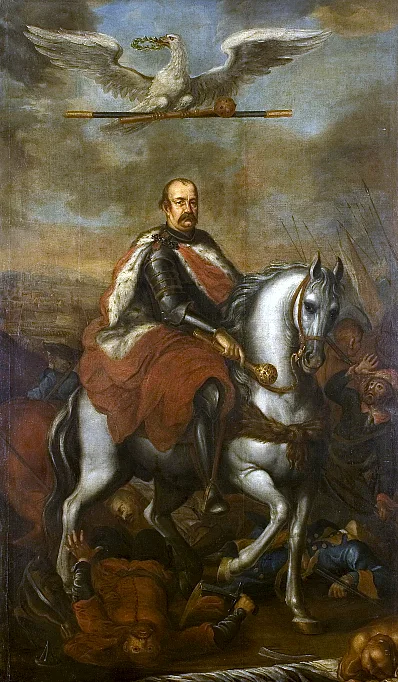
Painter: unknown · after 1667 · Wikimedia Commons · Public domain
Before the Swedish invasion
Jerzy Sebastian Lubomirski (c. 1616–1667) belonged to a powerful magnate family. He chaired the Sejm in 1643, became Crown grand marshal in 1650 and Crown field hetman in 1657. His campaigns spanned wars with Cossacks, Sweden, Transylvania and Russia. His military reputation and political office gave him influence over strategy as well as troops of his own1.
During the Deluge
In 1656 Lubomirski worked with Stefan Czarniecki during fighting near Jarosław and the Greater Poland campaign that led to the Battle of Kłecko. Accounts differ on his role at Warka itself2345.
His forces joined the siege of Toruń in 1658, and he accepted the Swedish garrison’s surrender. He also represented the Commonwealth in the negotiations at Oliwa678.
In 1657 he played a major part in defeating George II Rákóczi's forces. Three years later, the Commonwealth army forced a Russian surrender at Cudnów. His standing as a commander therefore rested on more than victories against the Swedes19.
Revolt after victory
After the war he opposed plans to strengthen royal authority and elect John Casimir's successor during the king's lifetime. Accused and exiled, he led a rebellion from 1665. At Mątwy in 1666 his forces defeated the royal army: the exhausted Commonwealth had entered a civil war. The Łęgonice settlement ended the revolt and forced the king to abandon the proposed vivente rege election. Lubomirski died the following year110.
Novel and film
Lubomirski belongs to the historical setting of Sienkiewicz's The Deluge. His later revolt lies beyond the main Kmicic narrative. The film's credited cast does not justify assigning him a distinct screen role or actor; Hoffman's principal drama follows other characters1112.
Notes
- Jerzy Sebastian Lubomirski, Warszawa: Biblioteka Sejmowa
- Konrad Sawinski, Szwedzi pod Jarosławiem 15 marca 1656 roku, Muzeum w Jarosławiu Kamienica Orsettich, Jarosław: Muzeum w Jarosławiu Kamienica Orsettich, 2026
- Bitwa pod Kłeckiem, Oś czasu, Warszawa: Muzeum Wojska Polskiego w Warszawie
- Ludwik Kubala, Wojna szwecka w roku 1655 i 1656, Szkice historyczne, serya IV (Biblioteka Historyczna Altenberga), Lwów; Warszawa: H. Altenberg, G. Seyfarth, E. Wende i Sp.; E. Wende i Sp., 1913, p. 292
- Bitwa pod Warką, Kalendarium, Warszawa: Muzeum Historii Polski w Warszawie
- Blokada szwedzkiej załogi Torunia, Oś czasu, Warszawa: Muzeum Wojska Polskiego w Warszawie
- Kapitulacja szwedzkiej załogi Torunia, Oś czasu, Warszawa: Muzeum Wojska Polskiego w Warszawie
- Ludwik Kubala, Wojny duńskie i pokój oliwski 1657–1660, Szkice historyczne, serja VI (Biblioteka Historyczna Altenberga), Lwów: Księgarnia Wydawnicza H. Altenberga, 1922, pp. 274–275
- Kapitulacja Jerzego II Rakoczego, Oś czasu, Warszawa: Muzeum Wojska Polskiego w Warszawie
- Bitwa pod Mątwami, Oś czasu, Warszawa: Muzeum Wojska Polskiego w Warszawie
- Henryk Sienkiewicz, Potop, Fundacja Nowoczesna Polska (Wolne Lektury), 2009–2010
- Potop, Łódź: Państwowa Wyższa Szkoła Filmowa, Telewizyjna i Teatralna im. Leona Schillera w Łodzi (filmpolski.pl)
Explore further
History
Related
Related
- Battle of Kłecko Documented
- Grudziądz
Sources for this page
- Jerzy Sebastian Lubomirski, Warszawa: Biblioteka Sejmowa (Institution)
- Konrad Sawinski, Szwedzi pod Jarosławiem 15 marca 1656 roku, Muzeum w Jarosławiu Kamienica Orsettich, Jarosław: Muzeum w Jarosławiu Kamienica Orsettich, 2026 (Institution)
- Bitwa pod Kłeckiem, Oś czasu, Warszawa: Muzeum Wojska Polskiego w Warszawie (Institution)
- Ludwik Kubala, Wojna szwecka w roku 1655 i 1656, Szkice historyczne, serya IV (Biblioteka Historyczna Altenberga), Lwów; Warszawa: H. Altenberg, G. Seyfarth, E. Wende i Sp.; E. Wende i Sp., 1913 (Academic study)
- Bitwa pod Warką, Kalendarium, Warszawa: Muzeum Historii Polski w Warszawie (Institution)
- Blokada szwedzkiej załogi Torunia, Oś czasu, Warszawa: Muzeum Wojska Polskiego w Warszawie (Institution)
- Kapitulacja szwedzkiej załogi Torunia, Oś czasu, Warszawa: Muzeum Wojska Polskiego w Warszawie (Institution)
- Ludwik Kubala, Wojny duńskie i pokój oliwski 1657–1660, Szkice historyczne, serja VI (Biblioteka Historyczna Altenberga), Lwów: Księgarnia Wydawnicza H. Altenberga, 1922 (Academic study)
- Kapitulacja Jerzego II Rakoczego, Oś czasu, Warszawa: Muzeum Wojska Polskiego w Warszawie (Institution)
- Bitwa pod Mątwami, Oś czasu, Warszawa: Muzeum Wojska Polskiego w Warszawie (Institution)
- Henryk Sienkiewicz, Potop, Fundacja Nowoczesna Polska (Wolne Lektury), 2009–2010 (Primary source)
- Potop, Łódź: Państwowa Wyższa Szkoła Filmowa, Telewizyjna i Teatralna im. Leona Schillera w Łodzi (filmpolski.pl) (Reference work)