
AI illustration
Imagined scene inspired by the biography and portrait shown below.
Commander
Stefan Czarniecki
b. c. 1599, d. 16 II 1665
Historical figureCastellan of Kiev, defender of Kraków in 1655 and leader of the war of harassment against the Swedes, later voivode of Ruthenia and Field Hetman of the Crown.
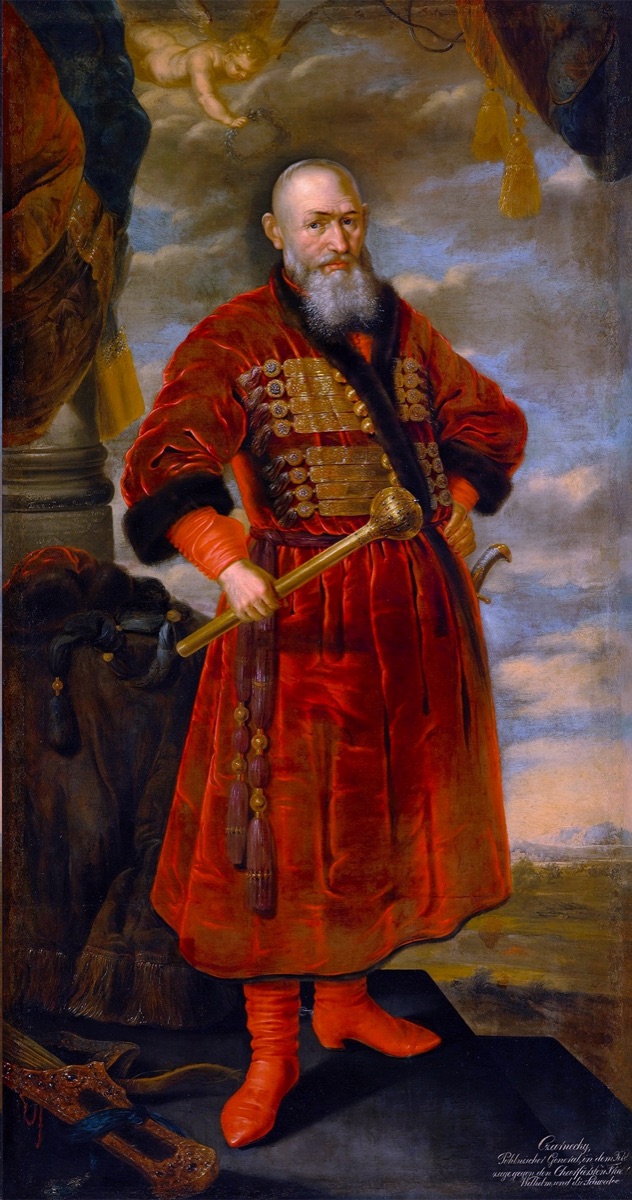
Painter: Brodero Matthisen · 1659 · Zamek Królewski w Warszawie / Wikimedia Commons · Public domain
Life
Stefan Czarniecki, of the Łodzia coat of arms, was born at Czarnca. He was the son of Krzysztof, starosta (royal district governor) of Chęciny and later of Żywiec, and of Krystyna Rzeszowska1.
He probably learned the soldier's trade under the care of his brother Paweł. He took part in the war with Sweden of 1626–1629, fought in Germany on the Emperor's side until March 1633, and then served in the Smolensk campaign1. In 1648 he was taken prisoner at Żółte Wody (Zhovti Vody) and regained his freedom only after Zborów (Zboriv) in 16491. From then on he fought the Cossacks tirelessly, and in 1653, at the siege of Monasterzyska (Monastyryska), he was wounded in the face1. From May 1655 he was castellan of Kiev, a senatorial office1.
He died on 16 February 1665 in the village of Sokołówka, not far from Brody1.
During the Deluge
On news of the invasion Czarniecki stood by the king1. John Casimir entrusted him with the defence of Kraków and left 3,600 men under his command4. Czarniecki held the city for more than three weeks1. Czapliński dates the signing of an honourable capitulation to 17 October1, while Kubala describes the garrison marching out under arms on 19 October5. The course of the defence is described on the page Siege of Kraków.
In January 1656 the king appointed him regimentarz (a commander appointed by the king or the Sejm to lead an army) and, passing over the hetmans, entrusted him with the winter campaign against the Swedes1. The campaign began with a defeat: on 18 February Charles Gustav took him by surprise at Gołąb61. Czarniecki afterwards wrote to the queen that the losses had been equal and that the enemy had held the field thanks to superior numbers7. From then on he avoided a pitched battle with the Swedish king and waged a war of harassment1. In April he defeated the corps of the Margrave of Baden at Warka (see Battle of Warka), and on 7 May he lost to Prince Adolph John (Adolf Johan) at Kłecko1.
In 1657 the king gave the field hetman's baton (the insignia of the Field Hetman of the Crown, second in command of the Crown army) not to him but to Jerzy Lubomirski1. He compensated Czarniecki with the voivodeship of Ruthenia (5 March 1657) and appointed him lieutenant general1. In 1658–1659 Czarniecki commanded the Polish division in Denmark1.
Controversies
In the novel
Sienkiewicz puts the saying into Czarniecki's mouth in different circumstances: in a conversation about the great families, when Lubomirski is under discussion, and with reference to the Cossacks and the Swedes:
– Jam też nie z soli wyrósł ani z roli, jeno z tego, co mnie boli – ozwał się Czarniecki – a boleli mnie Kozacy, którzy mi tę oto gębę przestrzelili, a teraz boli mnie Szwed (...)
Henryk Sienkiewicz, The Deluge (Potop)9
(Our translation: "I too grew up not from salt nor from the soil, but from what pains me," said Czarniecki, "and what pained me were the Cossacks, who shot through this face of mine, and now what pains me is the Swede (...)")
Czapliński records the wound in the face at the siege of Monasterzyska in 1653 and a wound received at Busza in the campaign at the turn of 1654 and 1655, without saying where he was hit on that occasion1. In the same chapter Sienkiewicz connects Czarniecki's silver palate with a bullet from Busza9.
In the film
In Jerzy Hoffman's film Czarniecki was played by Wiesław Gołas, and the role was dubbed by Ryszard Dembiński. In the filmpolski.pl database the role is named „hetman Stefan Czarniecki”10, although in 1655 Czarniecki was castellan of Kiev and received the field hetman's baton only towards the end of his life1.
Notes
- Władysław Czapliński, Czarniecki Stefan, herbu Łodzia (1599–1665), Polski słownik biograficzny, t. 4, Kraków: Polska Akademia Umiejętności, 1938
- Adam Kersten, Stefan Czarniecki 1599–1665, Warszawa: Wydawnictwo Ministerstwa Obrony Narodowej, 1963
- Wojciech Kalwat, Stefan Czarniecki (1604–1665) – hetman z hymnu, Silva Rerum, Warszawa: Muzeum Pałacu Króla Jana III w Wilanowie, 2007
- Ludwik Kubala, Wojna szwecka w roku 1655 i 1656, Szkice historyczne, serya IV (Biblioteka Historyczna Altenberga), Lwów; Warszawa: H. Altenberg, G. Seyfarth, E. Wende i Sp.; E. Wende i Sp., 1913, s. 117
- Ludwik Kubala, Wojna szwecka w roku 1655 i 1656, Szkice historyczne, serya IV (Biblioteka Historyczna Altenberga), Lwów; Warszawa: H. Altenberg, G. Seyfarth, E. Wende i Sp.; E. Wende i Sp., 1913, s. 129–131
- Ludwik Kubala, Wojna szwecka w roku 1655 i 1656, Szkice historyczne, serya IV (Biblioteka Historyczna Altenberga), Lwów; Warszawa: H. Altenberg, G. Seyfarth, E. Wende i Sp.; E. Wende i Sp., 1913, s. 276
- Ludwik Kubala, Wojna szwecka w roku 1655 i 1656, Szkice historyczne, serya IV (Biblioteka Historyczna Altenberga), Lwów; Warszawa: H. Altenberg, G. Seyfarth, E. Wende i Sp.; E. Wende i Sp., 1913, s. 277
- Ludwik Kubala, Wojna szwecka w roku 1655 i 1656, Szkice historyczne, serya IV (Biblioteka Historyczna Altenberga), Lwów; Warszawa: H. Altenberg, G. Seyfarth, E. Wende i Sp.; E. Wende i Sp., 1913, s. 262
- Henryk Sienkiewicz, Potop, Fundacja Nowoczesna Polska (Wolne Lektury), 2009–2010, t. III, rozdz. V
- Potop, Łódź: Państwowa Wyższa Szkoła Filmowa, Telewizyjna i Teatralna im. Leona Schillera w Łodzi (filmpolski.pl)
Explore further
Related
Ally
- John II Casimir Vasa Historical figure
Commanded
- Siege of Kraków (1655) obrona miasta i kapitulacja Documented
- Battle of Warka (1656) Documented
Opponent
- Charles X Gustav m.in. bitwa pod Gołębiem, 18 lutego 1656 Historical figure
Related
- Tyszowce Confederation (1655) według Kubali „za powodem” Czarnieckiego; według Czaplińskiego przystąpił dopiero do konfederacji łańcuckiej Documented
- Adam Kersten Historical figure
Sources for this page
- Władysław Czapliński, Czarniecki Stefan, herbu Łodzia (1599–1665), Polski słownik biograficzny, t. 4, Kraków: Polska Akademia Umiejętności, 1938 (Reference work)
- Adam Kersten, Stefan Czarniecki 1599–1665, Warszawa: Wydawnictwo Ministerstwa Obrony Narodowej, 1963 (Academic study)
- Wojciech Kalwat, Stefan Czarniecki (1604–1665) – hetman z hymnu, Silva Rerum, Warszawa: Muzeum Pałacu Króla Jana III w Wilanowie, 2007 (Institution)
- Ludwik Kubala, Wojna szwecka w roku 1655 i 1656, Szkice historyczne, serya IV (Biblioteka Historyczna Altenberga), Lwów; Warszawa: H. Altenberg, G. Seyfarth, E. Wende i Sp.; E. Wende i Sp., 1913 (Academic study)
- Henryk Sienkiewicz, Potop, Fundacja Nowoczesna Polska (Wolne Lektury), 2009–2010 (Primary source)
- Potop, Łódź: Państwowa Wyższa Szkoła Filmowa, Telewizyjna i Teatralna im. Leona Schillera w Łodzi (filmpolski.pl) (Reference work)