
AI illustration
Imagined scene inspired by the biography and portrait shown below.
Foreign leader
Charles X Gustav
b. 18 XI 1622, d. II 1660
Historical figureKing of Sweden from 1654, who invaded the Commonwealth in 1655; after rapid victories he was unable to hold the country, and he died in 1660, before peace was concluded at Oliva.
- Names and variants
- sv Karl X Gustav
- pl Karol X Gustaw
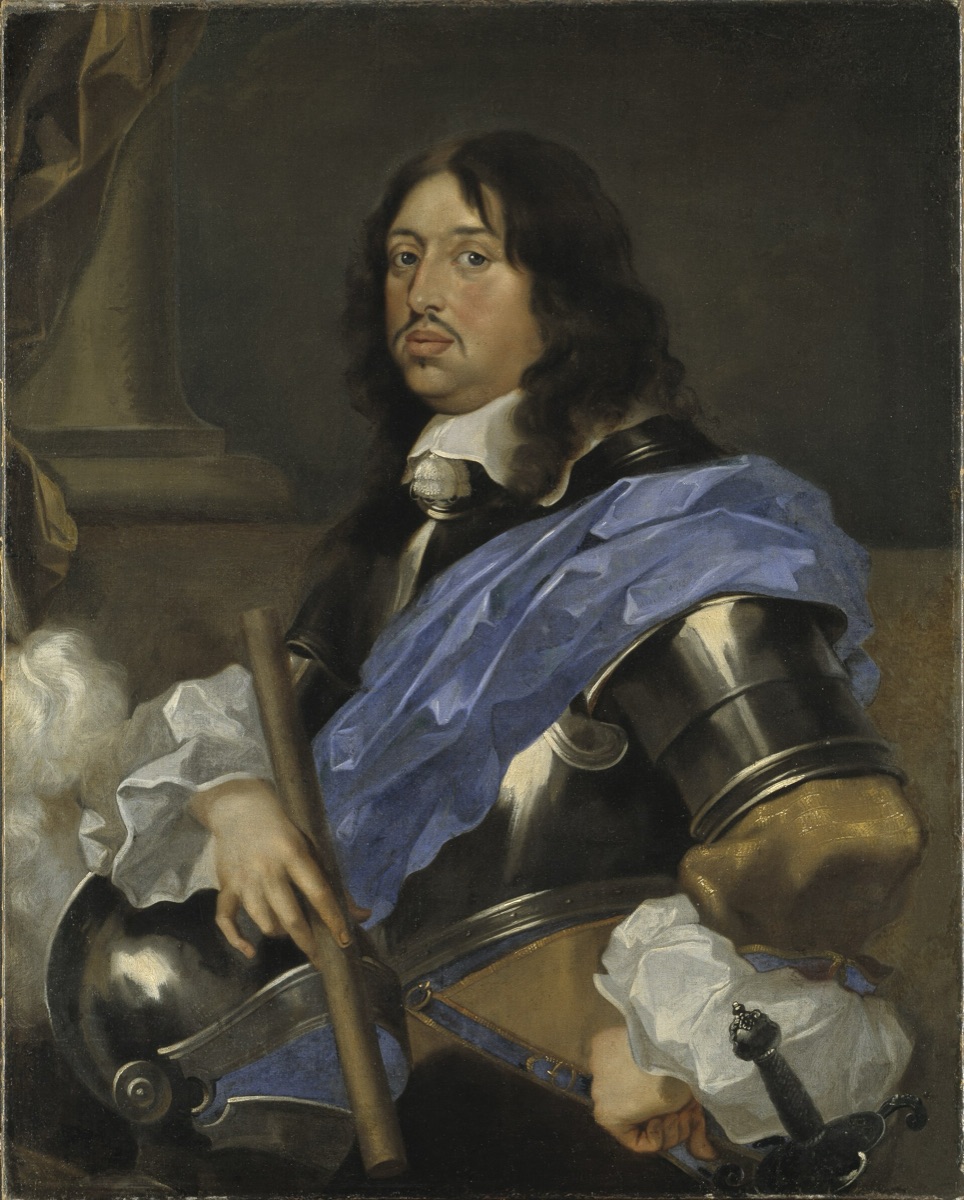
Painter: Sébastien Bourdon · Nationalmuseum, Sztokholm / Wikimedia Commons · Public domain
Life
Charles Gustav was born at Nyköping Castle, the son of John Casimir, Count Palatine of Zweibrücken, and of Catherine, sister of Gustavus II Adolphus. The Swedish Biographical Dictionary gives the date as 8 November 1622 in the Julian calendar, then in use in Sweden; in the Gregorian calendar it was 18 November1.
In 1638–1640 he made an educational journey, during which he studied at Benjamin's officers' academy in Paris1. From 1642 to 1645 he served in Lennart Torstensson's army in Germany, and in 1648 he became generalissimo of the Swedish forces in Germany1. In 1649 the Riksdag chose him as heir to the throne1. He became king in 1654, after the abdication of Queen Christina1.
During the Deluge
The decision to go to war with Poland was in effect taken during the debates in the Council of the Realm in December 16541. According to the dictionary, Charles Gustav chose to attack Poland rather than Russia because of, among other things, Poland's weakness, Swedish interests in Courland and Prussia, and the claims of the Polish Vasas to the Swedish throne1. In the first days of August 1655 he entered Poland with 15,000 soldiers, 60 heavy guns and 118 regimental cannon4. Janusz and Bogusław Radziwiłł surrendered Lithuania to him5 (see Capitulation of Kėdainiai).
At Wojnicz on 3 October he routed the army of the Field Hetman of the Crown and returned to besieged Kraków6 (see Siege of Kraków). On his way back from Kraków to Warsaw he was said to have ridden round Jasna Góra7. He ordered General Burchard Müller to occupy the monastery, whose treasures were to go towards paying the army7 (see Siege of Jasna Góra).
At Gołąb on 18 February 1656 he defeated Stefan Czarniecki8. As early as 11 February, however, Koniecpolski, Standard-bearer of the Crown, together with Prince Dymitr Wiśniowiecki, had sent envoys to John Casimir to declare that he was returning to obedience; the army under his command, 9,000 men strong, did the same9. Immediately after the battle Charles Gustav received the news that the quarter army (the standing army of the Crown) under Koniecpolski had abandoned him; the Poles were at that time his main force10. At the turn of March and April he was shut in the fork of the Vistula and the San near Sandomierz11. The Swedish dictionary judges that the great victories of 1655–1657, of which the three-day Battle of Warsaw attracted the most attention, did not bring corresponding political results, because Sweden lacked the forces and the money to master the whole of Poland1. In 1657, after Denmark declared war, he led his army against Denmark; the Peace of Roskilde in 1658 gave Sweden Scania, Halland, Blekinge, Bohuslän, Bornholm and the Trondheim region1. He died during the negotiations at Oliva. According to Kubala, before his death he advised his wife and ministers to seek an early peace, and his son's guardians resolved to secure the country by peace, even at some cost2 (see Treaty of Oliva).
Controversies
In the novel
Sienkiewicz describes the Swedish king in his camp after the Battle of Gołąb as follows:
Karol Gustaw, gdy był wesół, zdawał się być z samej dobroci ulepiony, ale gdy raz brew zmarszczył, wzbudzał strach nieopisany w najbliższych (...)
Henryk Sienkiewicz, The Deluge (Potop)12
(Our translation: "Charles Gustav, when he was in good humour, seemed moulded out of pure kindness, but once he knitted his brow he aroused indescribable fear in those closest to him (...)")
Later in the novel the king speaks of his opponent's tactics: „Czarniecki nie wybije, ale wykradnie mi wojsko” ("Czarniecki will not destroy my army, but he will steal it away from me")13.
In the film
In Jerzy Hoffman's film Charles X Gustav was played by Leon Niemczyk14.
Notes
- Stellan Dahlgren, Karl X Gustav, Svenskt biografiskt lexikon, bd 20, Svenskt biografiskt lexikon (Riksarkivet), 1973–1975, s. 641
- Ludwik Kubala, Wojny duńskie i pokój oliwski 1657–1660, Szkice historyczne, serja VI (Biblioteka Historyczna Altenberga), Lwów: Księgarnia Wydawnicza H. Altenberga, 1922, s. 310
- Ludwik Kubala, Wojny duńskie i pokój oliwski 1657–1660, Szkice historyczne, serja VI (Biblioteka Historyczna Altenberga), Lwów: Księgarnia Wydawnicza H. Altenberga, 1922, s. 302, 310
- Ludwik Kubala, Wojna szwecka w roku 1655 i 1656, Szkice historyczne, serya IV (Biblioteka Historyczna Altenberga), Lwów; Warszawa: H. Altenberg, G. Seyfarth, E. Wende i Sp.; E. Wende i Sp., 1913, s. 96
- Ludwik Kubala, Wojna szwecka w roku 1655 i 1656, Szkice historyczne, serya IV (Biblioteka Historyczna Altenberga), Lwów; Warszawa: H. Altenberg, G. Seyfarth, E. Wende i Sp.; E. Wende i Sp., 1913, s. 87
- Ludwik Kubala, Wojna szwecka w roku 1655 i 1656, Szkice historyczne, serya IV (Biblioteka Historyczna Altenberga), Lwów; Warszawa: H. Altenberg, G. Seyfarth, E. Wende i Sp.; E. Wende i Sp., 1913, s. 115–116
- Ludwik Kubala, Wojna szwecka w roku 1655 i 1656, Szkice historyczne, serya IV (Biblioteka Historyczna Altenberga), Lwów; Warszawa: H. Altenberg, G. Seyfarth, E. Wende i Sp.; E. Wende i Sp., 1913, s. 155
- Ludwik Kubala, Wojna szwecka w roku 1655 i 1656, Szkice historyczne, serya IV (Biblioteka Historyczna Altenberga), Lwów; Warszawa: H. Altenberg, G. Seyfarth, E. Wende i Sp.; E. Wende i Sp., 1913, s. 276
- Ludwik Kubala, Wojna szwecka w roku 1655 i 1656, Szkice historyczne, serya IV (Biblioteka Historyczna Altenberga), Lwów; Warszawa: H. Altenberg, G. Seyfarth, E. Wende i Sp.; E. Wende i Sp., 1913, s. 278
- Ludwik Kubala, Wojna szwecka w roku 1655 i 1656, Szkice historyczne, serya IV (Biblioteka Historyczna Altenberga), Lwów; Warszawa: H. Altenberg, G. Seyfarth, E. Wende i Sp.; E. Wende i Sp., 1913, s. 277
- Ludwik Kubala, Wojna szwecka w roku 1655 i 1656, Szkice historyczne, serya IV (Biblioteka Historyczna Altenberga), Lwów; Warszawa: H. Altenberg, G. Seyfarth, E. Wende i Sp.; E. Wende i Sp., 1913, s. 288–289
- Henryk Sienkiewicz, Potop, Fundacja Nowoczesna Polska (Wolne Lektury), 2009–2010, t. III, rozdz. I
- Henryk Sienkiewicz, Potop, Fundacja Nowoczesna Polska (Wolne Lektury), 2009–2010, t. III, rozdz. VI
- Potop, Łódź: Państwowa Wyższa Szkoła Filmowa, Telewizyjna i Teatralna im. Leona Schillera w Łodzi (filmpolski.pl)
Explore further
Related
Ally
- Burchard Müller von der Lühnen generał w służbie króla szwedzkiego Historical figure
- Janusz Radziwiłł poddanie Wielkiego Księstwa Litewskiego pod protekcję króla szwedzkiego Historical figure
Opponent
- John II Casimir Vasa Historical figure
- Stefan Czarniecki m.in. bitwa pod Gołębiem, 18 lutego 1656 Historical figure
Took part in
- Siege of Kraków (1655) wrócił pod oblegane miasto po bitwie pod Wojniczem Documented
Related
- Siege of Jasna Góra (1655) rozkazał Müllerowi zająć klasztor Documented
- Swedish forces occupy Warsaw Documented
- Dymitr Jerzy Wiśniowiecki Historical figure
Sources for this page
- Stellan Dahlgren, Karl X Gustav, Svenskt biografiskt lexikon, bd 20, Svenskt biografiskt lexikon (Riksarkivet), 1973–1975, s. 641 (Reference work)
- Ludwik Kubala, Wojny duńskie i pokój oliwski 1657–1660, Szkice historyczne, serja VI (Biblioteka Historyczna Altenberga), Lwów: Księgarnia Wydawnicza H. Altenberga, 1922 (Academic study)
- Ludwik Kubala, Wojna szwecka w roku 1655 i 1656, Szkice historyczne, serya IV (Biblioteka Historyczna Altenberga), Lwów; Warszawa: H. Altenberg, G. Seyfarth, E. Wende i Sp.; E. Wende i Sp., 1913 (Academic study)
- Henryk Sienkiewicz, Potop, Fundacja Nowoczesna Polska (Wolne Lektury), 2009–2010 (Primary source)
- Potop, Łódź: Państwowa Wyższa Szkoła Filmowa, Telewizyjna i Teatralna im. Leona Schillera w Łodzi (filmpolski.pl) (Reference work)