
AI illustration
Imagined scene inspired by the biography and portrait shown below.
Magnate
Bogusław Radziwiłł
Historical figurePrince, commander and governor of Ducal Prussia; a real participant in the Deluge and a famous antagonist in the novel and film.
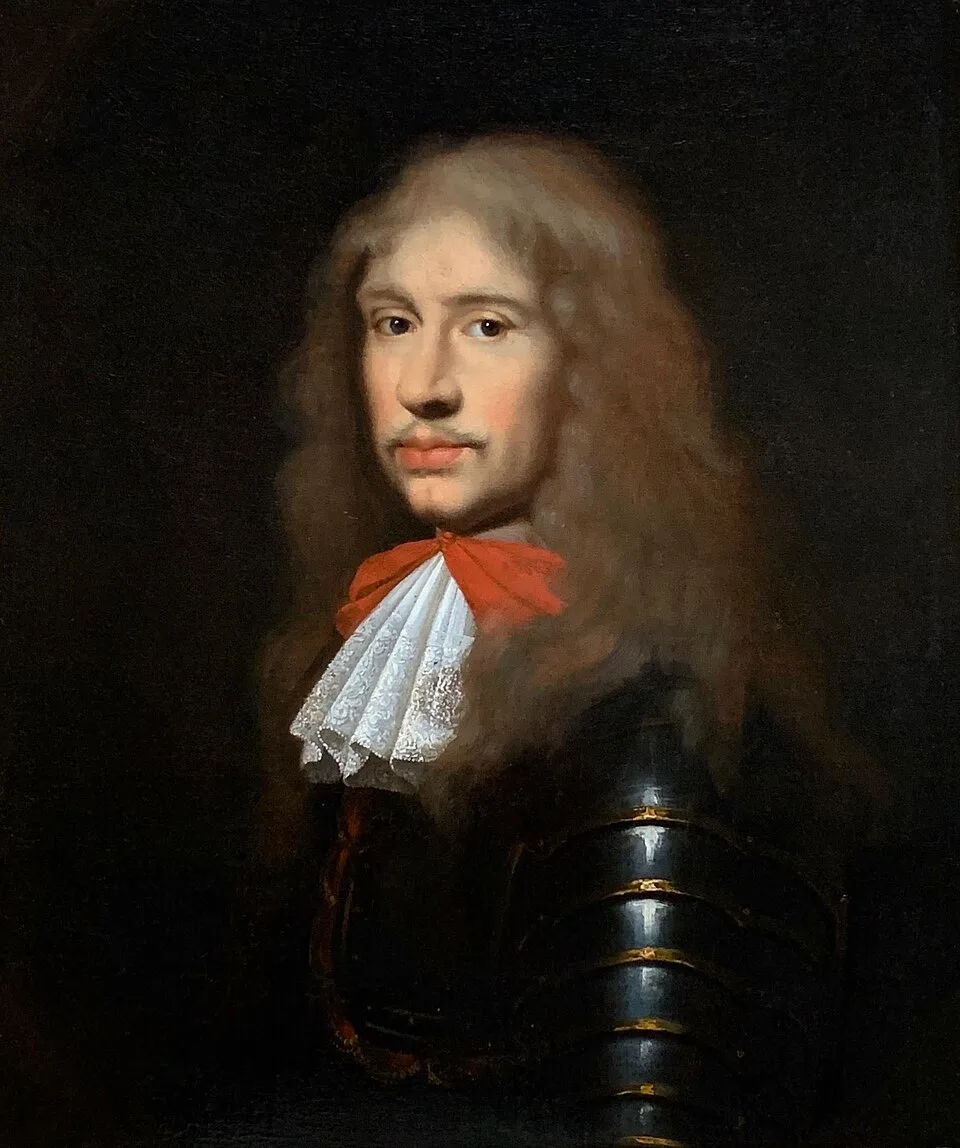
Painter: Willem van Honthorst · 1656–1659 · Wikimedia Commons · Public domain
Before the invasion
Born in Gdańsk in 1620, Bogusław lost his father as an infant. His uncle Krzysztof raised him and administered a vast estate. He studied at Kėdainiai and Vilnius and joined the court of Władysław IV in 1636. A Calvinist with extensive links to western European courts, he pursued dynastic, property and diplomatic interests alongside military ones1.
The shifting loyalties of 1655
At the start of the invasion he negotiated with the circle of Janusz Radziwiłł while seeking office from John Casimir. Intercepted letters exposed his Swedish contacts. He continued to profess loyalty, built up forces in Podlasie and occupied Tykocin. He joined Charles X Gustav in person only at the end of December 1655. The documented sequence is more complex than a single dramatic act of treason1.
Campaigns, captivity and partition plans
He relieved the Swedish garrison at Tykocin in February 1656. In March he took Janów Podlaski but was defeated the next day by Paweł Jan Sapieha. He fought with the Swedes in the three-day Battle of Warsaw. At Prostki on 8 October, the Swedish–Brandenburg force was defeated by Wincenty Gosiewski. Wounded in the head, Bogusław was taken captive by Tatar troops. Historians have had to reconstruct the precise course of that battle from conflicting accounts12.
The Radnot agreement of December 1656 assigned him Nowogródek province and envisaged hereditary rule over his estates; he demanded still more. This was a proposed partition of the Commonwealth, never carried out13.
After the Deluge
As governor of Ducal Prussia he served the Brandenburg elector. In 1661–63 he helped suppress resistance by the Prussian estates and loosen the duchy's ties to the Commonwealth, while also defending Calvinist congregations on his own lands. He wrote an autobiography amid struggles for office. He died suddenly in 1669, leaving a daughter, Ludwika Karolina1.
Novel and film
Sienkiewicz made the historical prince an opponent of Andrzej Kmicic. The personal rivalry over Oleńka and the duel belong to fiction, not his documented life. Leszek Teleszyński played him in Jerzy Hoffman's 1974 film. The screen concentrates a complicated political and military career into a memorable antagonist451.
Notes
- Bogusław Radziwiłł h. Trąby (1620–1669), Polski Słownik Biograficzny / Instytut Historii PAN
- Bitwa pod Prostkami, Oś czasu, Warszawa: Muzeum Wojska Polskiego w Warszawie
- Traktat w Radnot, Oś czasu, Warszawa: Muzeum Wojska Polskiego w Warszawie
- Henryk Sienkiewicz, Potop, Fundacja Nowoczesna Polska (Wolne Lektury), 2009–2010
- Potop, Łódź: Państwowa Wyższa Szkoła Filmowa, Telewizyjna i Teatralna im. Leona Schillera w Łodzi (filmpolski.pl)
Explore further
Related
Character in the novel
- Bogusław Radziwiłł in the novel Historical figure, fictionalized
Related
- Capitulation of Kėdainiai (1655) Documented
Sources for this page
- Bogusław Radziwiłł h. Trąby (1620–1669), Polski Słownik Biograficzny / Instytut Historii PAN (Institution)
- Bitwa pod Prostkami, Oś czasu, Warszawa: Muzeum Wojska Polskiego w Warszawie (Institution)
- Traktat w Radnot, Oś czasu, Warszawa: Muzeum Wojska Polskiego w Warszawie (Institution)
- Henryk Sienkiewicz, Potop, Fundacja Nowoczesna Polska (Wolne Lektury), 2009–2010 (Primary source)
- Potop, Łódź: Państwowa Wyższa Szkoła Filmowa, Telewizyjna i Teatralna im. Leona Schillera w Łodzi (filmpolski.pl) (Reference work)