
AI illustration
Imagined period town; smoke is an animation effect.
City
Gdańsk
A Baltic port that did not surrender to Sweden. John Casimir visited in December 1656; peace was signed in nearby Oliwa in 1660.
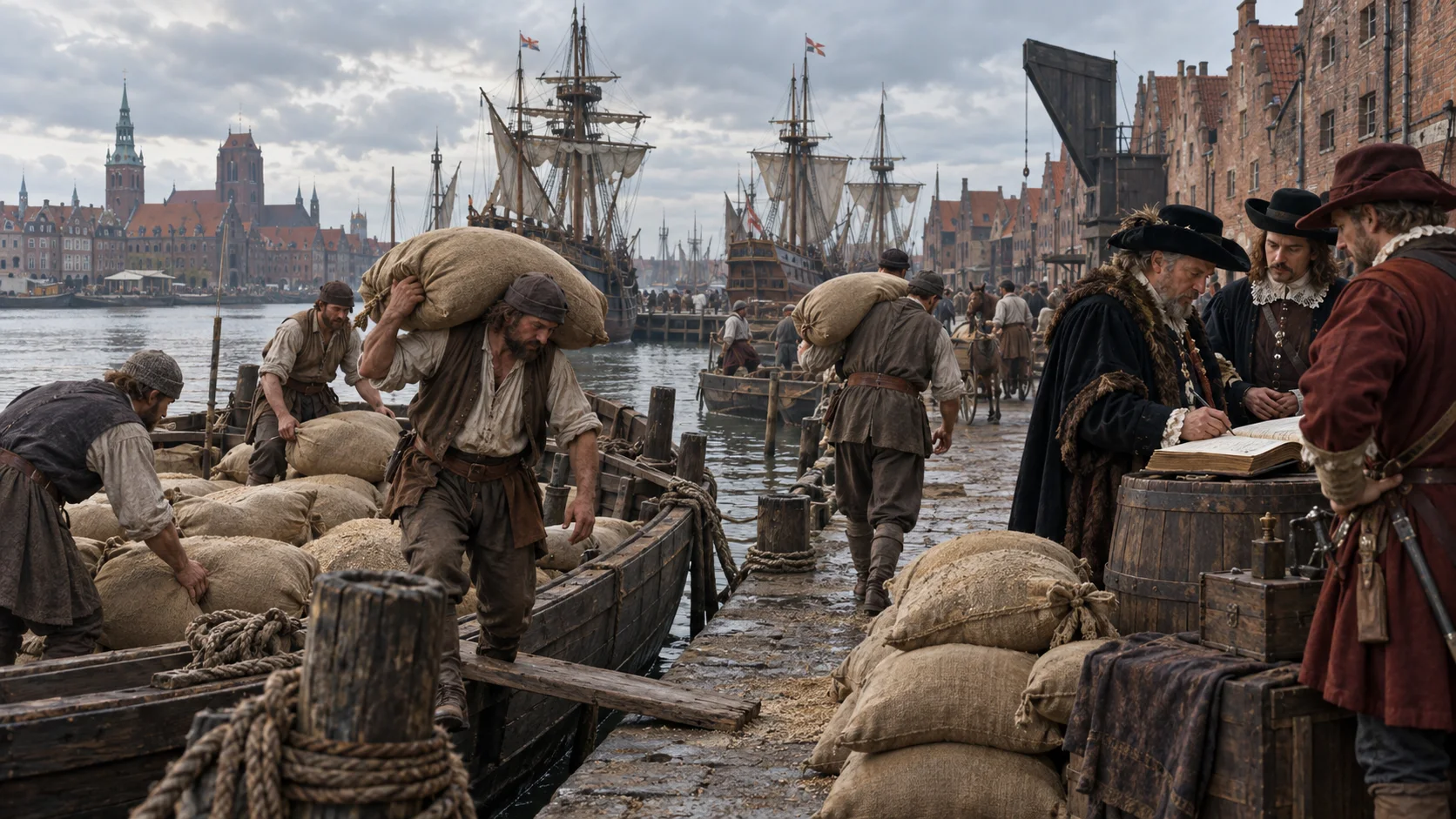
A city of merchants and water
Gdańsk’s history extends well beyond the Deluge. Duke Świętopełk II granted Lübeck law, and after the Teutonic takeover in 1308 the city’s economic infrastructure developed, including the Radunia Canal and Great Mill. From 1361 to 1669 Gdańsk belonged to the Hanseatic League of trading towns. This long maritime connection places the port within a wider commercial network. Rivers, canals, warehouses and waterways form as important a historical setting as its ceremonial buildings1.
A port outside Swedish control
Gdańsk did not surrender during the Swedish invasion. As a wealthy Baltic port it maintained the Commonwealth's contacts abroad, unlike many towns taken by Charles X Gustav's forces. John Casimir arrived in December 1656. The event page explains his visit2.
Gdańsk and the Peace of Oliwa
In 1660 the parties negotiated the end of the war in Oliwa near Gdańsk. The Peace of Oliwa was signed on 3 May. Oliwa was the treaty site; Gdańsk was the neighbouring port and a major reference point for the campaign. They are distinct places on the map3.
What the map shows
The Gdańsk marker identifies the modern city centre, not every former fortification or Oliwa. Its story helps explain why control of Royal Prussia and access to the Baltic mattered so much during the war23.
Gdańska Głowa: the struggle for the Vistula delta
The city remained free, but its river approaches were threatened. Gdańska Głowa stood where the Vistula and Szkarpawa separated, on land belonging to Gdańsk. Swedish troops captured its fort in February 1656 and enlarged the earthworks and water defences. Holding this position put pressure on navigation through the delta. Attempts to recover it in 1656–1657 failed. A siege late in the war finally brought its surrender in December 1659. Protecting the port therefore also meant fighting for waterways far from the city centre4.
A builder serving the defence
Jerzy Strakowski, a builder and fortification specialist, was among those responsible for the city’s security. Early in 1656 he commanded a company at Wisłoujście and attended military councils before undertaking engineering duties. He worked on defences by the Stone Lock and on improvements at Wisłoujście. His responsibilities combined design with commanding soldiers. His career reveals the practical work behind urban defence: royal and military decisions required plans, surveys and fortifications adapted to the local terrain5.
Wisłoujście: the gateway to the port
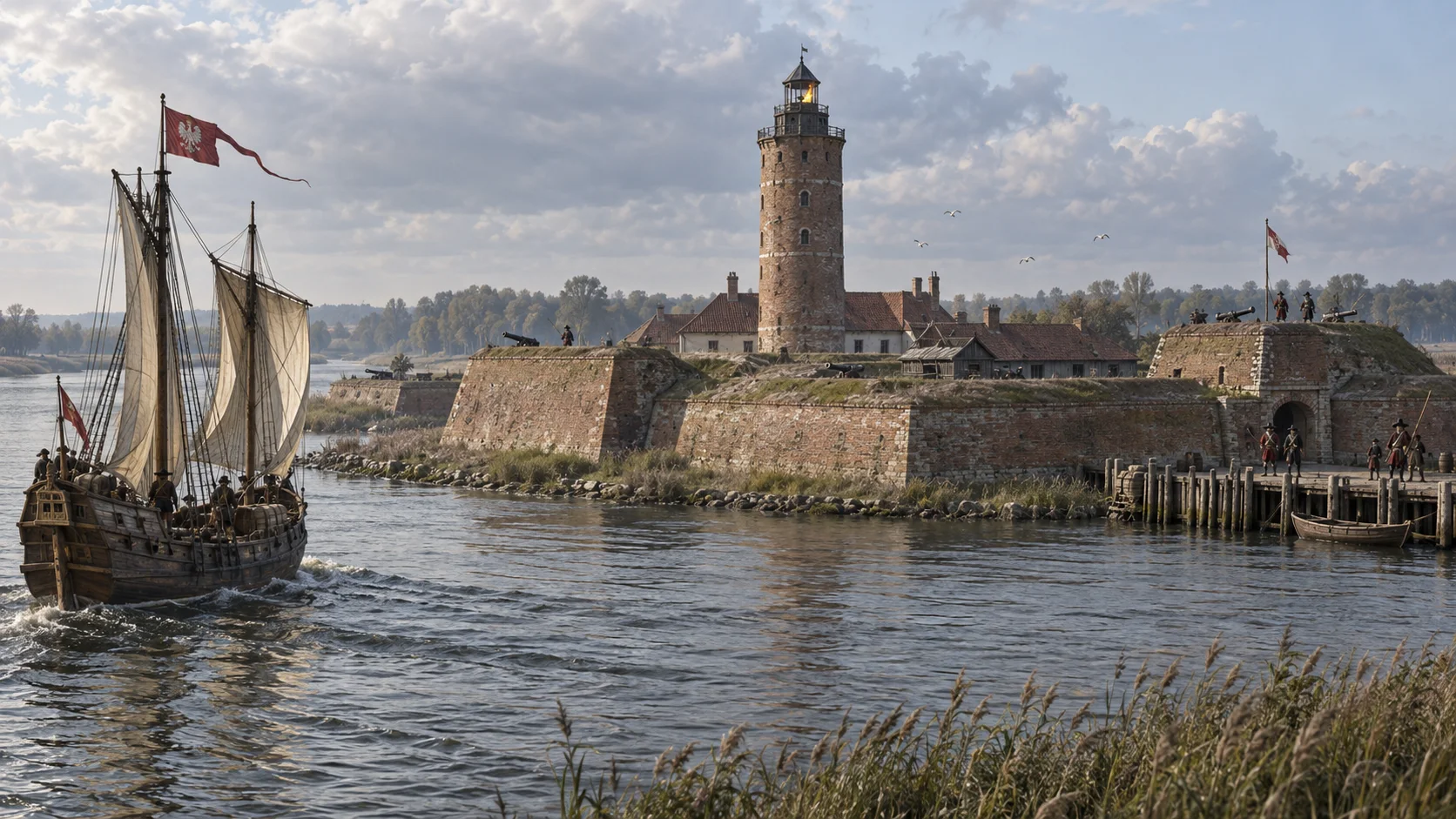
Wisłoujście Fortress guarded the former Vistula mouth and controlled shipping. Its circular tower of 1482 also served as a lighthouse. The four-bastion Fort Carré surrounded it in the late sixteenth century; further earthworks later appeared on both riverbanks. In 1657–1658 the fortress defences were connected with Gdańsk’s fortification system. The surviving monument reveals successive stages of military architecture, although it required reconstruction after the destruction of 1945. It gives a physical setting to the story of a city that did not surrender during the Deluge6.
Notes
- Historia Gdańska, Urząd Miejski w Gdańsku
- Jan II Kazimierz przybywa do Gdańska, Oś czasu, Warszawa: Muzeum Wojska Polskiego w Warszawie
- Ludwik Kubala, Wojny duńskie i pokój oliwski 1657–1660, Szkice historyczne, serja VI (Biblioteka Historyczna Altenberga), Lwów: Księgarnia Wydawnicza H. Altenberga, 1922
- GDAŃSKA GŁOWA, Encyklopedia Gdańska
- Jerzy Strakowski (1614–1675), budowniczy i fortyfikator gdański, Polski Słownik Biograficzny / Instytut Historii PAN, 2006–2007
- Twierdza Wisłoujście, Muzeum Gdańska
Explore further
Related
Related
- John II Casimir arrives in Gdańsk Documented
- Treaty of Oliva (1660) Documented
- Oliwa
Sources for this page
- Historia Gdańska, Urząd Miejski w Gdańsku (Institution)
- Jan II Kazimierz przybywa do Gdańska, Oś czasu, Warszawa: Muzeum Wojska Polskiego w Warszawie (Institution)
- Ludwik Kubala, Wojny duńskie i pokój oliwski 1657–1660, Szkice historyczne, serja VI (Biblioteka Historyczna Altenberga), Lwów: Księgarnia Wydawnicza H. Altenberga, 1922 (Academic study)
- GDAŃSKA GŁOWA, Encyklopedia Gdańska (Reference work)
- Jerzy Strakowski (1614–1675), budowniczy i fortyfikator gdański, Polski Słownik Biograficzny / Instytut Historii PAN, 2006–2007 (Academic study)
- Twierdza Wisłoujście, Muzeum Gdańska (Institution)