
AI illustration
Imagined landscape of the 1655 invasion; smoke is an animation effect.
History
The Swedish Deluge (1655–1660)
DocumentedHow Sweden's invasion began, how the war unfolded and what changed after the Peace of Oliva in 1660.
- Names and variants
- pl Potop szwedzki (1655–1660)
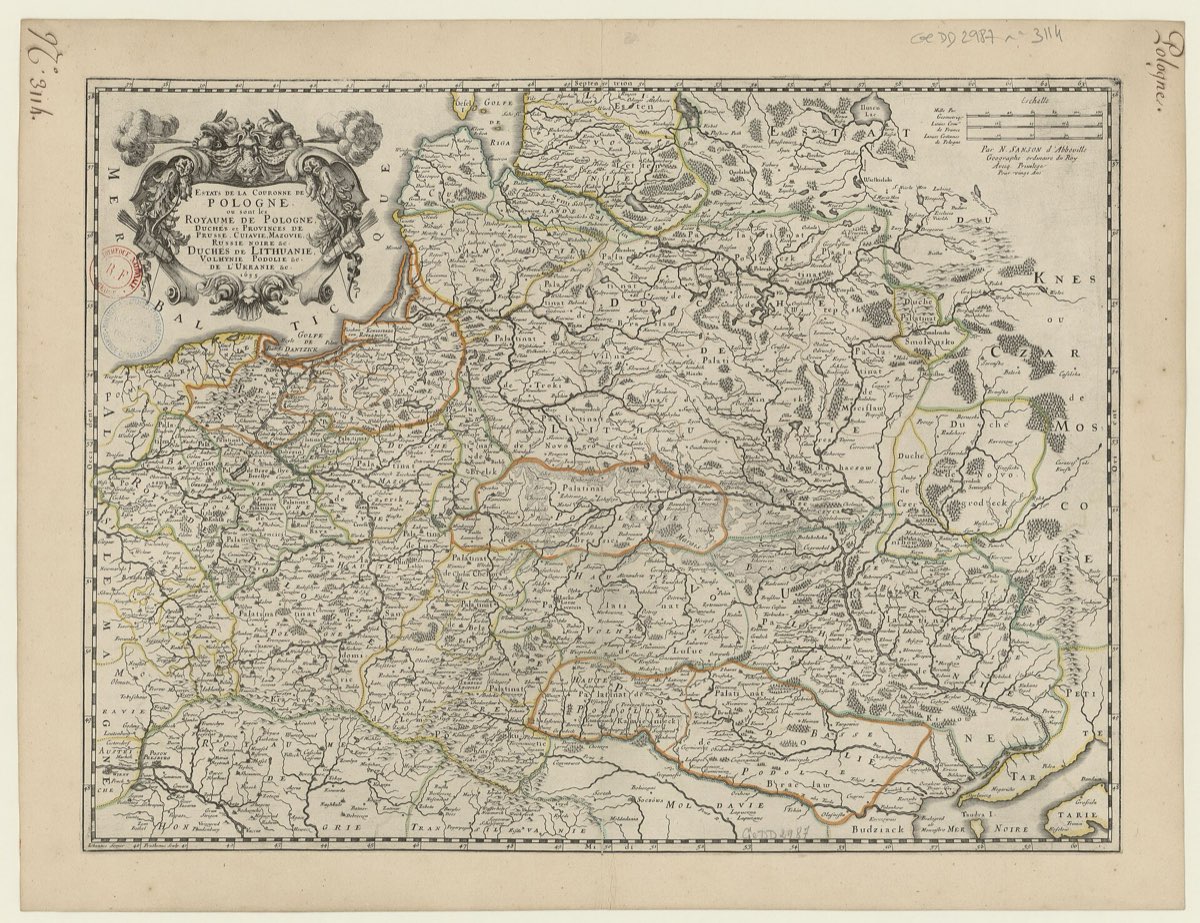
Map authorship: Nicolas Sanson; engraver: Johannes Somer · 1655 · Bibliothèque nationale de France / Wikimedia Commons · Public domain
The Deluge (potop) is the name given to the war that Sweden waged against the Polish-Lithuanian Commonwealth from the summer of 1655 until the Peace of Oliva in 1660. Ludwik Kubala treated it as the second part of a wider conflict he described as the Seven Years' Northern War (1654–1660). The first part was the war with Muscovy1. We cover the later novel by Sienkiewicz and film by Hoffman separately. The Jasna Góra comparison shows how their versions differ from the sources.
Background: the Vasas, Sweden and the Commonwealth before 1655
According to Kubala, the dispute within the House of Vasa over the Swedish throne began in 1601, when Duke Charles of Södermanland deprived his nephew, the Polish king Sigismund III, of the throne. The wars with Sigismund III and Władysław IV were interrupted, according to Kubala, by a truce concluded „w r. 1636 na 26 lat, a zatem do r. 1661” ("in 1636 for 26 years, and thus until 1661")2.
John II Casimir Vasa, the brother of Władysław IV, was elected King of Poland on 20 November 1648 and crowned on 17 January 16493. The first years of his reign were taken up by the war against the Khmelnytsky Uprising: Czapliński lists Zborów (1649), Beresteczko (1651) and Żwaniec (1653)3. In Swedish affairs the king, who dreamed of the Swedish throne, or at least of handsome payment for his rights to it, did not hurry the negotiations to extend the truce3.
In Sweden Queen Christina renounced the crown on 6 June 1654 in the Julian calendar, that is, 16 June in the Gregorian. Power passed to her cousin, Charles X Gustav4. The Swedish biographical dictionary explains his decision to go to war with Poland as follows. Russia, which was already at war with Poland, threatened areas lying within the Swedish sphere of influence and Sweden's Baltic provinces. The king concluded that he had to intervene. He chose to attack Poland rather than Russia because Poland was weak, because Courland and Prussia, the territories Sweden coveted most, lay under its suzerainty, and because unresolved disputes supplied pretexts: the claims of the Polish Vasas to the Swedish throne and Polish claims to Livonia4. The dictionary does not conceal the expansionist aim of the war, and adds that the king was also tempted by the prospect of new revenue for the treasury4. The actual decision was taken during debates in the Council of the Realm in December 1654 (by the calendar then in use in Sweden); the council agreed to rearm for an offensive war against Poland4.
Kubala lays the emphasis on the Baltic trade. Royal and Ducal Prussia were the only stretch of coast that Sweden did not yet hold, and taking their ports would have given it mastery of the Baltic and enormous customs revenue5. The war was made easier for the Swedes by Hieronim Radziejowski, formerly Vice-Chancellor of the Crown, who had been sentenced in 1652 to infamy and banishment for lèse-majesté. „Nie on wywołał tę wojnę, ale on ją Szwedom ułatwił (...)” ("It was not he who caused this war, but he made it easier for the Swedes (...)"), Kubala wrote2. In an interview published by the Museum of Polish History, Krzysztof Kossarzecki names Muscovy's earlier attack as one of the causes of the invasion: the Swedes feared that the eastern part of the Commonwealth would be absorbed by Muscovy and that the Russians would reach the Baltic6.
The Commonwealth was losing this war in the east. The Grand Hetman of Lithuania (the commander-in-chief of the Lithuanian army), Janusz Radziwiłł, won a battle against the Tsar's forces at Shklov on 12 August 1654, but on 24 August he was defeated, and on 3 October Smolensk capitulated7. According to Ludwik Finkel's preface to the last volume of Kubala's work, the Tsar reached Wilno (today Vilnius) in August 16558.
Invasion (1655)
Field Marshal Arvid Wittenberg crossed the border on 21 July 1655, and four days later the noble levy (pospolite ruszenie) of the voivodeships (provinces) of Poznań and Kalisz surrendered at Ujście (Capitulation at Ujście)9. In the first days of August Charles Gustav himself entered Poland; according to Kubala he led 15,000 soldiers, 60 heavy guns and 118 field guns10. In Lithuania, on 18 August at Kėdainiai, Janusz Radziwiłł proclaimed the act submitting the Grand Duchy to the protection of the Swedish king, and on 20 October the Union of Kėdainiai was signed there (Capitulation of Kėdainiai)1112.
Warsaw offered no resistance. When news came on 7 September that the Swedes were at Błonie, the burghers asked the Swedish king for protection the next day. Charles Gustav left Bengt Oxenstierna as governor of the city13. John Casimir, after unsuccessful skirmishes and the defection of whole voivodeships, took refuge in Silesia, at Głogówek, where he arrived on 17 October 16553. Stefan Czarniecki defended Kraków from 26 September to 17 October, and then signed an honourable capitulation (Siege of Kraków)14.
Kubala regarded the surrender of the Crown army as the high point of Charles Gustav's success; the whole of Lesser Poland then recognised his rule15. There was, however, no decision on what to do with the conquered country. There was an intention to create three or four smaller vassal principalities, in Mazovia, Podlasie, Polesie and Lithuania, and there were thoughts of ceding some parts of Poland to Brandenburg, to the Cossacks and to George II Rákóczi16.
Occupation
The Swedes placed garrisons in the larger towns and in strategically important places. According to Kossarzecki, in Greater Poland many small garrisons had already been drawn into larger ones by the end of 1655, and Swedish rule there lasted less than a year, from the end of July 1655 to the beginning of summer 165617. Plunder, contributions and the looting of churches led in the autumn of 1655 to resistance among the nobility, and the occupier's reprisals only strengthened it. The Swedes, who at first proclaimed themselves protectors of the lands they had occupied, became ordinary occupiers18.
A contribution of 600,000 złotys was levied on Kraków19. In Warsaw, on 16 and 17 September 1655, some houses of Polish lords and three royal palaces were plundered20. Charles Gustav plundered churches and monasteries and imposed ransoms on the clergy: the Bishop of Chełmno paid 4,000 thalers a month, the Jesuits of Kalisz 12,000 thalers in a single payment, and those of Kraków were to pay 30,00016. The scale of the losses is described in the article Consequences of the Deluge.
Resistance
The Swedish biographical dictionary calls the failed siege of Jasna Góra the Swedes' first serious setback in this war21. According to Kersten, Prior Augustyn Kordecki was not the military commander of the defence, but his role in the negotiations and in the decisions of the monastic community was decisive22. The corps of General Burchard Müller stood before Jasna Góra from 18 November and withdrew on 27 December 16552324. Kubala called this a moral defeat for the Swedes, one that shook belief in their invincibility25.
John Casimir, encouraged by news of the rising, issued on 20 November 1655 a proclamation (uniwersał) calling on all the estates to fight the Swedes, and in the second half of December he set out from Silesia and reached Lwów (today Lviv) by way of Slovakia and the Carpathian foothills3. The Crown hetmans (the commanders of the Polish army) returned to their allegiance to the king on 17 December, and on 29 December they formed a confederation at Tyszowce (Tyszowce Confederation)26. Czarniecki, appointed regimentarz (a commander appointed in place of the hetmans) in January 1656, waged a war of harassment. He began it with a defeat at Gołąb, where on 18 February Charles Gustav inflicted a heavy reverse on him14. In April he defeated the corps of the Margrave of Baden at Warka (Battle of Warka)14. In Lwów on 1 April 1656 the king vowed to ease the lot of the peasants; according to Czapliński he never seriously thought of keeping this promise3.
Polish forces besieged Warsaw from 30 May to 1 July 16563. Wittenberg, together with other Swedish dignitaries, was taken to Zamość, where he died27. In the battle of Warsaw on 28–30 July 1656 the king was in personal command3; the Swedish biographical dictionary lists it among Charles Gustav's great victories of 1655–1657, which nevertheless brought him no political decision, because the Swedes had neither the forces nor the money to hold the whole country4.
The war becomes European
Brandenburg and Prussia
Frederick William, Elector of Brandenburg, was, as Duke of Prussia, a vassal of the Commonwealth28. In January 1656 he concluded the Treaty of Königsberg with Sweden: he took Ducal Prussia as a fief of the Swedish crown and received the bishopric of Warmia as a hereditary fief294. At Malbork, on 25 June 1656, a Swedish-Brandenburg alliance was concluded; in a secret article the Elector was granted sovereign rule over the voivodeships of Poznań, Kalisz, Łęczyca and Sieradz and the Land of Wieluń30. In November 1656, at Labiau, Charles Gustav had to grant him full sovereignty in Ducal Prussia, and in the autumn of 1657 Brandenburg went over to Poland's side4. Finkel dates the Treaty of Wehlau–Bromberg with the Elector to 6 November 16578. Kossarzecki calls the Elector the great winner of the war, because he gained sovereignty in Ducal Prussia6.
Muscovy
The victories of the Swedes and of Muscovy set the Commonwealth's two rivals against each other. In 1656 the Commonwealth and Muscovy concluded an agreement at Niemież near Wilno that suspended hostilities, and in October 1658 the Polish-Muscovite war broke out again6. The Swedes concluded a truce with Russia in December 16584.
Transylvania
George II Rákóczi had offered Sweden an alliance and 40,000 troops as early as 165131. In 1657 his forces fought in Poland alongside the Swedes: when Charles Gustav learned of the war with Denmark, he was with Rákóczi near Brest, and he abandoned his ally32. Czarniecki routed a detachment of Rákóczi's forces at Rawa, on 11 July inflicted a defeat on the retreating Transylvanians at Magierów, and at Czarny Ostrów Rákóczi laid down his arms without a fight14.
The Habsburgs
Austria concluded an alliance with Poland in the spring of 1657 and sent it troops433. After Kraków had been recovered, the Austrian army, nearly 16,000 strong, marched on Toruń. Kubala judges that the Commonwealth gained no benefit whatever from it. The treaty obliged the Austrians to operate only in Polish and Prussian lands, and in the winter of 1657/1658 complaints about their plundering and disputes over the cost of their upkeep weighed on the alliance34. The siege of Toruń, in which imperial troops took part, lasted from 26 September to 23 December 16583, when the Swedish garrison capitulated35.
Denmark
In June 1657 Denmark declared war on Sweden in the hope of recovering its lost provinces437. On 18 July 1657 a Danish-Polish alliance was concluded in Copenhagen38. Charles Gustav marched from Poland against Denmark and, as Kubala writes, never returned to Poland32. In the winter of 1658 he led his army across the straits over the ice and forced the Peace of Roskilde, under which Sweden received Scania, Halland, Blekinge, Bornholm, Bohuslän and the Trondheim district394.
In the summer of 1658 Charles Gustav broke the peace and landed on Zealand414. Besieged Copenhagen was saved in November by the Dutch fleet42. An allied army under the command of the Elector of Brandenburg went to Denmark's aid, with imperial troops and with Czarniecki's division, which in December 1658 distinguished itself in the crossing to the island of Als and took the castle of Koldinghus4314.
Peace
Charles X Gustav died in February 1660 in Gothenburg, and the guardians of his young son resolved to secure the country by making peace44. Negotiations held in the monastery at Oliva through French mediation ended with the signing of the treaty on 3 May 1660 (Treaty of Oliva)45. Sweden gave back Royal Prussia but kept Livonia apart from its south-eastern part, and John Casimir renounced his rights to the Swedish throne46. According to Kossarzecki, however, he kept the title of King of Sweden for life; the treaty also obliged the Swedes to return the archives and libraries they had carried off, and the Commonwealth in essence returned to its borders from before the war with Sweden6. The peace did not end the Commonwealth's wars: its forces were moved east, against Muscovy, which at that time occupied almost the whole of the Grand Duchy of Lithuania6.
What this page is based on
Most of the facts come from two volumes by Ludwik Kubala, from biographical entries in the Polski Słownik Biograficzny (Polish Biographical Dictionary) and in the Swedish biographical dictionary, from notes by the Museum of Polish History and from an article by Krzysztof Kossarzecki. Kubala's books are more than a hundred years old; we give his judgements as the author's own. Newer monographs – by Adam Kersten, Jan Wimmer and Robert Frost – are recorded on the source pages, but we have not read them, and no fact on this page rests on them (of Kersten's work we cite only his PSB entry on Kordecki). Dates from the Swedish biographical dictionary are given in the Julian calendar; wherever possible we convert them to the Gregorian, and in the remaining cases we say so explicitly.
Notes
- Ludwik Kubala, Wojna szwecka w roku 1655 i 1656, Szkice historyczne, serya IV (Biblioteka Historyczna Altenberga), Lwów; Warszawa: H. Altenberg, G. Seyfarth, E. Wende i Sp.; E. Wende i Sp., 1913, s. V
- Ludwik Kubala, Wojna szwecka w roku 1655 i 1656, Szkice historyczne, serya IV (Biblioteka Historyczna Altenberga), Lwów; Warszawa: H. Altenberg, G. Seyfarth, E. Wende i Sp.; E. Wende i Sp., 1913, s. 1
- Władysław Czapliński, Jan II Kazimierz (Waza), Polski słownik biograficzny, t. 10, Wrocław: Zakład Narodowy im. Ossolińskich – Wydawnictwo Polskiej Akademii Nauk, 1962–1964
- Stellan Dahlgren, Karl X Gustav, Svenskt biografiskt lexikon, bd 20, Svenskt biografiskt lexikon (Riksarkivet), 1973–1975, s. 641
- Ludwik Kubala, Wojna szwecka w roku 1655 i 1656, Szkice historyczne, serya IV (Biblioteka Historyczna Altenberga), Lwów; Warszawa: H. Altenberg, G. Seyfarth, E. Wende i Sp.; E. Wende i Sp., 1913, s. 15
- Krzysztof Kossarzecki; rozm. Ewa Zientara, Pokój w Oliwie, Kalendarium, Warszawa: Muzeum Historii Polski w Warszawie
- Tadeusz Wasilewski, Radziwiłł Janusz h. Trąby (1612–1655), Polski słownik biograficzny, t. 30, Wrocław: Zakład Narodowy im. Ossolińskich – Wydawnictwo Polskiej Akademii Nauk, 1987
- Ludwik Kubala, Wojny duńskie i pokój oliwski 1657–1660, Szkice historyczne, serja VI (Biblioteka Historyczna Altenberga), Lwów: Księgarnia Wydawnicza H. Altenberga, 1922, s. VIII
- Ludwik Kubala, Wojna szwecka w roku 1655 i 1656, Szkice historyczne, serya IV (Biblioteka Historyczna Altenberga), Lwów; Warszawa: H. Altenberg, G. Seyfarth, E. Wende i Sp.; E. Wende i Sp., 1913, s. 70, 74–76
- Ludwik Kubala, Wojna szwecka w roku 1655 i 1656, Szkice historyczne, serya IV (Biblioteka Historyczna Altenberga), Lwów; Warszawa: H. Altenberg, G. Seyfarth, E. Wende i Sp.; E. Wende i Sp., 1913, s. 96
- Ludwik Kubala, Wojna szwecka w roku 1655 i 1656, Szkice historyczne, serya IV (Biblioteka Historyczna Altenberga), Lwów; Warszawa: H. Altenberg, G. Seyfarth, E. Wende i Sp.; E. Wende i Sp., 1913, s. 87
- Układ w Kiejdanach, Kalendarium, Warszawa: Muzeum Historii Polski w Warszawie
- Ludwik Kubala, Wojna szwecka w roku 1655 i 1656, Szkice historyczne, serya IV (Biblioteka Historyczna Altenberga), Lwów; Warszawa: H. Altenberg, G. Seyfarth, E. Wende i Sp.; E. Wende i Sp., 1913, s. 104–105
- Władysław Czapliński, Czarniecki Stefan, herbu Łodzia (1599–1665), Polski słownik biograficzny, t. 4, Kraków: Polska Akademia Umiejętności, 1938
- Ludwik Kubala, Wojna szwecka w roku 1655 i 1656, Szkice historyczne, serya IV (Biblioteka Historyczna Altenberga), Lwów; Warszawa: H. Altenberg, G. Seyfarth, E. Wende i Sp.; E. Wende i Sp., 1913, s. 133
- Ludwik Kubala, Wojna szwecka w roku 1655 i 1656, Szkice historyczne, serya IV (Biblioteka Historyczna Altenberga), Lwów; Warszawa: H. Altenberg, G. Seyfarth, E. Wende i Sp.; E. Wende i Sp., 1913, s. 150
- Krzysztof Kossarzecki, Zniszczenia i rabunki dóbr kultury w Wielkopolsce w czasie potopu szwedzkiego 1655–1660, Analecta. Studia i Materiały z Dziejów Nauki, 33, z. 1, Warszawa: Instytut Historii Nauki PAN, 2024, s. 289–306, s. 291–292
- Krzysztof Kossarzecki, Zniszczenia i rabunki dóbr kultury w Wielkopolsce w czasie potopu szwedzkiego 1655–1660, Analecta. Studia i Materiały z Dziejów Nauki, 33, z. 1, Warszawa: Instytut Historii Nauki PAN, 2024, s. 289–306, s. 293
- Ludwik Kubala, Wojna szwecka w roku 1655 i 1656, Szkice historyczne, serya IV (Biblioteka Historyczna Altenberga), Lwów; Warszawa: H. Altenberg, G. Seyfarth, E. Wende i Sp.; E. Wende i Sp., 1913, s. 132
- Ludwik Kubala, Wojna szwecka w roku 1655 i 1656, Szkice historyczne, serya IV (Biblioteka Historyczna Altenberga), Lwów; Warszawa: H. Altenberg, G. Seyfarth, E. Wende i Sp.; E. Wende i Sp., 1913, s. 105
- H G-m, Müller von der Lühnen, släkt, Svenskt biografiskt lexikon, bd 26, Svenskt biografiskt lexikon (Riksarkivet), 1987–1989, s. 125
- Adam Kersten, Kordecki Klemens, imię zakonne Augustyn (1603–1673), Polski słownik biograficzny, t. 14, Wrocław: Zakład Narodowy im. Ossolińskich, 1968–1969, s. 53–55
- Augustyn Kordecki; przeł. Józef Łepkowski, (Nowa Gigantomachia): pamiętnik oblężenia Częstochowy roku 1655, Warszawa: S. Orgelbrand, 1858, s. 28, 103
- Ludwik Kubala, Wojna szwecka w roku 1655 i 1656, Szkice historyczne, serya IV (Biblioteka Historyczna Altenberga), Lwów; Warszawa: H. Altenberg, G. Seyfarth, E. Wende i Sp.; E. Wende i Sp., 1913, s. 179
- Ludwik Kubala, Wojna szwecka w roku 1655 i 1656, Szkice historyczne, serya IV (Biblioteka Historyczna Altenberga), Lwów; Warszawa: H. Altenberg, G. Seyfarth, E. Wende i Sp.; E. Wende i Sp., 1913, s. 182
- Ludwik Kubala, Wojna szwecka w roku 1655 i 1656, Szkice historyczne, serya IV (Biblioteka Historyczna Altenberga), Lwów; Warszawa: H. Altenberg, G. Seyfarth, E. Wende i Sp.; E. Wende i Sp., 1913, s. 181, 262
- Ludwik Kubala, Wojna szwecka w roku 1655 i 1656, Szkice historyczne, serya IV (Biblioteka Historyczna Altenberga), Lwów; Warszawa: H. Altenberg, G. Seyfarth, E. Wende i Sp.; E. Wende i Sp., 1913, s. 349
- Ludwik Kubala, Wojna szwecka w roku 1655 i 1656, Szkice historyczne, serya IV (Biblioteka Historyczna Altenberga), Lwów; Warszawa: H. Altenberg, G. Seyfarth, E. Wende i Sp.; E. Wende i Sp., 1913, s. 184
- Ludwik Kubala, Wojna szwecka w roku 1655 i 1656, Szkice historyczne, serya IV (Biblioteka Historyczna Altenberga), Lwów; Warszawa: H. Altenberg, G. Seyfarth, E. Wende i Sp.; E. Wende i Sp., 1913, s. 222–223
- Ludwik Kubala, Wojna szwecka w roku 1655 i 1656, Szkice historyczne, serya IV (Biblioteka Historyczna Altenberga), Lwów; Warszawa: H. Altenberg, G. Seyfarth, E. Wende i Sp.; E. Wende i Sp., 1913, s. 334
- Ludwik Kubala, Wojna szwecka w roku 1655 i 1656, Szkice historyczne, serya IV (Biblioteka Historyczna Altenberga), Lwów; Warszawa: H. Altenberg, G. Seyfarth, E. Wende i Sp.; E. Wende i Sp., 1913, s. 2
- Ludwik Kubala, Wojny duńskie i pokój oliwski 1657–1660, Szkice historyczne, serja VI (Biblioteka Historyczna Altenberga), Lwów: Księgarnia Wydawnicza H. Altenberga, 1922, s. 11
- Ludwik Kubala, Wojny duńskie i pokój oliwski 1657–1660, Szkice historyczne, serja VI (Biblioteka Historyczna Altenberga), Lwów: Księgarnia Wydawnicza H. Altenberga, 1922, s. 6
- Ludwik Kubala, Wojny duńskie i pokój oliwski 1657–1660, Szkice historyczne, serja VI (Biblioteka Historyczna Altenberga), Lwów: Księgarnia Wydawnicza H. Altenberga, 1922, s. 25–31
- Ludwik Kubala, Wojny duńskie i pokój oliwski 1657–1660, Szkice historyczne, serja VI (Biblioteka Historyczna Altenberga), Lwów: Księgarnia Wydawnicza H. Altenberga, 1922, s. 195
- Ludwik Kubala, Wojny duńskie i pokój oliwski 1657–1660, Szkice historyczne, serja VI (Biblioteka Historyczna Altenberga), Lwów: Księgarnia Wydawnicza H. Altenberga, 1922, s. 25
- Ludwik Kubala, Wojny duńskie i pokój oliwski 1657–1660, Szkice historyczne, serja VI (Biblioteka Historyczna Altenberga), Lwów: Księgarnia Wydawnicza H. Altenberga, 1922, s. 10
- Ludwik Kubala, Wojny duńskie i pokój oliwski 1657–1660, Szkice historyczne, serja VI (Biblioteka Historyczna Altenberga), Lwów: Księgarnia Wydawnicza H. Altenberga, 1922, s. 9–10
- Ludwik Kubala, Wojny duńskie i pokój oliwski 1657–1660, Szkice historyczne, serja VI (Biblioteka Historyczna Altenberga), Lwów: Księgarnia Wydawnicza H. Altenberga, 1922, s. 22–24
- Ludwik Kubala, Wojny duńskie i pokój oliwski 1657–1660, Szkice historyczne, serja VI (Biblioteka Historyczna Altenberga), Lwów: Księgarnia Wydawnicza H. Altenberga, 1922, s. 24
- Ludwik Kubala, Wojny duńskie i pokój oliwski 1657–1660, Szkice historyczne, serja VI (Biblioteka Historyczna Altenberga), Lwów: Księgarnia Wydawnicza H. Altenberga, 1922, s. 160–161
- Ludwik Kubala, Wojny duńskie i pokój oliwski 1657–1660, Szkice historyczne, serja VI (Biblioteka Historyczna Altenberga), Lwów: Księgarnia Wydawnicza H. Altenberga, 1922, s. 162
- Ludwik Kubala, Wojny duńskie i pokój oliwski 1657–1660, Szkice historyczne, serja VI (Biblioteka Historyczna Altenberga), Lwów: Księgarnia Wydawnicza H. Altenberga, 1922, s. 162–166
- Ludwik Kubala, Wojny duńskie i pokój oliwski 1657–1660, Szkice historyczne, serja VI (Biblioteka Historyczna Altenberga), Lwów: Księgarnia Wydawnicza H. Altenberga, 1922, s. 310
- Ludwik Kubala, Wojny duńskie i pokój oliwski 1657–1660, Szkice historyczne, serja VI (Biblioteka Historyczna Altenberga), Lwów: Księgarnia Wydawnicza H. Altenberga, 1922, s. 327–328
- Ludwik Kubala, Wojny duńskie i pokój oliwski 1657–1660, Szkice historyczne, serja VI (Biblioteka Historyczna Altenberga), Lwów: Księgarnia Wydawnicza H. Altenberga, 1922, s. 329–330
Related
Related
- Consequences of the Deluge skutki wojny Disputed
- Why did Sweden invade? background to the war Documented
Sources for this page
- Ludwik Kubala, Wojna szwecka w roku 1655 i 1656, Szkice historyczne, serya IV (Biblioteka Historyczna Altenberga), Lwów; Warszawa: H. Altenberg, G. Seyfarth, E. Wende i Sp.; E. Wende i Sp., 1913 (Academic study)
- Władysław Czapliński, Jan II Kazimierz (Waza), Polski słownik biograficzny, t. 10, Wrocław: Zakład Narodowy im. Ossolińskich – Wydawnictwo Polskiej Akademii Nauk, 1962–1964 (Reference work)
- Stellan Dahlgren, Karl X Gustav, Svenskt biografiskt lexikon, bd 20, Svenskt biografiskt lexikon (Riksarkivet), 1973–1975, s. 641 (Reference work)
- Krzysztof Kossarzecki; rozm. Ewa Zientara, Pokój w Oliwie, Kalendarium, Warszawa: Muzeum Historii Polski w Warszawie (Institution)
- Tadeusz Wasilewski, Radziwiłł Janusz h. Trąby (1612–1655), Polski słownik biograficzny, t. 30, Wrocław: Zakład Narodowy im. Ossolińskich – Wydawnictwo Polskiej Akademii Nauk, 1987 (Reference work)
- Ludwik Kubala, Wojny duńskie i pokój oliwski 1657–1660, Szkice historyczne, serja VI (Biblioteka Historyczna Altenberga), Lwów: Księgarnia Wydawnicza H. Altenberga, 1922 (Academic study)
- Układ w Kiejdanach, Kalendarium, Warszawa: Muzeum Historii Polski w Warszawie (Institution)
- Władysław Czapliński, Czarniecki Stefan, herbu Łodzia (1599–1665), Polski słownik biograficzny, t. 4, Kraków: Polska Akademia Umiejętności, 1938 (Reference work)
- Krzysztof Kossarzecki, Zniszczenia i rabunki dóbr kultury w Wielkopolsce w czasie potopu szwedzkiego 1655–1660, Analecta. Studia i Materiały z Dziejów Nauki, 33, z. 1, Warszawa: Instytut Historii Nauki PAN, 2024, s. 289–306 (Academic study)
- H G-m, Müller von der Lühnen, släkt, Svenskt biografiskt lexikon, bd 26, Svenskt biografiskt lexikon (Riksarkivet), 1987–1989, s. 125 (Reference work)
- Adam Kersten, Kordecki Klemens, imię zakonne Augustyn (1603–1673), Polski słownik biograficzny, t. 14, Wrocław: Zakład Narodowy im. Ossolińskich, 1968–1969, s. 53–55 (Reference work)
- Augustyn Kordecki; przeł. Józef Łepkowski, (Nowa Gigantomachia): pamiętnik oblężenia Częstochowy roku 1655, Warszawa: S. Orgelbrand, 1858 (Primary source)