
AI illustration
Imagined scene inspired by the biography and portrait shown below.
Politician
Hieronim Radziejowski
Historical figureExiled Crown vice chancellor, Swedish adviser and participant in the surrender at Ujście; also a character in Sienkiewicz's novel.
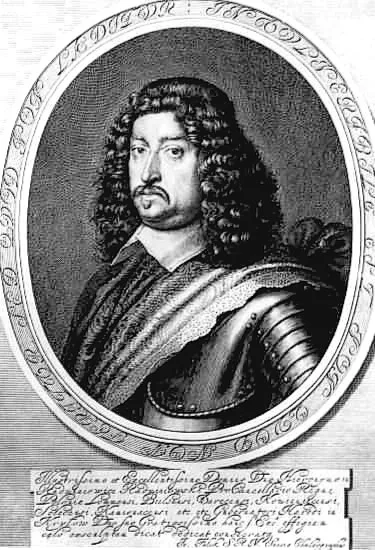
Engraver: Jeremiasz Falck · 1652 · Wikimedia Commons · Public domain
From court to exile
Hieronim Radziejowski (1612–1667) chaired the Sejm in 1645 and became Crown vice chancellor in 1650. Once close to the court, he fell into a political and legal dispute with John Casimir and fled the country in 1652. In Sweden he secured the protection of Queen Christina and links with Magnus de la Gardie. Exile made him an intermediary valuable to the Commonwealth's opponents1.
Before the invasion
While abroad he maintained contacts with Cossacks and magnate opposition groups. In 1654 he tried to encourage the new Swedish king to attack the Commonwealth. He later denied doing so, but a Swedish interrogation record cited by the Polish Biographical Dictionary reports his urging. He did not single-handedly cause the Deluge: Swedish decisions also reflected Baltic strategy and the Commonwealth's war with Muscovy1.
Ujście and Warsaw
At Ujście in July 1655 he helped negotiate the capitulation and urged Greater Poland nobles to accept Swedish protection, arguing that John Casimir endangered their liberties. He then entered Poznań with troops, exacted contributions and advised Swedish commanders. In September he mediated between Charles X Gustav and Warsaw's authorities. A southern campaign suited his advice, but historians point out that the plan arose without his direct participation12.
Later life, novel and film
His Swedish alliance broke down and the Swedes eventually imprisoned him. After the war he sought rehabilitation and resumed political activity, dying in 1667. Sienkiewicz included him as a historical figure in The Deluge; fictional dialogue should be kept separate from the records. The credited cast of Hoffman's film does not establish a separate Radziejowski role134.
Notes
- Hieronim Radziejowski, Warszawa: Polski Słownik Biograficzny / Instytut Historii PAN
- Katarzyna Wagner, „Potop” a wielka wojna północna w Warszawie w świetle rejestrów podatkowych – przyczynek do porównania dwóch szwedzkich okupacji, Saeculum Christianum, Warszawa: Uniwersytet Kardynała Stefana Wyszyńskiego, 2013, 109–119, p. 111
- Henryk Sienkiewicz, Potop, Fundacja Nowoczesna Polska (Wolne Lektury), 2009–2010
- Potop, Łódź: Państwowa Wyższa Szkoła Filmowa, Telewizyjna i Teatralna im. Leona Schillera w Łodzi (filmpolski.pl)
Explore further
Related
Related
- Capitulation at Ujście (1655) Documented
Sources for this page
- Hieronim Radziejowski, Warszawa: Polski Słownik Biograficzny / Instytut Historii PAN (Institution)
- Katarzyna Wagner, „Potop” a wielka wojna północna w Warszawie w świetle rejestrów podatkowych – przyczynek do porównania dwóch szwedzkich okupacji, Saeculum Christianum, Warszawa: Uniwersytet Kardynała Stefana Wyszyńskiego, 2013, 109–119 (Academic study)
- Henryk Sienkiewicz, Potop, Fundacja Nowoczesna Polska (Wolne Lektury), 2009–2010 (Primary source)
- Potop, Łódź: Państwowa Wyższa Szkoła Filmowa, Telewizyjna i Teatralna im. Leona Schillera w Łodzi (filmpolski.pl) (Reference work)