
AI illustration
Imagined 1970s film set; not a production photograph from The Deluge.
Film
The Deluge (1974): Jerzy Hoffman's film
DocumentedJerzy Hoffman's two-part adaptation of Sienkiewicz's novel: production, duels, costumes, music, comparison with the book and history, awards, restoration and "Potop Redivivus".
- Names and variants
- pl „Potop” (1974) – film Jerzego Hoffmana
Jerzy Hoffman's The Deluge (Potop) is a two-part adaptation of Henryk Sienkiewicz's novel1. Explore the film-makers, work on set, music and different edits, then compare the screen story with the book and historical evidence.
View all actors and film-makers → · Names grouped by role and contribution
Film-makers
The film was directed by Jerzy Hoffman. He wrote the screenplay together with Adam Kersten and Wojciech Żukrowski12. Kersten, the author of a study of the relationship between The Deluge and history3, was also the film's scholarly supervisor. The consultants included Jan Wimmer, among others1. The cinematographer was Jerzy Wójcik, the music was composed by Kazimierz Serocki, and the film was edited by Zenon Piórecki14. The production design was by Wojciech Krysztofiak and the costumes by Magdalena Tesławska1.
The leading roles were played by Daniel Olbrychski (Andrzej Kmicic) and Małgorzata Braunek (Oleńka Billewiczówna)14. The cast also included Tadeusz Łomnicki (Wołodyjowski), Kazimierz Wichniarz (Zagłoba) and Władysław Hańcza (Janusz Radziwiłł), among others1. Prior Kordecki was played by Stanisław Jasiukiewicz1.
Other performers include Ryszard Filipski (Soroka), Wiesław Gołas (Czarniecki) and Leon Niemczyk (Charles X Gustav)1. Cast and crew biographies also introduce the cinematography, sets, costumes, choreography and editing contributors.
Casting: returning roles, replacements and supporting actors
Hoffman explained that Łomnicki and Mieczysław Pawlikowski were to return as Wołodyjowski and Zagłoba. In his account, Pawlikowski withdrew after a heart attack; Kazimierz Wichniarz took the part5.
One screen family included real brothers: Lesław Janicki played Damian Kiemlicz and Wacław Janicki played Kosma6. Both also acted in Tadeusz Kantor’s Cricot 2 theatre7. Their individual profiles connect The Deluge with Kraków’s avant-garde and complement the biography of their screen father, Franciszek Pieczka.
The profiles explore different acting tasks: Wichniarz discusses make-up and simulated riding, Hańcza pride and tragedy in the hetman, and Teleszyński Bogusław’s human passions. Follow each role for the details and their sources.
Production
The film was produced by Przedsiębiorstwo Realizacji Filmów "Zespoły Filmowe" (the "Film Units" Film Production Enterprise) in co-operation with the Belarusfilm studio in Minsk and the Dovzhenko studio in Kyiv. The production manager was Wilhelm Hollender18. The film was shot in colour (Eastmancolor – Panavision); documentation lists 70 mm and 35 mm versions1. It was filmed at Jasna Góra, at Wawel, at Pieskowa Skała and in the Cistercian monastery at Wąchock, among other places, as well as in Ukraine and Belarus1. According to FINA (the National Film Archive – Audiovisual Institute), the film was more than five years in preparation, and shooting lasted 535 days4.
Making The Deluge
Hoffman was not the first director associated with the project. FINA’s archival commentary records a plan announced by Aleksander Ford in March 1965, with a screenplay being prepared with Wojciech Żukrowski. That project was not realised9.
Hoffman had known the Trilogy since childhood: he recalled his father sending him its volumes in Siberia in 1944. After Pan Wołodyjowski, he began work on The Deluge screenplay with Adam Kersten and Wojciech Żukrowski in July 19691011.
Logistics were a major difficulty. Hoffman recalled having only one camera and one lens for part of the shoot; preparing extras and pyrotechnics could take longer than filming a shot12. The crew waited for real snow for winter scenes. At Jasna Góra, they had to adapt the monastery's modern appearance to the film's seventeenth-century setting while protecting the historic site1314.
Casting provoked strong reactions before the premiere. Hoffman recalled numerous letters protesting against Olbrychski as Kmicic; Braunek said that any candidate for Oleńka would have had to contend with readers' expectations15. Their profiles explain the choices and the work behind the scenes: Olbrychski, Braunek and Hoffman. The National Film Archive exhibition also displays authentic production photographs; reuse of those images remains subject to the rights of the credited photographers and institution16.
Historical preparation and working without immediate playback
In his 2019 interview, Hoffman described preparing for the Trilogy by reading memoirs, particularly Pasek’s, and studying paintings, engravings and weapon collections to construct the characters’ material world17.
He also recalled the absence of immediate playback: exposed negatives went to a laboratory, followed by a wait for development. He could not immediately assess the result and repeat an unsuccessful take18. The credits identify the Łódź Feature Film Studio’s laboratory, managed by Marek Pawiński19.
Faulty lenses, responsibility and official approval
In his 2015 PAP interview, Hoffman recalled discarding Lauda return footage: a technical commission confirmed worn lenses were responsible, clearing Wójcik20.
He also described signing a document accepting artistic and financial responsibility after another director criticised the footage. He did not name that director21.
Hoffman recalled officials demanding a shorter unveiling of the Jasna Góra icon at the approval screening. He and Piórecki removed three frames; the next screening secured approval22.
Production challenges: scale, weather and risk
Costumes, props and transport
Culture.pl’s account reports 23,000 costumes, about 400 actors, and equipment transport to Belarus requiring 37 wagons. It identifies Elbląg’s Zamech as the manufacturer of the film’s cannons and Belarus as the location of sets representing Wołmontowicze, Wodokty and Lubicz23.
Staging the background
Waldemar Prokopowicz recalled daily work throughout more than two years of shooting and staging the background action. He also described organisation before mobile phones: calls between cities could require hours of waiting25. For a large crowd of extras, choosing the leading actors was only one task. Many people’s movements had to fit costumes, makeup, camera positions and shooting time. Read more about this function in Waldemar Prokopowicz’s profile.
Weather changes the schedule
Winter scenes required snow, while wide compositions made an entire landscape difficult to replace with a simple set. Rain in the duel was a planned effect, supplied by firefighters12. A limited number of cameras further slowed large sequences, as the director stressed in a later interview26.
Wołmontowicze: fire as image and hazard
Seweryn Kuśmierczyk analyses Kmicic’s revenge sequence: a burning torch reveals the dead companions and the hero’s face, while the attack on the village begins at sunset. The scholar links fire to growing revenge. He also cites Wójcik’s recollection that the set fire escalated rapidly, forcing crew, actors and extras to retreat27.
The literary revenge episode is in volume I, chapter V28. This comparison makes the conversion of prose into images concrete: a character’s decision needs a visible situation, lighting, movement and space. Read Kuśmierczyk’s analysis.
Historical consultation and the story
Kersten co-wrote the screenplay and supervised the historical consultation, but the film still adapted a novel21. The giant cannon illustrates the boundary: a historical question about weaponry met the dramatic requirement to stage Babinicz’s exploit.
Horses: preparation beyond the frame
In his 1975 account, Hoffman describes an initial plan to distinguish the horses of Swedish troops, hussars, light cavalry and Tatars. They were to become accustomed to formations, banners, fire and explosions. Budget limits reduced the plan: Andrzej Osadziński of Bogusławice could principally prepare the leading actors’ horses and organise riding instruction for actors and stunt performers. The director describes the gap between ambition and available resources29.
When conservation changes a film
Kersten recalled abandoning Wiśnicz because filming could interrupt the castle’s conservation. Boguszyce was rejected because of the risk to unconserved wall paintings. The final royal-letter scene was filmed at Wola Justowska, with the interior adapted for the scene30. Responsibility for historic buildings also shaped location choices. Krysztofiak’s profile explores the documentation used for the wooden settlements.
From footage to a completed film
Editing and sound have different contributors
Zenon Piórecki edited the original film. SFP’s documentation lists Stanisław Piotrowski and Jerzy Blaszyński for sound, and Maria Lasnowska, Mirosław Jakubowski and Jan Płażewski for makeup31. Each department had a different task: editing determines the order and duration of shots; sound work combines dialogue, effects and music; makeup contributes to character appearance during filming.
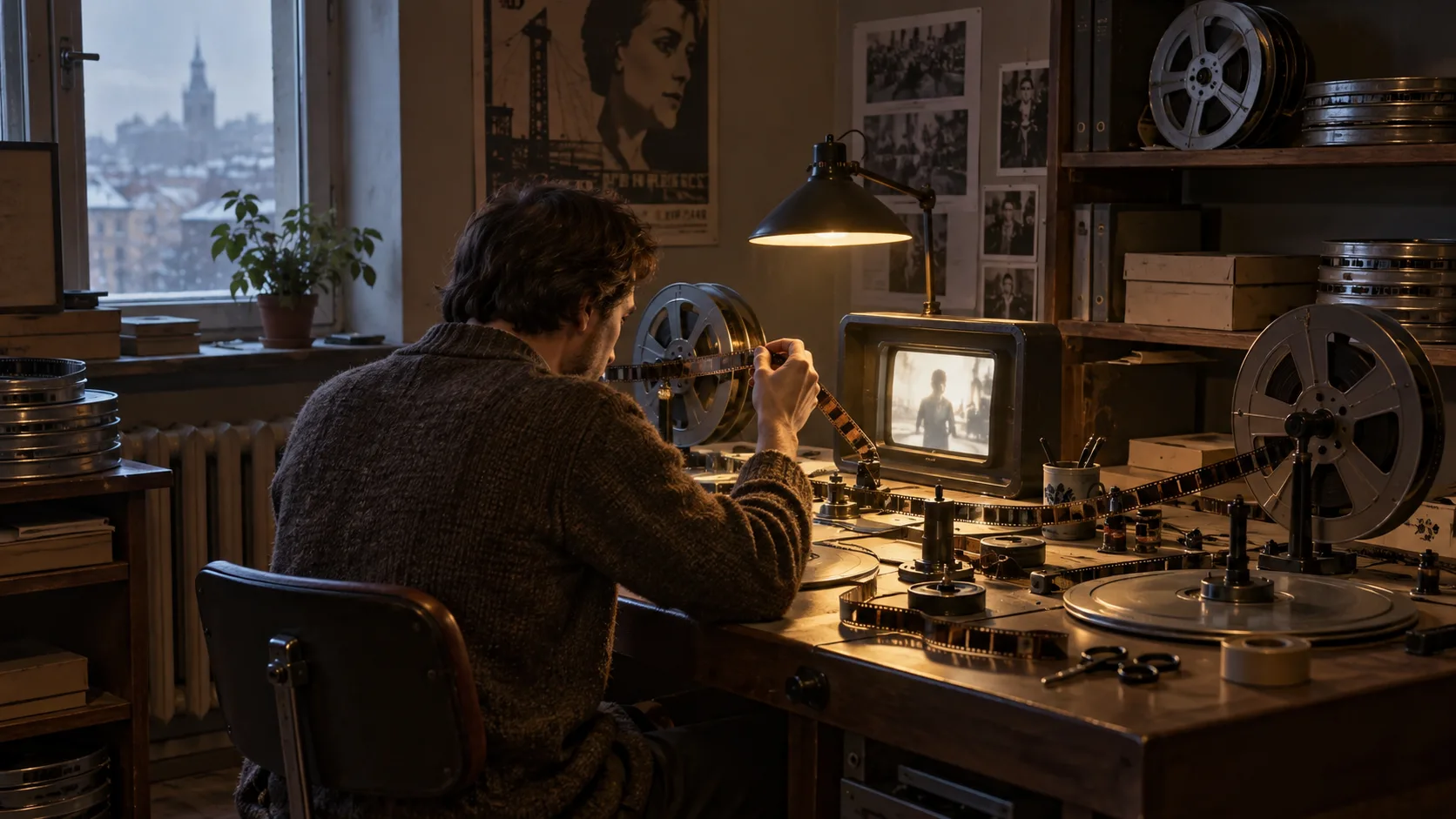
Completing Stanisław Jasiukiewicz’s performance also involved replacing his voice. Cast documentation credits Zygmunt Maciejewski with dubbing Kordecki32. The actor’s expanded profile examines Hoffman’s account and Fr Tomziński’s recollections.
Hoffman also reports eleven months of stereo sound work involving sound specialists and the editing room. Sound-effects performer Zygmunt Nowak supplied additional effects33. Finishing photography therefore did not finish the film.
Screenplay, novel and edit are successive selections
Hoffman recalled abandoning the Kanneberg duel, Michałek scene and Lubomirski strand during production34.
The novel also has its own rhythm for transmitting news and developing secondary characters. Assessing adaptation fidelity means asking both which events survive and who experiences or reports them. Similarity in the central plot does not by itself establish fidelity to the book’s entire structure.
Cinematography: movement, space and equipment
In a later interview Hoffman described rehearsing the actors’ movements before bringing in the camera, then adapting the photography to that staging. He recalled receiving a second camera only during production of The Deluge, which used Panavision lenses. He also linked long tracking shots to scarce equipment, as well as artistic choice26.
Distinguish filming locations from locations within the story. Wawel and Pieskowa Skała are documented production locations, but a list of sites alone does not establish which building appears in every scene set at a Radziwiłł residence1. Landscape also belongs to the film’s staging. When watching, consider how open country, a palace interior and monastery fortifications change what the characters can do.
Duels: actors and fight choreography
Waldemar Wilhelm staged the fights. He recalled having to change Łomnicki’s sporting habits and make the movements serve safety and drama. The duel with Olbrychski required two months of practice. For close-ups in the mounted duel with Bogusław, Wilhelm said that he and Hoffman replaced the horses by carrying the actors on their shoulders35.
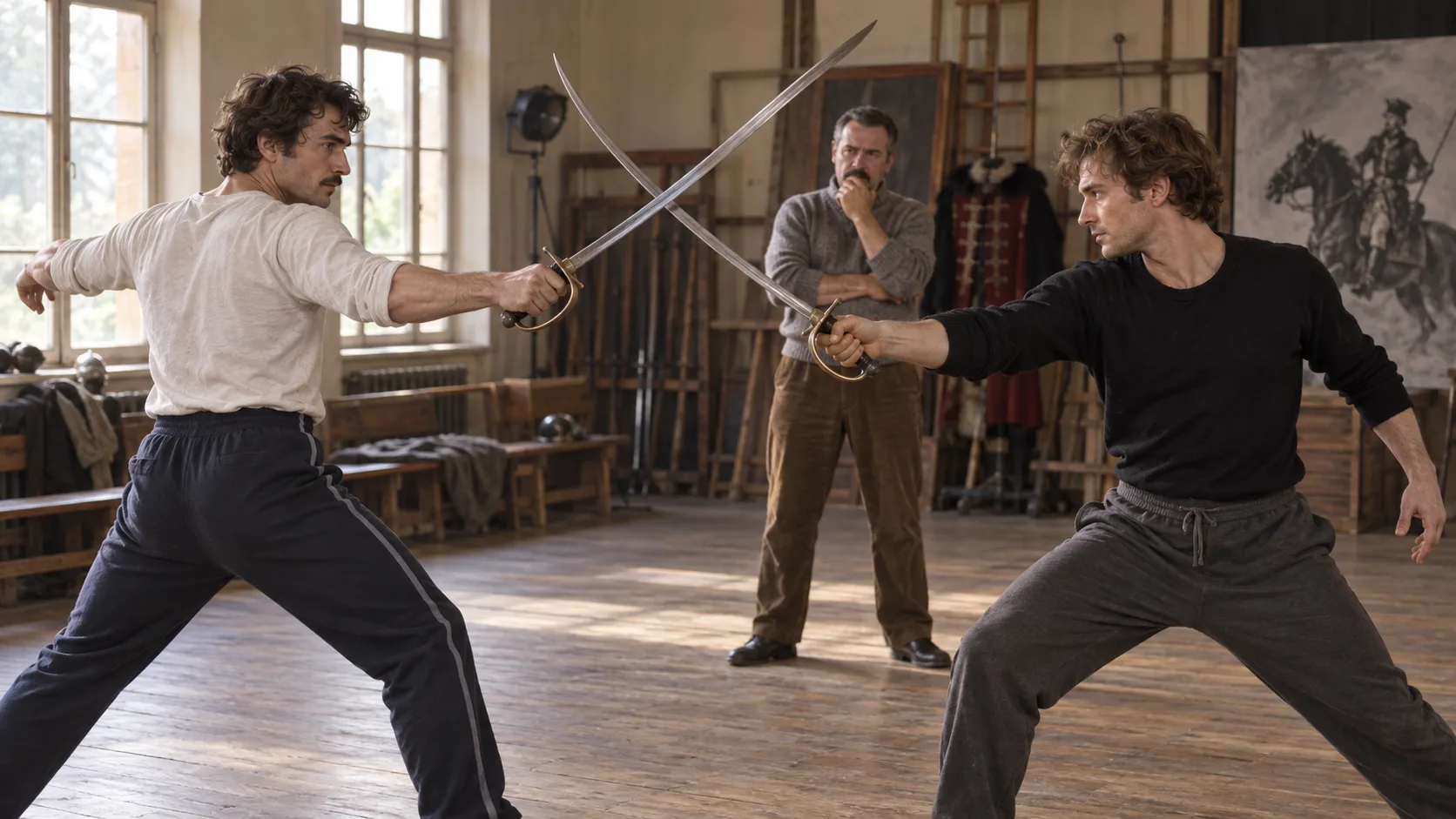
Hoffman recalled a week of filming for the Kmicic–Wołodyjowski duel, with fire engines supplying the rain36. The rain is a departure from the novel, highlighted in Adapter’s description of Seweryn Kuśmierczyk’s scene analysis37. The literary scene is in volume I, chapter VII38. This offers a useful adaptation comparison: the film retains the essential conflict and outcome while giving the encounter its own visual conditions.
Costumes and the giant cannon
Magdalena Tesławska recalled a distinction between Kėdainiai, where Polish clothing was contrasted with foreign officers’ dress, and Taurogi, associated with Parisian fashion. Costume helped characterise the two Radziwiłł environments39.
Jerzy Szeski, whose work included weaponry, described consulting artillery historian Tadeusz Nowak. They considered the enormous cannon historically problematic; the prop was designed to convey the dramatic force of Sienkiewicz’s description40. The film’s cannon consequently cannot establish what artillery was actually present at the siege.
Workshops: building the look of the seventeenth century
Oleksiewicz’s report describes mass-produced polystyrene armour made in Łódź. Jerzy Szeski also explains that film muskets used electrical ignition to produce flash and smoke. Old drawings inspired the banners, but he did not copy them literally; they were painted on silk from Milanówek. He names makers including Ryszard Jachna and Lech Leski, stressing the work of craftspeople absent from the opening credits41.
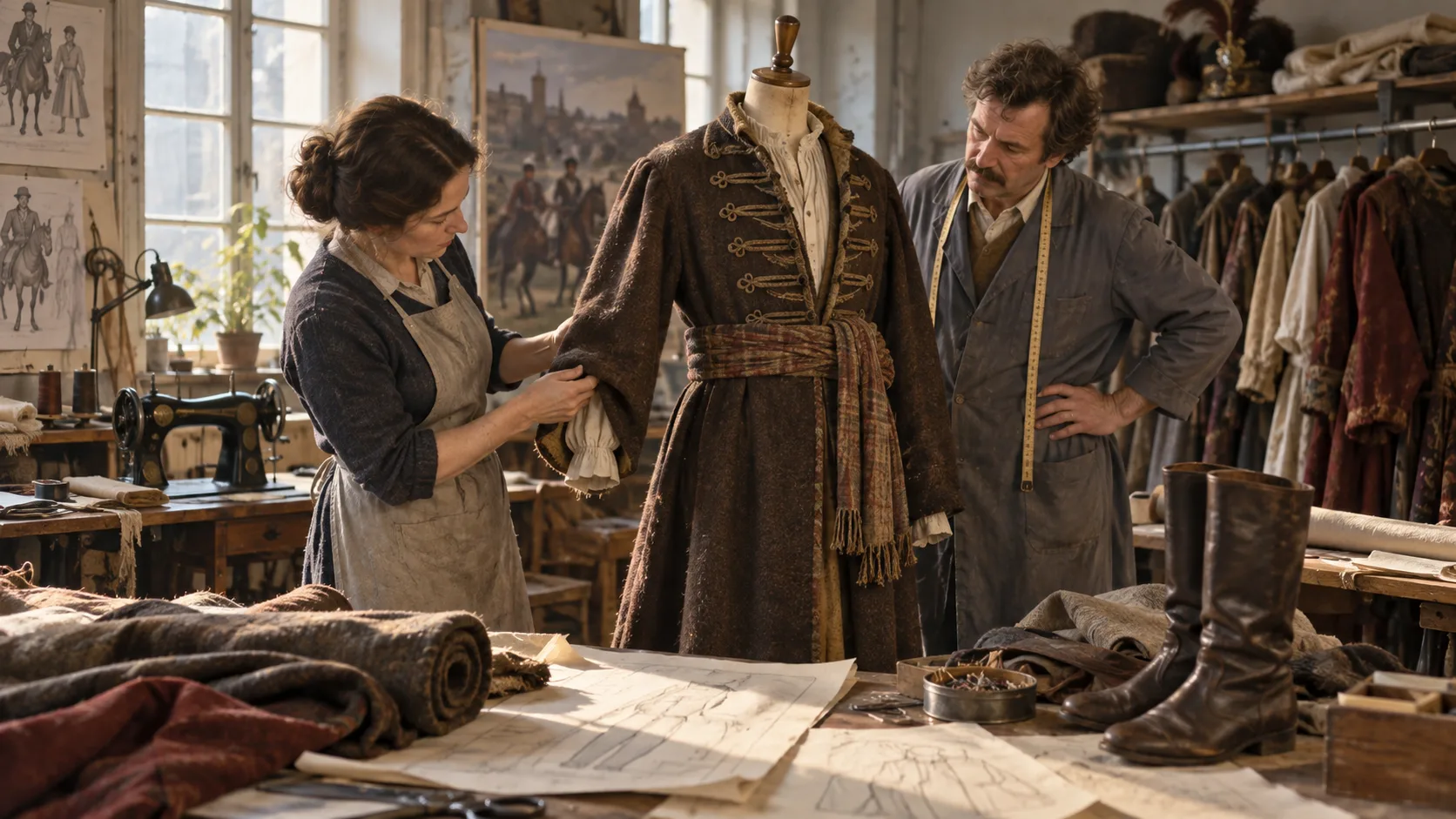
Tesławska recalled collecting visual documentation and researching museum collections. Kersten initially criticised costumes for being too clean; the designer questioned whether Eastmancolor made them look prettier42. The costume designer’s profile explores this work further.
Kazimierz Serocki’s music
POLMIC’s analysis identifies recurring musical associations in Kazimierz Serocki’s score: the Lutheran chorale A Mighty Fortress Is Our God with the Swedes, Oj wyjdę ja in the spinning scene and Bogurodzica at Jasna Góra43. The music performers were the Great Symphony Orchestra of Polish Radio and Television in Katowice and the National Philharmonic’s choir and instrumental ensemble in Warsaw. The credits name Stanisław Wisłocki and Arnold Rezler as their respective conductors, and Piotr Marczewski as music consultant44.
What does the adaptation select from the novel?
The book gives its narrator room for commentary, lengthy conversations and events outside Kmicic’s immediate experience. For example, the capitulation at Ujście reaches the characters through Stanisław Skrzetuski’s account, while Anusia Borzobohata brings news of the Tyszowce Confederation4546. Comparing adaptations therefore also means comparing how information travels: through action, dialogue, a reported message or an omission.
Aleksandra Sekuła interprets the film as concentrating on Kmicic and his transformation. She identifies a less pronounced division by religious affiliation than in the novel and a more modern psychology of the characters47.
The novel supplies a useful route through the main character’s development: the oath to Radziwiłł in volume I, chapter XIII; Babinicz’s action at Jasna Góra in volume II, chapter XVII; revealing his identity to the king in volume II, chapter XXVI; and the public restoration of his honour in the final chapter of volume III48495051.
Film, novel and history: key distinctions
This comparison draws on the novel, archival descriptions of the film and historical studies. Film plot information follows FINA’s description; the table does not catalogue every difference between film edits52.
| Theme | Novel and adaptation | What does historical evidence establish? |
|---|---|---|
| Andrzej Kmicic | The story leads from private violence to royal service and the recovery of a good name.53 | The Polish Biographical Dictionary identifies Samuel Kmicic as a prototype; Andrzej’s adventures are not thereby Samuel’s biography.54 |
| Kėdainiai | The literary banquet and oath connect a political choice to Kmicic’s personal dilemma.48 | There were distinct agreements in August and October; the process cannot be reduced to a single banquet.5556 |
| Destruction of the cannon | Babinicz blows it up, an episode in both the book and the film description.4952 | Kordecki describes a heavy cannon bursting; Kubala repeats that account. These passages do not credit the fictional Babinicz.5758 |
| Prior Kordecki | He belongs to the story of the monastery’s defence.5952 | Kersten’s analysis includes resistance, negotiations and the monastery’s earlier recognition of Swedish protection.60 |
| Duel with Wołodyjowski | A literary scene acquires screen choreography and rain.3837 | Its source is the fictional plot. Historically plausible weapons do not establish that these characters fought such a duel. |
| Ending | Restored honour and reunion with Oleńka close Kmicic’s story.5152 | The war with Sweden ended with the Treaty of Oliwa on 3 May 1660.61 |
Scroll the table sideways to read all columns.
Kėdainiai: the wider political setting
The agreement announced on 18 August 1655 was dated 17 August; a second agreement followed on 20 October. Henryk Wisner examined the original August document and corrected its list of signatories55. The context also included the Lithuanian army’s defeat and Moscow’s capture of Vilnius62. Assessing Janusz Radziwiłł’s conduct therefore requires questions about military threats, the agreements’ terms and opposition within the army. The literary scene illuminates Kmicic’s conflict of loyalties; the Kėdainiai article follows the political sequence in detail.
Jasna Góra: resistance and diplomacy
Adam Kersten stresses the monastery’s earlier recognition of Swedish protection and its subsequent diplomacy. He also questions how Kordecki presented the siege in Nova Gigantomachia60. The cannon, letters, negotiations and Babinicz’s literary role are examined further in Jasna Góra: history, novel and film.
The final battle as a combination of events
Lubelski interprets the final clash as combining Warka and Prostki for dramatic purposes63. The historical events have separate accounts: Warka and Prostki. Screen action does not replace their chronology.
The story ends; the war continues
The hero’s return and reconciliation with Oleńka give the story closure without dating the conflict’s end. Follow the remaining history through the war overview, the Treaty of Oliwa and the consequences of the invasion.
Release and versions
The first part opened in cinemas on 2 September 1974, the second on 10 October 197414.
Foreign distribution: a shorter East German version
DEFA’s catalogue records Potop as Sintflut, released in East Germany on 19 December 1975 with a running time of 160 minutes. The record specifies a 70 mm print and DEFA-Studio für Synchronisation64. This running time belongs to the distribution version described there. It does not replace the Polish film’s duration and should not be confused with the later Potop Redivivus. The catalogue does not explain who decided on individual cuts.
Before Hoffman: silent adaptations
Oleksiewicz recounts Edward Puchalski’s unfinished 1913 project, begun with Sienkiewicz’s permission. Aleksander Zelwerowicz played Zagłoba and Stefan Jaracz played Wołodyjowski. Khanzhonkov’s studio bought the footage. A new production was entrusted to Pyotr Chardynin, with Ivan Mozzhukhin as Kmicic. The two-part Russian film premiered on 14 April 191565. The characters’ screen history therefore predates Hoffman by decades.
A chronology of production and later versions
- July 1969:Hoffman, Kersten and Żukrowski began their screenplay work, according to the director’s account.66
- 2 September 1974:first-part premiere.1
- 10 October 1974:second-part premiere.1
- 8 April 1975:Academy Awards ceremony; the film was nominated for Foreign Language Film.67
- 2010:4K digitisation of materials, preceding the complete restoration.8
- 25–26 December 2013:TVN broadcast the restored film.8
- 15 September 2014:Redivivus premiere date in FINA’s record.8
Awards and reception
At the Festival of Polish Feature Films in Gdańsk in 1974 The Deluge received the Grand Prize, „Złote Lwy Gdańskie” ("Golden Lions of Gdańsk"), the Best Actor award for Daniel Olbrychski and the Audience Award14. The film was nominated for the Academy Award for Best Foreign Language Film67; the awards were presented at the 47th ceremony on 8 April 1975. The winner in that category was the Italian Amarcord67.
FINA reports a cinema audience exceeding 27 million. This is an attendance figure, rather than a verified count of distinct individuals, and places the film among Polish cinema’s greatest audience successes4. The festival organiser confirms that its first edition was held in Gdańsk, with competition screenings in Sopot cinemas68. In a 1999 poll by the weekly Polityka for the most interesting Polish films of the twentieth century it came fifth1. The description of the film in the filmpolski.pl database says that Hoffman adapted the novel „w duchu tradycyjnej interpretacji dzieła »ku pokrzepieniu serc«” ("in the spirit of the traditional 'to fortify hearts' interpretation of the work"), with the emphasis on Kmicic's transformation1. On the origin of this formula see Henryk Sienkiewicz.
Critical reception was not unanimous. Iwona Kurz contrasts Krzysztof Teodor Toeplitz’s emphasis on cinematic merit with Krzysztof Tatarkiewicz’s criticism of the community’s conservative and devotional portrayal69.
Reconstruction and Potop Redivivus
In 2010, as part of the National Film Archive's Digital Repository project and with the participation of TVN, both parts of the film were digitised at 4K resolution from the original camera negative and the interpositive8. The full digital reconstruction was carried out by Magyar Filmlabor of Budapest and Studio Produkcyjne ORKA of Warsaw. The colour grading was done by Aleksander Winecki under the direction of Jerzy Wójcik8. The reconstructed version was broadcast by the TVN television channel on 25 and 26 December 20138.
On this basis a new, shortened version, Potop Redivivus, was made. It was edited by Marcin Kot Bastkowski under the artistic supervision of Jerzy Hoffman and Jerzy Wójcik81. FINA's Repository gives its premiere date as 15 September 20148.
Restoration recovered the original film’s image and sound. Redivivus followed, rearranging and shortening that material into a separate version8.
What specifically changed in 2014?
Bastkowski told PAP that Braun’s strand was reduced and his death removed; Bogusław’s dance with Oleńka was shortened, while his assault remained. Kmicic’s meeting with Wołodyjowski was initially cut, then restored for their friendship. Editing took five months71.
In his Film Archive account, Marcin Kot Bastkowski explains the difficulty of shortening long dialogue takes: music and dialogue shared his working soundtrack. He also shortened troop marches, the cannon’s installation and Kmicic’s mounted display72. PAP also describes the digitisation of separate sound materials held by the archive71.
Compare history, novel and film
Expand a subject to distinguish historical testimony, the novel’s plot and the screen adaptation.
Jasna Góra and the Swedish cannon
History. Kordecki describes a large cannon bursting; Kubala includes that episode in his siege account. Neither passage documents an exploit by Kmicic.5758
Novel. Sienkiewicz makes Babinicz, Kmicic’s assumed identity, responsible for blowing up the cannon. His mission and subsequent captivity belong to the fictional plot.73
Film. FINA’s synopsis of Potop Redivivus also has Kmicic destroy the cannon. It confirms the episode in the version described, but does not establish the length of those scenes in the complete film.8
Read the Jasna Góra comparison for the evidence and differences between sources.
Kmicic: historical soldier, fictional hero, screen role
History. The biography of Samuel Kmicic describes a real soldier. It is not a biography of Andrzej and does not verify all his fictional adventures.54
Novel. Andrzej Kmicic has the name and life Sienkiewicz gives him. His relationship with Oleńka and service as Babinicz shape the story of a damaged reputation and its recovery.74
Film. Daniel Olbrychski plays Kmicic. FINA describes the hero’s transformation as the film’s central story. The actor’s appearance, gestures and screen scenes form part of the cinematic interpretation.14
Watching and reading together
This suggested reading route follows four scenes. Chapter numbers refer to Wolne Lektury’s three-volume text, not the six-volume first edition or the film’s two-part division53.
- The duel: volume I, chapter VII. Compare how the narrator describes Wołodyjowski’s superiority with how images and movement can demonstrate it. Consider the weather and the scene’s pace.3837
- The banquet and oath: volume I, chapter XIII. Separate what Kmicic knows before the announcement from what he learns afterwards. Then check the historical dates of the agreements.4855
- The cannon: volume II, chapter XVII. Set Babinicz’s literary exploit beside Kordecki’s account of a cannon bursting. Ask what crediting the hero with this success contributes to his transformation.4957
- The royal letter: volume III, chapter XXX. Observe who learns of the hero’s services and how this changes the public judgement of his earlier actions.51
Archives, documentary and further resources
- Original production photographs and participants’ accounts: the National Film Archive exhibition on Google Arts & Culture brings together production materials and recollections from different crew members.16
- Full film credits: the Akademia Polskiego Filmu record lists cast and crew, a useful starting point for checking names.2
- Duel analysis: Adapter’s resource has commentary by Seweryn Kuśmierczyk; the page lists captions, audio description and Polish Sign Language.37
- A documentary about the production: Łukasz Czajka’s Potop. Postscriptum, co-produced by FINA. The institution announced its gala premiere at Warsaw’s Kino Kultura for 12 April 2024.75
- The 2024 anniversary: the 49th Polish Film Festival catalogue lists The Deluge: Postscriptum as a 54-minute documentary from 2024. Its screening was scheduled for 24 September at the Musical Theatre’s Chamber Stage, with Redivivus also in that day’s GCF programme.76
- Official viewing links: FINA’s Ninateka announcement links both original parts and Redivivus. Links in the announcement were checked on 28 September 2026; consult the service for playback conditions.77
- The book for comparison: the complete Polish text on Wolne Lektury and our guide to the novel.53
How this page uses its sources
Dates, credits and version details come from film records. Production stories are attributed to the people who took part, and film analyses to the researchers who wrote them. Comparisons with the book use Sienkiewicz’s text; the historical sections draw on Kordecki’s account and historians’ studies. Where catalogues disagree on figures, we give both figures with their sources.
Notes
- Potop, Łódź: Państwowa Wyższa Szkoła Filmowa, Telewizyjna i Teatralna im. Leona Schillera w Łodzi (filmpolski.pl)
- Potop, reż. Jerzy Hoffman, Akademia Polskiego Filmu / FINA
- Adam Kersten, Sienkiewicz – „Potop” – historia, Warszawa: Państwowy Instytut Wydawniczy, 1966
- Stefan Głowacki, Potop, Lista Polskiego Dziedzictwa Filmowego, Warszawa: Filmoteka Narodowa – Instytut Audiowizualny
- Maria Oleksiewicz, 535 dni Potopu, część VI, Filmoteka Narodowa – Instytut Audiowizualny, 1975, casting
- Potop, reż. Jerzy Hoffman, Akademia Polskiego Filmu / FINA, cast
- Druga Grupa – To co mieliśmy zrobić, tośmy zrobili, Ośrodek Dokumentacji Sztuki Tadeusza Kantora Cricoteka, 2017, biographies
- Potop Redivivus, Repozytorium Cyfrowe Filmoteki Narodowej, Warszawa: Filmoteka Narodowa – Instytut Audiowizualny
- Potop (1974), Filmoteka Narodowa – Instytut Audiowizualny, Konrad J. Zarębski’s commentary
- Anna Bielak, „Potop jest jak panoramiczne płótno”. Rozmowa z Jerzym Hoffmanem, Magazyn Filmowy, Warszawa: Stowarzyszenie Filmowców Polskich, 2014, 40–43, p. 42
- Potop / Potop Redivivus, Warszawa: Filmoteka Narodowa / Google Arts & Culture, 2014, Hoffman's account
- Anna Bielak, „Potop jest jak panoramiczne płótno”. Rozmowa z Jerzym Hoffmanem, Magazyn Filmowy, Warszawa: Stowarzyszenie Filmowców Polskich, 2014, 40–43, pp. 42–43
- Potop / Potop Redivivus, Warszawa: Filmoteka Narodowa / Google Arts & Culture, 2014, winter filming
- Anna Wyszyńska, „Potop” na Jasnej Górze, Niedziela, Częstochowa: Niedziela, 2005, filming at Jasna Góra
- Potop / Potop Redivivus, Warszawa: Filmoteka Narodowa / Google Arts & Culture, 2014, Hoffman and Braunek's accounts
- Potop / Potop Redivivus, Warszawa: Filmoteka Narodowa / Google Arts & Culture, 2014
- Jerzy Hoffman. Dzisiejszemu widzowi nie trzeba podawać wszystkiego na talerzu, Fundacja Legalna Kultura, 2019, passage on documentary experience
- Jerzy Hoffman. Dzisiejszemu widzowi nie trzeba podawać wszystkiego na talerzu, Fundacja Legalna Kultura, 2019, passage on shooting conditions
- Potop, Łódź: Państwowa Wyższa Szkoła Filmowa, Telewizyjna i Teatralna im. Leona Schillera w Łodzi (filmpolski.pl), laboratory
- Joanna Poros, Jerzy Hoffman: nie żegnam się z kinem, Polska Agencja Prasowa / dzieje.pl, 2015, passage on equipment
- Joanna Poros, Jerzy Hoffman: nie żegnam się z kinem, Polska Agencja Prasowa / dzieje.pl, 2015, passage on responsibility
- Joanna Poros, Jerzy Hoffman: nie żegnam się z kinem, Polska Agencja Prasowa / dzieje.pl, 2015, passage on official approval
- Wszystko, czego nie wiedzieliście o „Potopie”, Instytut Adama Mickiewicza / Culture.pl, production figures
- Iwona Kurz, Wspólnota obrazów. Sienkiewicz na ekranie, Wydawnictwo IBL PAN, 2019, 271–302, p. 294
- Andrzej Bukowiecki, Swoich nie znacie: Waldemar Prokopowicz, Magazyn Filmowy, Warszawa: Stowarzyszenie Filmowców Polskich, 2014, 66–68, pp. 66–68
- Nie miałem czasu się nudzić. Rozmowa z Jerzym Hoffmanem, Stowarzyszenie Filmowców Polskich, 2017, 8–13, p. 11
- Seweryn Kuśmierczyk, Potop. Analiza sceny zemsty Kmicica, Edukacja Spojrzenia, 1–2, pp. 1–2
- Henryk Sienkiewicz, Potop, Fundacja Nowoczesna Polska (Wolne Lektury), 2009–2010, vol. I, ch. V
- Maria Oleksiewicz, 535 dni Potopu, część V, Filmoteka Narodowa – Instytut Audiowizualny, 1975, Szukamy koni
- Maria Oleksiewicz, 535 dni Potopu, część IV, Filmoteka Narodowa – Instytut Audiowizualny, 1975, Kościoły i płoty
- Potop (1974): obsada i ekipa, Stowarzyszenie Filmowców Polskich, 1974
- Potop, Łódź: Państwowa Wyższa Szkoła Filmowa, Telewizyjna i Teatralna im. Leona Schillera w Łodzi (filmpolski.pl), cast and dubbing
- Maria Oleksiewicz; wypowiedź Jerzego Hoffmana, 535 dni Potopu, część VII: A więc już po zdjęciach…, Filmoteka Narodowa – Instytut Audiowizualny, 1975, “Pieśni i armatnie strzały”
- Maria Oleksiewicz; wypowiedź Jerzego Hoffmana, 535 dni Potopu, część VII: A więc już po zdjęciach…, Filmoteka Narodowa – Instytut Audiowizualny, 1975, “Znów w Związku Radzieckim”
- Mieczysław Kuźmicki, Waldemar Wilhelm: szable w dłoń!, Stowarzyszenie Filmowców Polskich, 2015, 76–77, pp. 76–77
- Anna Bielak, „Potop jest jak panoramiczne płótno”. Rozmowa z Jerzym Hoffmanem, Magazyn Filmowy, Warszawa: Stowarzyszenie Filmowców Polskich, 2014, 40–43, p. 43
- Potop – Analiza sceny pojedynku, Fundacja Katarynka / Adapter
- Henryk Sienkiewicz, Potop, Fundacja Nowoczesna Polska (Wolne Lektury), 2009–2010, vol. I, ch. VII
- Potop / Potop Redivivus, Warszawa: Filmoteka Narodowa / Google Arts & Culture, 2014, Magdalena Tesławska’s recollection
- Potop / Potop Redivivus, Warszawa: Filmoteka Narodowa / Google Arts & Culture, 2014, Jerzy Szeski’s recollection
- Maria Oleksiewicz, 535 dni Potopu, część X, Filmoteka Narodowa – Instytut Audiowizualny, 1975, workshops and banners
- Maria Oleksiewicz, 535 dni Potopu, część XII, Filmoteka Narodowa – Instytut Audiowizualny, 1975, Tesławska’s testimony
- O muzyce filmowej Kazimierza Serockiego, Warszawa: Polskie Centrum Informacji Muzycznej POLMIC
- Potop, Łódź: Państwowa Wyższa Szkoła Filmowa, Telewizyjna i Teatralna im. Leona Schillera w Łodzi (filmpolski.pl), music performers, conductors and consultation
- Henryk Sienkiewicz, Potop, Fundacja Nowoczesna Polska (Wolne Lektury), 2009–2010, vol. I, ch. XI
- Henryk Sienkiewicz, Potop, Fundacja Nowoczesna Polska (Wolne Lektury), 2009–2010, vol. III, ch. XX
- Aleksandra Sekuła, Chłop Kmicicem. Zmiana wyobrażeń tożsamościowych (1960–1999 i dalej), Instytut Badań Literackich PAN, 2014, 299–312, p. 307
- Henryk Sienkiewicz, Potop, Fundacja Nowoczesna Polska (Wolne Lektury), 2009–2010, vol. I, ch. XIII
- Henryk Sienkiewicz, Potop, Fundacja Nowoczesna Polska (Wolne Lektury), 2009–2010, vol. II, ch. XVII
- Henryk Sienkiewicz, Potop, Fundacja Nowoczesna Polska (Wolne Lektury), 2009–2010, vol. II, ch. XXVI
- Henryk Sienkiewicz, Potop, Fundacja Nowoczesna Polska (Wolne Lektury), 2009–2010, vol. III, ch. XXX
- Potop (1974), Filmoteka Narodowa – Instytut Audiowizualny
- Henryk Sienkiewicz, Potop, Fundacja Nowoczesna Polska (Wolne Lektury), 2009–2010
- Tadeusz Wasilewski, Kmicic Samuel h. Radzic odm. (zm. 1692), Polski słownik biograficzny, t. 13, Wrocław–Warszawa–Kraków: Zakład Narodowy im. Ossolińskich – Wydawnictwo Polskiej Akademii Nauk, 1967–1968
- Rok 1655 na Litwie, Odrodzenie i Reformacja w Polsce / Instytut Historii PAN
- Układ w Kiejdanach, Kalendarium, Warszawa: Muzeum Historii Polski w Warszawie
- Augustyn Kordecki; przeł. Józef Łepkowski, (Nowa Gigantomachia): pamiętnik oblężenia Częstochowy roku 1655, Warszawa: S. Orgelbrand, 1858, p. 97
- Ludwik Kubala, Wojna szwecka w roku 1655 i 1656, Szkice historyczne, serya IV (Biblioteka Historyczna Altenberga), Lwów; Warszawa: H. Altenberg, G. Seyfarth, E. Wende i Sp.; E. Wende i Sp., 1913, p. 178
- Henryk Sienkiewicz, Potop, Fundacja Nowoczesna Polska (Wolne Lektury), 2009–2010, vol. II, ch. XII–XIX
- Adam Kersten, Kordecki Klemens, imię zakonne Augustyn (1603–1673), Polski słownik biograficzny, t. 14, Wrocław: Zakład Narodowy im. Ossolińskich, 1968–1969, s. 53–55
- Ludwik Kubala, Wojny duńskie i pokój oliwski 1657–1660, Szkice historyczne, serja VI (Biblioteka Historyczna Altenberga), Lwów: Księgarnia Wydawnicza H. Altenberga, 1922, pp. 327–330
- Ludwik Kubala, Wojna szwecka w roku 1655 i 1656, Szkice historyczne, serya IV (Biblioteka Historyczna Altenberga), Lwów; Warszawa: H. Altenberg, G. Seyfarth, E. Wende i Sp.; E. Wende i Sp., 1913, pp. 86–90
- Tadeusz Lubelski; cytowany w komunikacie SFP, Potop w Gdyni: przytoczenie Historii kina polskiego Tadeusza Lubelskiego, Stowarzyszenie Filmowców Polskich, 2014
- POTOP / Sintflut, DEFA-Stiftung
- Maria Oleksiewicz, 535 dni Potopu, część I, Filmoteka Narodowa – Instytut Audiowizualny, 1975, W starym iluzjonie
- Potop / Potop Redivivus, Warszawa: Filmoteka Narodowa / Google Arts & Culture, 2014, Hoffman’s recollection
- The 47th Academy Awards | 1975, Oscars.org, Academy of Motion Picture Arts and Sciences
- Historia Festiwalu Polskich Filmów Fabularnych w Gdyni, Festiwal Polskich Filmów Fabularnych
- Iwona Kurz, Wspólnota obrazów. Sienkiewicz na ekranie, Wydawnictwo IBL PAN, 2019, 271–302, pp. 274–275
- Filmy 49. Festiwalu Polskich Filmów Fabularnych, Festiwal Polskich Filmów Fabularnych w Gdyni, 2024, 61–62, p. 61
- Montażysta o skracaniu „Potopu”: zmiany w wątkach Bogusława i Brauna, Polska Agencja Prasowa / dzieje.pl, 2014
- Jerzy Hoffman; Marcin Kot Bastkowski, „Potop Redivivus”, czyli „Potop odrodzony”, Filmoteka Narodowa – Instytut Audiowizualny, 2014
- Henryk Sienkiewicz, Potop, Fundacja Nowoczesna Polska (Wolne Lektury), 2009–2010, vol. II, chapters XVII–XVIII
- Henryk Sienkiewicz, Potop, Fundacja Nowoczesna Polska (Wolne Lektury), 2009–2010, vol. I, chapters V–VII; vol. II, chapter XXVI; vol. III, chapter XXX
- „Potop. Postscriptum” – nowa koprodukcja FINA, Filmoteka Narodowa – Instytut Audiowizualny, 2024
- Filmy 49. Festiwalu Polskich Filmów Fabularnych, Festiwal Polskich Filmów Fabularnych w Gdyni, 2024, 61–62, pp. 61–62
- „Potop” na stałe na Ninatece! | Lista Polskiego Dziedzictwa Filmowego, Filmoteka Narodowa – Instytut Audiowizualny, 2026
Explore further
History
Related
Related
- The Deluge: the novel ekranizacja powieści Documented
- Adam Kersten Historical figure
Sources for this page
- Potop, Łódź: Państwowa Wyższa Szkoła Filmowa, Telewizyjna i Teatralna im. Leona Schillera w Łodzi (filmpolski.pl) (Reference work)
- Potop, reż. Jerzy Hoffman, Akademia Polskiego Filmu / FINA (Institution)
- Adam Kersten, Sienkiewicz – „Potop” – historia, Warszawa: Państwowy Instytut Wydawniczy, 1966 (Academic study)
- Stefan Głowacki, Potop, Lista Polskiego Dziedzictwa Filmowego, Warszawa: Filmoteka Narodowa – Instytut Audiowizualny (Institution)
- Maria Oleksiewicz, 535 dni Potopu, część VI, Filmoteka Narodowa – Instytut Audiowizualny, 1975 (Primary source)
- Druga Grupa – To co mieliśmy zrobić, tośmy zrobili, Ośrodek Dokumentacji Sztuki Tadeusza Kantora Cricoteka, 2017 (Academic study)
- Potop Redivivus, Repozytorium Cyfrowe Filmoteki Narodowej, Warszawa: Filmoteka Narodowa – Instytut Audiowizualny (Institution)
- Potop (1974), Filmoteka Narodowa – Instytut Audiowizualny (Institution)
- Anna Bielak, „Potop jest jak panoramiczne płótno”. Rozmowa z Jerzym Hoffmanem, Magazyn Filmowy, Warszawa: Stowarzyszenie Filmowców Polskich, 2014, 40–43 (Primary source)
- Potop / Potop Redivivus, Warszawa: Filmoteka Narodowa / Google Arts & Culture, 2014 (Academic study)
- Anna Wyszyńska, „Potop” na Jasnej Górze, Niedziela, Częstochowa: Niedziela, 2005 (Academic study)
- Jerzy Hoffman. Dzisiejszemu widzowi nie trzeba podawać wszystkiego na talerzu, Fundacja Legalna Kultura, 2019 (Primary source)
- Joanna Poros, Jerzy Hoffman: nie żegnam się z kinem, Polska Agencja Prasowa / dzieje.pl, 2015 (Primary source)
- Wszystko, czego nie wiedzieliście o „Potopie”, Instytut Adama Mickiewicza / Culture.pl (Institution)
- Iwona Kurz, Wspólnota obrazów. Sienkiewicz na ekranie, Wydawnictwo IBL PAN, 2019, 271–302 (Academic study)
- Andrzej Bukowiecki, Swoich nie znacie: Waldemar Prokopowicz, Magazyn Filmowy, Warszawa: Stowarzyszenie Filmowców Polskich, 2014, 66–68 (Primary source)
- Nie miałem czasu się nudzić. Rozmowa z Jerzym Hoffmanem, Stowarzyszenie Filmowców Polskich, 2017, 8–13 (Primary source)
- Seweryn Kuśmierczyk, Potop. Analiza sceny zemsty Kmicica, Edukacja Spojrzenia, 1–2 (Academic study)
- Henryk Sienkiewicz, Potop, Fundacja Nowoczesna Polska (Wolne Lektury), 2009–2010 (Primary source)
- Maria Oleksiewicz, 535 dni Potopu, część V, Filmoteka Narodowa – Instytut Audiowizualny, 1975 (Primary source)
- Maria Oleksiewicz, 535 dni Potopu, część IV, Filmoteka Narodowa – Instytut Audiowizualny, 1975 (Primary source)
- Potop (1974): obsada i ekipa, Stowarzyszenie Filmowców Polskich, 1974 (Institution)
- Maria Oleksiewicz; wypowiedź Jerzego Hoffmana, 535 dni Potopu, część VII: A więc już po zdjęciach…, Filmoteka Narodowa – Instytut Audiowizualny, 1975 (Primary source)
- Mieczysław Kuźmicki, Waldemar Wilhelm: szable w dłoń!, Stowarzyszenie Filmowców Polskich, 2015, 76–77 (Primary source)
- Potop – Analiza sceny pojedynku, Fundacja Katarynka / Adapter (Institution)
- Maria Oleksiewicz, 535 dni Potopu, część X, Filmoteka Narodowa – Instytut Audiowizualny, 1975 (Primary source)
- Maria Oleksiewicz, 535 dni Potopu, część XII, Filmoteka Narodowa – Instytut Audiowizualny, 1975 (Primary source)
- O muzyce filmowej Kazimierza Serockiego, Warszawa: Polskie Centrum Informacji Muzycznej POLMIC (Academic study)
- Aleksandra Sekuła, Chłop Kmicicem. Zmiana wyobrażeń tożsamościowych (1960–1999 i dalej), Instytut Badań Literackich PAN, 2014, 299–312 (Academic study)
- Tadeusz Wasilewski, Kmicic Samuel h. Radzic odm. (zm. 1692), Polski słownik biograficzny, t. 13, Wrocław–Warszawa–Kraków: Zakład Narodowy im. Ossolińskich – Wydawnictwo Polskiej Akademii Nauk, 1967–1968 (Reference work)
- Rok 1655 na Litwie, Odrodzenie i Reformacja w Polsce / Instytut Historii PAN (Academic study)
- Układ w Kiejdanach, Kalendarium, Warszawa: Muzeum Historii Polski w Warszawie (Institution)
- Augustyn Kordecki; przeł. Józef Łepkowski, (Nowa Gigantomachia): pamiętnik oblężenia Częstochowy roku 1655, Warszawa: S. Orgelbrand, 1858 (Primary source)
- Ludwik Kubala, Wojna szwecka w roku 1655 i 1656, Szkice historyczne, serya IV (Biblioteka Historyczna Altenberga), Lwów; Warszawa: H. Altenberg, G. Seyfarth, E. Wende i Sp.; E. Wende i Sp., 1913 (Academic study)
- Adam Kersten, Kordecki Klemens, imię zakonne Augustyn (1603–1673), Polski słownik biograficzny, t. 14, Wrocław: Zakład Narodowy im. Ossolińskich, 1968–1969, s. 53–55 (Reference work)
- Ludwik Kubala, Wojny duńskie i pokój oliwski 1657–1660, Szkice historyczne, serja VI (Biblioteka Historyczna Altenberga), Lwów: Księgarnia Wydawnicza H. Altenberga, 1922 (Academic study)
- Tadeusz Lubelski; cytowany w komunikacie SFP, Potop w Gdyni: przytoczenie Historii kina polskiego Tadeusza Lubelskiego, Stowarzyszenie Filmowców Polskich, 2014 (Academic study)
- POTOP / Sintflut, DEFA-Stiftung (Academic study)
- Maria Oleksiewicz, 535 dni Potopu, część I, Filmoteka Narodowa – Instytut Audiowizualny, 1975 (Academic study)
- The 47th Academy Awards | 1975, Oscars.org, Academy of Motion Picture Arts and Sciences (Institution)
- Historia Festiwalu Polskich Filmów Fabularnych w Gdyni, Festiwal Polskich Filmów Fabularnych (Institution)
- Filmy 49. Festiwalu Polskich Filmów Fabularnych, Festiwal Polskich Filmów Fabularnych w Gdyni, 2024, 61–62 (Primary source)
- Montażysta o skracaniu „Potopu”: zmiany w wątkach Bogusława i Brauna, Polska Agencja Prasowa / dzieje.pl, 2014 (Primary source)
- Jerzy Hoffman; Marcin Kot Bastkowski, „Potop Redivivus”, czyli „Potop odrodzony”, Filmoteka Narodowa – Instytut Audiowizualny, 2014 (Primary source)
- „Potop. Postscriptum” – nowa koprodukcja FINA, Filmoteka Narodowa – Instytut Audiowizualny, 2024 (Institution)
- „Potop” na stałe na Ninatece! | Lista Polskiego Dziedzictwa Filmowego, Filmoteka Narodowa – Instytut Audiowizualny, 2026 (Institution)