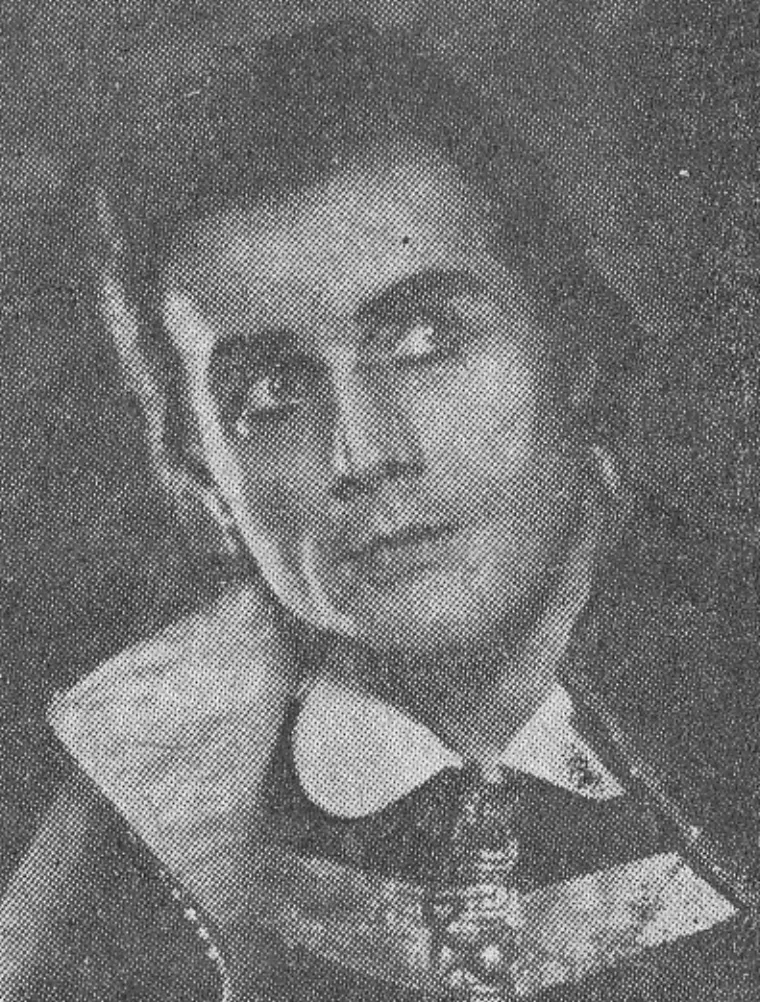
Actor
Stanisław Jasiukiewicz
b. 14 V 1921, d. 27 VI 1973
Actor who played Prior Augustyn Kordecki in Jerzy Hoffman's "The Deluge". He died before the film's premiere; his role was dubbed by Zygmunt Maciejewski.
Life
Stanisław Jasiukiewicz was born on 14 May 1921 in Postawy near Wilno (Vilnius)1. According to the note in the filmpolski.pl database, after the outbreak of war he volunteered for the army and fought in the September campaign, and later served in the underground as a soldier of the Home Army (AK)1. In 1946 he began studies at the Faculty of Fine Arts of Nicolaus Copernicus University in Toruń. He made his stage debut on 5 October 1946 as Jan in Maidens' Vows (Śluby panieńskie) at the Soldiers' House Theatre (Teatralny Dom Żołnierza) in Toruń1. In 1949 he graduated from the acting department of the State Higher School of Drama (PWST)1.
He acted at the Teatry Dramatyczne in Wrocław (1950–1955), and from 1955 until the end of his life at the Teatr Polski in Warsaw. He was a popular film and television actor; in the Television Theatre (Teatr Telewizji) he played more than 60 roles1. In 1973 he appeared in another Sienkiewicz adaptation, In Desert and Wilderness (W pustyni i w puszczy), as Władysław Tarkowski1.
He died on 27 June 1973 in Warsaw and was buried in the Old Powązki Cemetery1.
In The Deluge
In Jerzy Hoffman's film Jasiukiewicz played Prior Augustyn Kordecki, and the role was dubbed by Zygmunt Maciejewski2. The actor did not live to see the premiere: the first part of the film was released on 2 September 197423. The historical prior is presented on the page Augustyn Kordecki.
A prior across history, novel and film
Kordecki is one of the points at which the three strands of The Deluge meet most closely. He really did lead the Jasna Góra community during the siege of 1655; Sienkiewicz gave him a prominent part in a story of resistance, and Hoffman brought that interpretation to the screen24. A speech or conversation in the film is not thereby a transcript of the historical Kordecki's words. The screen prior can be read as a spiritual anchor for the defenders; this interpretation of a performance should be distinguished from establishing Kordecki’s historical actions.
Face and voice: what does Hoffman’s account explain?
The cast record credits Jasiukiewicz with the role and Zygmunt Maciejewski with its dubbing2. Hoffman describes Włodzimierz Olszewski finding voices for deceased actors, explicitly including Jasiukiewicz5. The voice was added after the actor’s death. The account does not explain the choice of Maciejewski.
Maciejewski recorded the dialogue for scenes that had already been filmed. Jasiukiewicz supplied the gestures, expressions and physical presence; Maciejewski supplied the voice. Kordecki’s screen performance combines their work.
Preparation at Leśniów
Fr Jerzy Tomziński recalled that Jasiukiewicz prepared by staying at a Pauline novitiate in Leśniów. This is a specific preparation location, distinct from Jasna Góra, where scenes were filmed6.
Tomziński did not say how long the stay lasted or describe the actor’s daily routine at the novitiate.
The refectory conversation: repeated takes of a quiet scene
Tomziński remembered Kmicic’s conversation with Kordecki in the monastery refectory being repeated about fifteen times. He gave the number of takes approximately6.
Small gestures shape this quiet conversation: a glance, a pause before an answer and the listener’s response. Tomziński did not explain what changed between takes.
The procession and an object from the treasury
In his interview with Piotr Świątkowski, Hoffman recalled Jasiukiewicz carrying a monstrance provided by the Paulines during the procession under bombardment. The director associated it with the historical Kordecki. He also described the monks’ cooperation and firefighters protecting the monastery7.
Filming the procession brought actors, monks and firefighters together.
Comparing the screen prior with the historical Kordecki
Begin with chapters XII–XIX of the novel’s second volume, which contain the siege narrative, the prior’s actions and Babinicz’s exploit8. Keep three questions separate:
- Performance: how do Jasiukiewicz’s image and Maciejewski’s voice convey calm or determination?
- Adaptation: which words and actions come from Sienkiewicz’s story, and what does the staging contribute?
- History: what do sources establish about the real prior, and what belongs to the literary construction of the defence?
Continue with the historical Augustyn Kordecki’s biography, his character in the novel and the comparison of Jasna Góra in history, book and film. Our film guide supplies the wider production and sound context.
Notes
- Internetowa Baza Filmu Polskiego – strony osób, Łódź: Państwowa Wyższa Szkoła Filmowa, Telewizyjna i Teatralna im. Leona Schillera w Łodzi (filmpolski.pl), hasło „Stanisław Jasiukiewicz”
- Potop, Łódź: Państwowa Wyższa Szkoła Filmowa, Telewizyjna i Teatralna im. Leona Schillera w Łodzi (filmpolski.pl)
- Stefan Głowacki, Potop, Lista Polskiego Dziedzictwa Filmowego, Warszawa: Filmoteka Narodowa – Instytut Audiowizualny
- Henryk Sienkiewicz, Potop, Fundacja Nowoczesna Polska (Wolne Lektury), 2009–2010, volume II
- Maria Oleksiewicz; wypowiedź Jerzego Hoffmana, 535 dni Potopu, część VII: A więc już po zdjęciach…, Filmoteka Narodowa – Instytut Audiowizualny, 1975, “Pieśni i armatnie strzały”
- Anna Wyszyńska, „Potop” na Jasnej Górze, Niedziela, Częstochowa: Niedziela, 2005, Fr Jerzy Tomziński’s recollection
- Jerzy Hoffman; Piotr Świątkowski, „Potopu” nie oglądam, W drodze 2016, nr specjalny, Wydawnictwo W drodze, 2016, passage on filming at Jasna Góra
- Henryk Sienkiewicz, Potop, Fundacja Nowoczesna Polska (Wolne Lektury), 2009–2010, vol. II, ch. XII–XIX
Explore further
Novel
Related
Depicted in
Role
- Father Kordecki rola dubbingowana przez Zygmunta Maciejewskiego Historical figure, fictionalized
Sources for this page
- Internetowa Baza Filmu Polskiego – strony osób, Łódź: Państwowa Wyższa Szkoła Filmowa, Telewizyjna i Teatralna im. Leona Schillera w Łodzi (filmpolski.pl) (Reference work)
- Potop, Łódź: Państwowa Wyższa Szkoła Filmowa, Telewizyjna i Teatralna im. Leona Schillera w Łodzi (filmpolski.pl) (Reference work)
- Stefan Głowacki, Potop, Lista Polskiego Dziedzictwa Filmowego, Warszawa: Filmoteka Narodowa – Instytut Audiowizualny (Institution)
- Henryk Sienkiewicz, Potop, Fundacja Nowoczesna Polska (Wolne Lektury), 2009–2010 (Primary source)
- Maria Oleksiewicz; wypowiedź Jerzego Hoffmana, 535 dni Potopu, część VII: A więc już po zdjęciach…, Filmoteka Narodowa – Instytut Audiowizualny, 1975 (Primary source)
- Anna Wyszyńska, „Potop” na Jasnej Górze, Niedziela, Częstochowa: Niedziela, 2005 (Academic study)
- Jerzy Hoffman; Piotr Świątkowski, „Potopu” nie oglądam, W drodze 2016, nr specjalny, Wydawnictwo W drodze, 2016 (Primary source)