
AI illustration
Imagined scene inspired by the biography and portrait shown below.
Clergy
Augustyn Kordecki
b. 1603, d. 20 III 1673
Historical figurePrior of the Pauline monastery of Jasna Góra during the siege of 1655 and author of the Nova Gigantomachia, an account of the monastery's defence.
- Names and variants
- la Augustinus Kordecki
- pl Klemens Kordecki (imię chrzestne, zmienione przy ślubach zakonnych (Kubala))
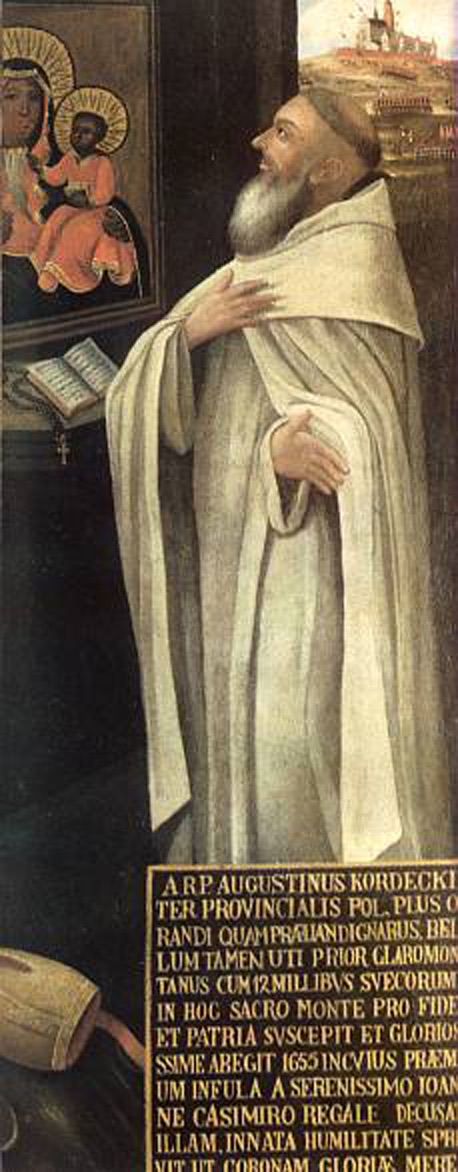
Painter: unknown; attribution to Ratyński uncertain · after 1655 · Klasztor Jasnogórski / Wikimedia Commons · Public domain
Life
Klemens Kordecki was the son of Marcin and Dorota, townspeople of Iwanowice12. According to Kubala, he changed his baptismal name Klemens to Augustyn when he took his religious vows3. Kersten gives 25 March 1634 as the date of his clothing with the habit and notes that, according to the Jasna Góra register of professions, this is the date of his religious vows1.
In 1633 he began his novitiate with the Paulines at Jasna Góra, and in 1634 he was ordained priest at Wieluń1. He was then assistant master of novices at Jasna Góra, from July 1638 prior at Wieluń, and in 1640 the chapter sent him to Rome as its delegate1. In August 1644 he was elected prior of Jasna Góra for the first time1. After a dispute with the general of the order, Mikołaj Staszewski, he was moved in 1645 to Beszowa; he was later prior at Oporów and superior at Pińczów, and in 1650 he again became prior of Jasna Góra1.
After the war, in February 1657, the chapter elected him provincial; he was re-elected to the office in 1660 and 16711. In 1663 he again took up the priorate of Jasna Góra1. During the clash beneath the monastery on 4 April 1665 between the royal troops and the rebels of Jerzy Lubomirski's rokosz (armed rebellion), he did not open fire on the rebels, and John Casimir afterwards placed his own garrison at Jasna Góra1. He died on 20 March 1673 during a visitation of the monastery at Wieruszów and was buried at Jasna Góra; his tomb has not survived1.
During the Deluge
Kordecki was prior of Jasna Góra at the time of the Swedish invasion1. Kubala calls him „wszechwładnym gospodarzem w klasztorze” ("the all-powerful master in the monastery")4. According to Kersten, the prior's policy was consistently aimed at keeping a foreign garrison out of the monastery. The act of submission and the letter of safe-conduct (salva guardia) were meant to serve this end, while at the same time Kordecki sought help from John Casimir and the Polish commanders1. When the Swedish troops approached the monastery, he and the majority of the community decided to defend themselves by force of arms1.
During the siege he corresponded with General Burchard Müller5. To the demand for a ransom he replied on 26 December that the monastery had nothing to pay with6. The course of the defence is described on the page Siege of Jasna Góra.
On the initiative of Queen Marie Louise (Ludwika Maria) the events were set down in writing1. In 1657 the manuscript was presented to the nuncio Pietro Vidoni and to the king1. The book was published in Kraków under Kordecki's name as Nova Gigantomachia7.
Controversies
Kersten observed that judgements of Kordecki had mostly been extreme, ranging from the uncritically apologetic to the defamatory1.
In the novel
Kersten lists The Deluge (Potop) among the best-known literary transpositions of Kordecki's account1. Sienkiewicz does not hide the fact that the monastery had a Swedish letter of safe-conduct. After Kmicic's warning, his prior says:
– A ja zakonników do Wrzeszczowicza wyślę – rzekł ksiądz Kordecki – z zapytaniem: czyli to salwa-gwardia królewska nic już nie znaczy?
Henryk Sienkiewicz, The Deluge (Potop)11
(Our translation: "And I shall send monks to Wrzeszczowicz," said Father Kordecki, "to ask whether the king's salva guardia means nothing any more.")
In the film
In Jerzy Hoffman's film Prior Augustyn Kordecki was played by Stanisław Jasiukiewicz, and the role was dubbed by Zygmunt Maciejewski12.
Notes
- Adam Kersten, Kordecki Klemens, imię zakonne Augustyn (1603–1673), Polski słownik biograficzny, t. 14, Wrocław: Zakład Narodowy im. Ossolińskich, 1968–1969, s. 53–55
- Ludwik Kubala, Wojna szwecka w roku 1655 i 1656, Szkice historyczne, serya IV (Biblioteka Historyczna Altenberga), Lwów; Warszawa: H. Altenberg, G. Seyfarth, E. Wende i Sp.; E. Wende i Sp., 1913, s. 416
- Ludwik Kubala, Wojna szwecka w roku 1655 i 1656, Szkice historyczne, serya IV (Biblioteka Historyczna Altenberga), Lwów; Warszawa: H. Altenberg, G. Seyfarth, E. Wende i Sp.; E. Wende i Sp., 1913, s. 153, 416
- Ludwik Kubala, Wojna szwecka w roku 1655 i 1656, Szkice historyczne, serya IV (Biblioteka Historyczna Altenberga), Lwów; Warszawa: H. Altenberg, G. Seyfarth, E. Wende i Sp.; E. Wende i Sp., 1913, s. 153
- Augustyn Kordecki; przeł. Józef Łepkowski, (Nowa Gigantomachia): pamiętnik oblężenia Częstochowy roku 1655, Warszawa: S. Orgelbrand, 1858, s. 28–29, 98–102
- Augustyn Kordecki; przeł. Józef Łepkowski, (Nowa Gigantomachia): pamiętnik oblężenia Częstochowy roku 1655, Warszawa: S. Orgelbrand, 1858, s. 98–102
- Augustyn Kordecki, Nova gigantomachia contra sacram imaginem Deiparae Virginis a sancto Luca depictam, et in Monte Claro Częstochouiensi apud [...] patres Ordinis S. Pauli Eremitae in [...] Regni Poloniae coenobio collocatam per Suecos et alios haereticos excitata [...], Cracoviae: in officina viduae et heredum Francisci Caesarij, [1657]
- Ludwik Kubala, Wojna szwecka w roku 1655 i 1656, Szkice historyczne, serya IV (Biblioteka Historyczna Altenberga), Lwów; Warszawa: H. Altenberg, G. Seyfarth, E. Wende i Sp.; E. Wende i Sp., 1913, s. 419
- Ludwik Kubala, Wojna szwecka w roku 1655 i 1656, Szkice historyczne, serya IV (Biblioteka Historyczna Altenberga), Lwów; Warszawa: H. Altenberg, G. Seyfarth, E. Wende i Sp.; E. Wende i Sp., 1913, s. 419–420
- Ludwik Kubala, Wojna szwecka w roku 1655 i 1656, Szkice historyczne, serya IV (Biblioteka Historyczna Altenberga), Lwów; Warszawa: H. Altenberg, G. Seyfarth, E. Wende i Sp.; E. Wende i Sp., 1913, s. 420–421
- Henryk Sienkiewicz, Potop, Fundacja Nowoczesna Polska (Wolne Lektury), 2009–2010, t. II, rozdz. XII
- Potop, Łódź: Państwowa Wyższa Szkoła Filmowa, Telewizyjna i Teatralna im. Leona Schillera w Łodzi (filmpolski.pl)
Explore further
History
Novel
Related
Character in the novel
- Father Kordecki Historical figure, fictionalized
Depicted in
Opponent
- Burchard Müller von der Lühnen korespondencja i rokowania w czasie oblężenia Jasnej Góry Historical figure
Took part in
- Siege of Jasna Góra (1655) przeor klasztoru w czasie oblężenia Documented
Related
- Adam Kersten Historical figure
- Jacek Brzuchański Historical figure
- Konstancja Historical figure
Sources for this page
- Adam Kersten, Kordecki Klemens, imię zakonne Augustyn (1603–1673), Polski słownik biograficzny, t. 14, Wrocław: Zakład Narodowy im. Ossolińskich, 1968–1969, s. 53–55 (Reference work)
- Ludwik Kubala, Wojna szwecka w roku 1655 i 1656, Szkice historyczne, serya IV (Biblioteka Historyczna Altenberga), Lwów; Warszawa: H. Altenberg, G. Seyfarth, E. Wende i Sp.; E. Wende i Sp., 1913 (Academic study)
- Augustyn Kordecki; przeł. Józef Łepkowski, (Nowa Gigantomachia): pamiętnik oblężenia Częstochowy roku 1655, Warszawa: S. Orgelbrand, 1858 (Primary source)
- Augustyn Kordecki, Nova gigantomachia contra sacram imaginem Deiparae Virginis a sancto Luca depictam, et in Monte Claro Częstochouiensi apud [...] patres Ordinis S. Pauli Eremitae in [...] Regni Poloniae coenobio collocatam per Suecos et alios haereticos excitata [...], Cracoviae: in officina viduae et heredum Francisci Caesarij, [1657] (Primary source)
- Henryk Sienkiewicz, Potop, Fundacja Nowoczesna Polska (Wolne Lektury), 2009–2010 (Primary source)
- Potop, Łódź: Państwowa Wyższa Szkoła Filmowa, Telewizyjna i Teatralna im. Leona Schillera w Łodzi (filmpolski.pl) (Reference work)