
AI illustration
Imagined period town; smoke is an animation effect.
City
Kraków
Stefan Czarniecki defended the former capital and its royal castle at Wawel against Swedish forces in the autumn of 1655.
Wawel and the former royal seat
Wawel Hill above the Vistula was a major centre of authority under the Piasts. Władysław Łokietek was crowned here in 1320, and his tomb began the royal necropolis. A Renaissance palace with an arcaded courtyard followed in the sixteenth century, later altered by Sigismund III. Although the court moved to Warsaw, Wawel continued to host coronations, weddings and funerals. Kraków’s occupation in 1655 therefore affected a city whose symbolic importance exceeded its contemporary political role1.
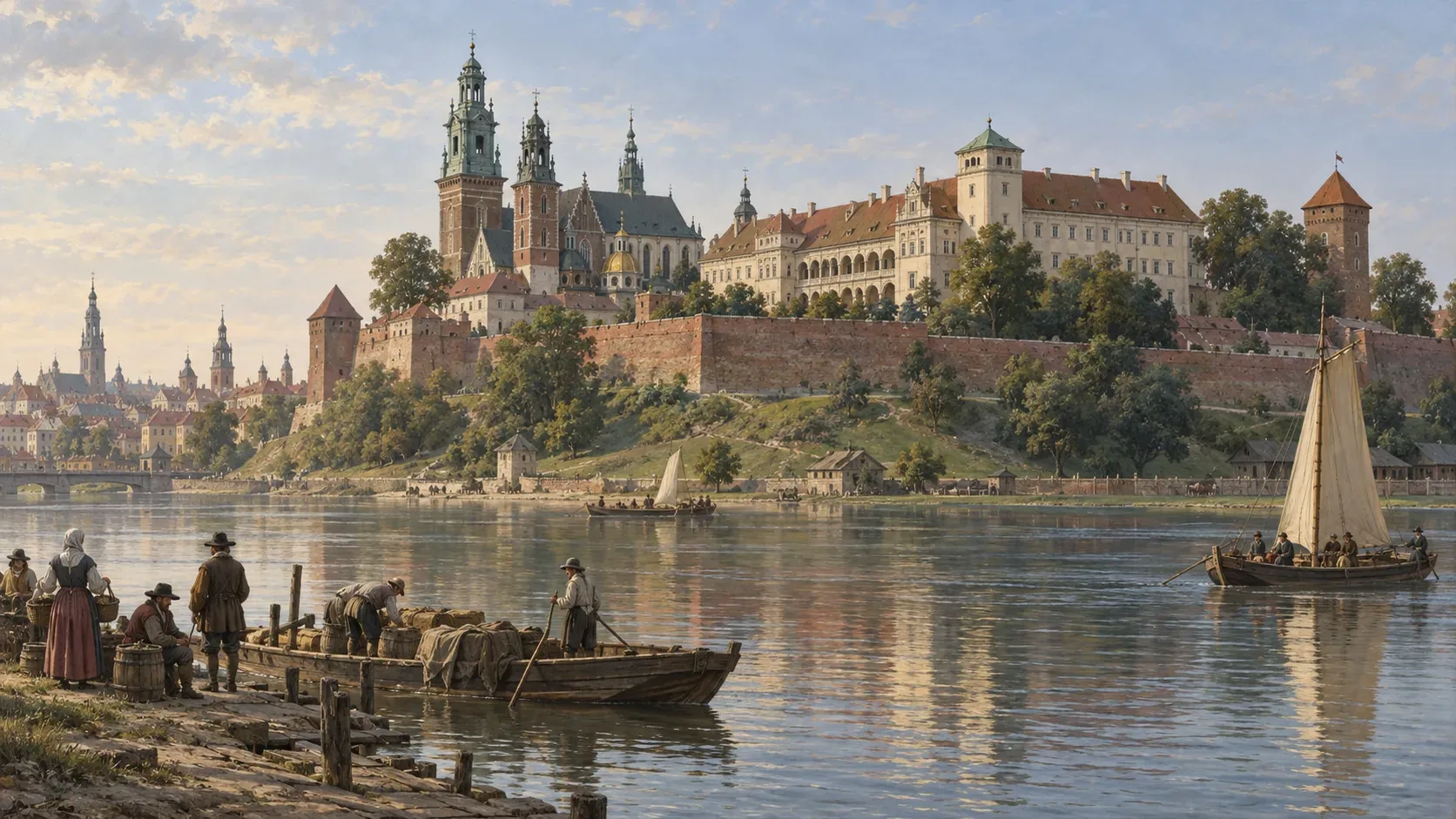
City and castle
After the defeat at Żarnów, John Casimir reached Kraków in September 1655. Stefan Czarniecki took charge of the city's and Wawel Castle's defence. The siege page follows the fighting and terms of surrender23.
Why Wojnicz mattered to Kraków
The Swedish king detached troops from Kraków to defeat the Crown field army. After the Battle of Wojnicz on 3 October, the defenders could no longer expect relief from that force. The battle took place outside Kraków, but its result shaped the siege4.
In history and fiction
Kraków was one of the places where rapid Swedish successes in 1655 met sustained resistance. Readers of The Deluge should distinguish the city, Wawel and the Wojnicz battlefield: they belong to the same campaign, but occupy different points on the map25.
Recovering the city in 1657
The city’s account of Izydor Affaita’s siege plan helps explain Kraków’s recovery. Imperial troops under Melchior Hatzfeld cooperated with Polish forces. After the Transylvanians departed in August 1657, Swedish commander Paul Wirtz capitulated. The plan depicts earthworks, approach trenches, gun positions and camps, together with two Vistula bridges, including a pontoon crossing. It records the wider operational landscape: suburbs, river crossings and positions advancing toward the walls, as well as the castle itself6.
Destruction beyond the castle walls
The invasion affected the Old Town, Kazimierz, Kleparz and the suburbs. Plunder and destruction weakened commerce and crafts. Church patronage played a substantial role in rebuilding, and restored churches acquired Baroque decoration. Present monuments consequently also reflect recovery from crisis. The Deluge must be distinguished from the later Swedish occupation of 1702, when Wawel burned. Not every loss or architectural alteration belongs to the events of 1655–16577.
Notes
- O muzeum – historia wzgórza i zamku, Zamek Królewski na Wawelu
- Ludwik Kubala, Wojna szwecka w roku 1655 i 1656, Szkice historyczne, serya IV (Biblioteka Historyczna Altenberga), Lwów; Warszawa: H. Altenberg, G. Seyfarth, E. Wende i Sp.; E. Wende i Sp., 1913, s. 110–116
- Władysław Czapliński, Czarniecki Stefan, herbu Łodzia (1599–1665), Polski słownik biograficzny, t. 4, Kraków: Polska Akademia Umiejętności, 1938
- Bitwa pod Wojniczem, Oś czasu, Warszawa: Muzeum Wojska Polskiego w Warszawie
- Henryk Sienkiewicz, Potop, Fundacja Nowoczesna Polska (Wolne Lektury), 2009–2010
- Historyczne widoki i plany Krakowa – Plany z XVII i XVIII wieku, Urząd Miasta Krakowa, 2010
- Historia Krakowa, Urząd Miasta Krakowa
Explore further
Related
Related
- Siege of Kraków (1655) Documented
- Battle of Wojnicz Documented
- Wojnicz
Sources for this page
- O muzeum – historia wzgórza i zamku, Zamek Królewski na Wawelu (Institution)
- Ludwik Kubala, Wojna szwecka w roku 1655 i 1656, Szkice historyczne, serya IV (Biblioteka Historyczna Altenberga), Lwów; Warszawa: H. Altenberg, G. Seyfarth, E. Wende i Sp.; E. Wende i Sp., 1913 (Academic study)
- Władysław Czapliński, Czarniecki Stefan, herbu Łodzia (1599–1665), Polski słownik biograficzny, t. 4, Kraków: Polska Akademia Umiejętności, 1938 (Reference work)
- Bitwa pod Wojniczem, Oś czasu, Warszawa: Muzeum Wojska Polskiego w Warszawie (Institution)
- Henryk Sienkiewicz, Potop, Fundacja Nowoczesna Polska (Wolne Lektury), 2009–2010 (Primary source)
- Historyczne widoki i plany Krakowa – Plany z XVII i XVIII wieku, Urząd Miasta Krakowa, 2010 (Institution)
- Historia Krakowa, Urząd Miasta Krakowa (Institution)