
AI illustration
Imagined period town; smoke is an animation effect.
Town
Kościan
Krzysztof Żegocki's attack on the Swedish garrison at Kościan showed that resistance continued in Greater Poland after Ujście.
Cloth, books and prosperous burghers
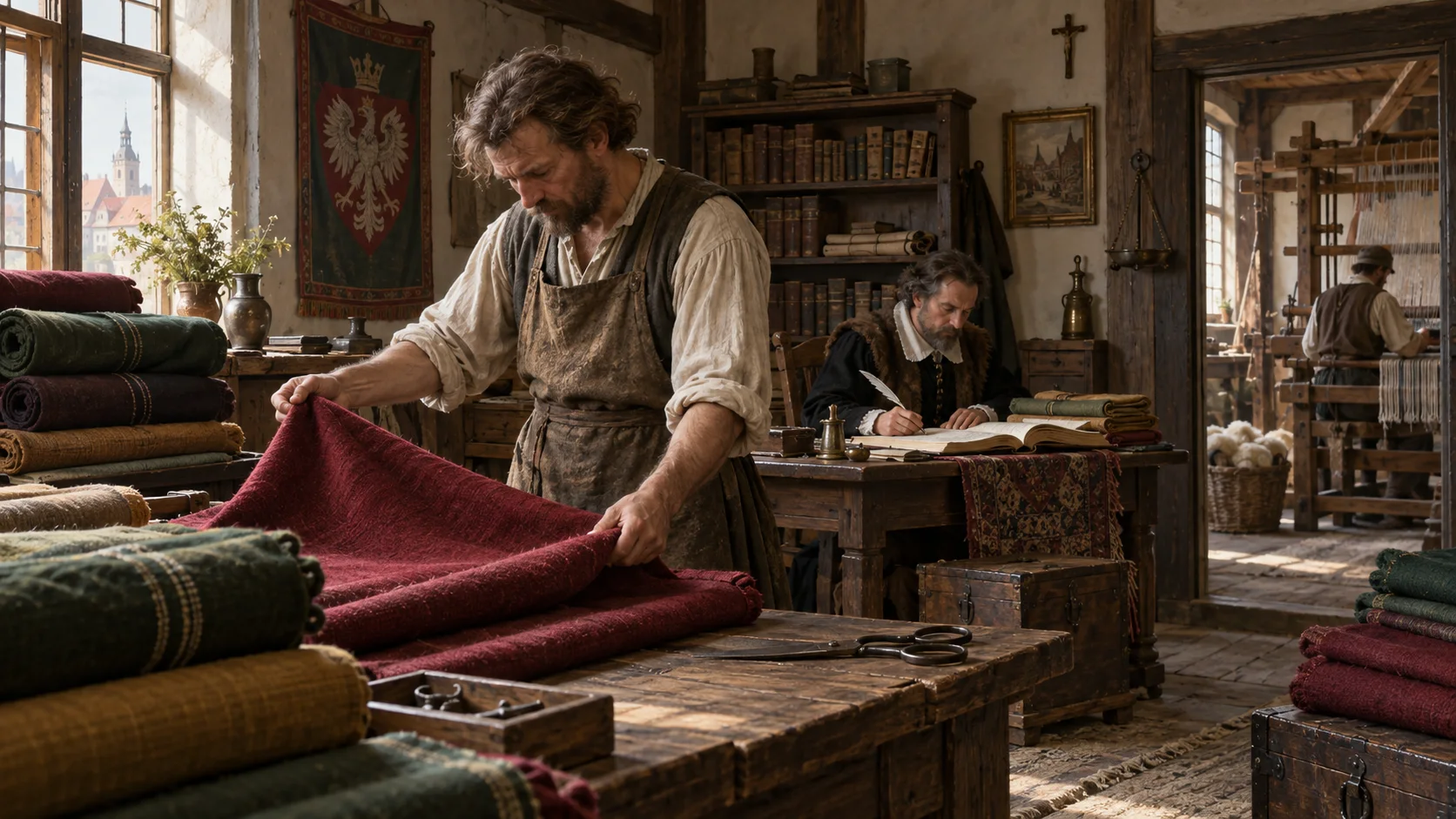
Before the Deluge Kościan was a prosperous Greater Polish town, with cloth production central to its growth. Guilds participated in government and funded church furnishings. Wealthy families sent sons to Kraków and other European universities. The Kosz family owned books on philosophy, law, medicine and literature. This broadens the partisan story: war struck a local world of work, education and patronage. The municipal history associates the decline of cloth production with the wars beginning in 16551.
Greater Poland after Ujście
The surrender at Ujście did not end fighting in Greater Poland. In 1655 Krzysztof Żegocki attacked and defeated the Swedish garrison at Kościan. This local success shows that the region did not simply acquiesce in occupation2.
Striking the supply line
Żegocki also seized wagons carrying the Swedish army's treasury, guarded by a hundred soldiers under Louis of Nassau. The event page covers the raid. The Kościan marker and nearby Poznań help locate this resistance within Greater Poland2.
The cost of a brief success
The municipal history describes Swedish entry after Ujście and Żegocki’s capture of Kościan by stratagem on 4 October 1655. Retaliation brought killings, plunder and fire, destroying the starosta’s castle and Corpus Christi Church among other buildings. A Brandenburg garrison arrived in April 1656. Brief recovery was therefore not the end of occupation. The city account also gives precise casualty and housing figures; these are not treated as an undisputed total without comparison with records and other evidence3.
Seeing the town before disaster
The museum diorama reconstructs early seventeenth-century Kościan. It shows forty documented sites, including the castle, churches, monasteries, two watermills and a water-supply device called a rurmus. Suburbs flank the Poznań–Głogów road outside the walls. Associated exhibits include a wooden water pipe, craft tools, cannonballs and a medal of Charles Gustav. The model is a researched reconstruction rather than a surviving view from 1655, but helps relate descriptions of destruction to residents’ everyday surroundings4.
Notes
- Złoty wiek Kościana 1400–1655, Urząd Miejski Kościana
- Opór pod Kościanem, Oś czasu, Warszawa: Muzeum Wojska Polskiego w Warszawie
- Kościan w latach 1655–1793, Urząd Miejski Kościana
- Diorama – Królewskie miasto Kościan, Muzeum Regionalne w Kościanie / MOSiR Kościan
Explore further
History
Related
Related
- Resistance at Kościan Documented
- Poznań
Sources for this page
- Złoty wiek Kościana 1400–1655, Urząd Miejski Kościana (Institution)
- Opór pod Kościanem, Oś czasu, Warszawa: Muzeum Wojska Polskiego w Warszawie (Institution)
- Kościan w latach 1655–1793, Urząd Miejski Kościana (Institution)
- Diorama – Królewskie miasto Kościan, Muzeum Regionalne w Kościanie / MOSiR Kościan (Institution)