
AI illustration
Imagined scene inspired by the biography and portrait shown below.
Magnate
Janusz Radziwiłł
b. XII 1612, d. 31 XII 1655
Historical figureGrand Hetman of Lithuania and voivode of Vilnius, who in 1655 placed the Grand Duchy of Lithuania under the protection of Charles X Gustav and died at Tykocin in the last days of that year.
- Names and variants
- lt Jonušas Radvila
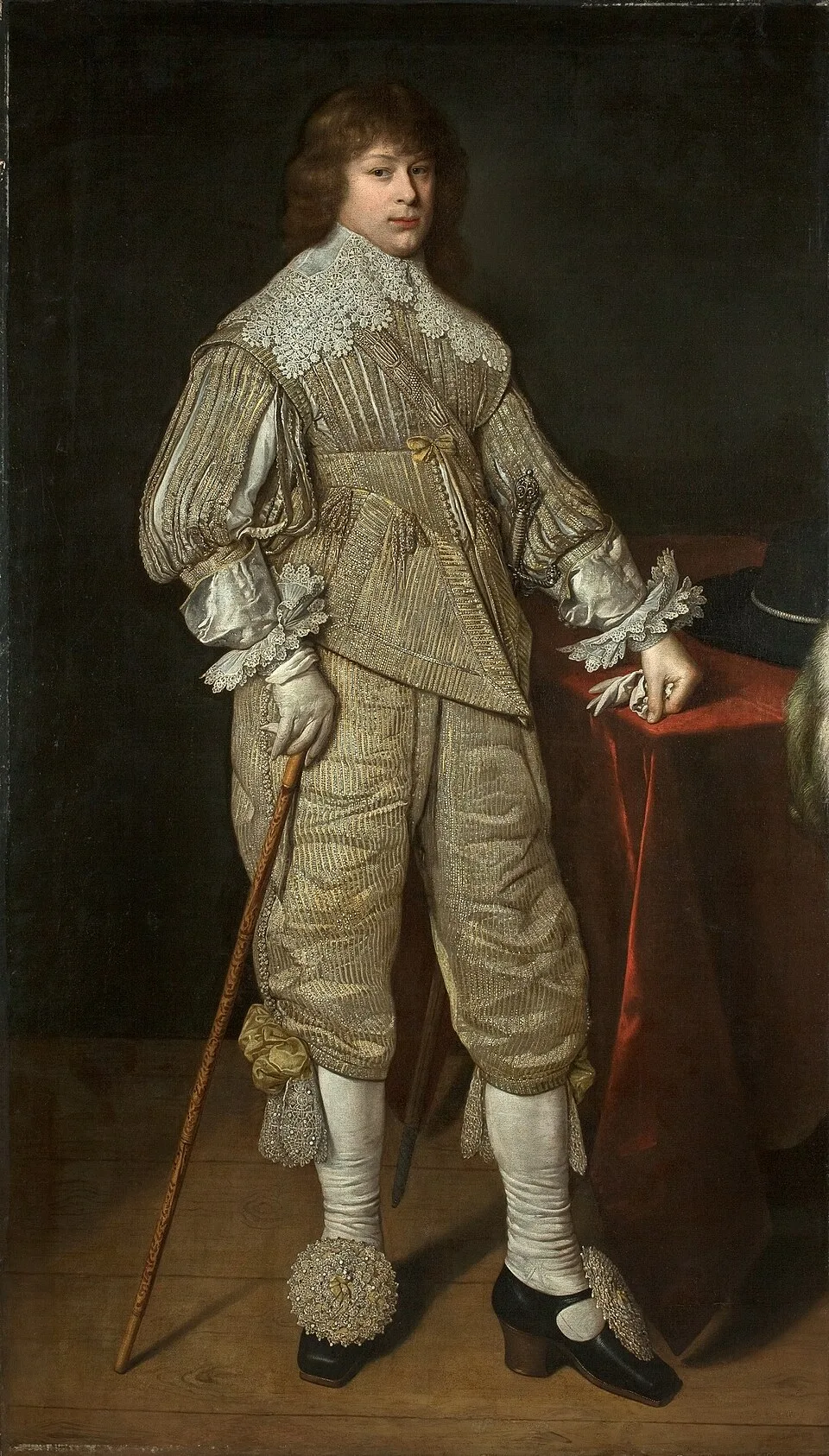
Painter: David Bailly · c. 1632 · Muzeum Narodowe we Wrocławiu / Wikimedia Commons · Public domain
Life
Janusz Radziwiłł, of the Trąby coat of arms, was born in December 1612 at Popiel in Lithuania1. He was the son of Krzysztof, Grand Hetman of Lithuania, and of Anna Kiszczanka1. He attended the gymnasium at Słuck (Slutsk) and then studied abroad, at Leipzig, Altdorf and Leiden among other places1.
In 1633 Władysław IV conferred on him the office of Chamberlain of Lithuania1. In 1646 he received the baton of Field Hetman of Lithuania, and in 1653 he forced John Casimir to give him the voivodeship of Vilnius1. He won fame by his victory over the Cossacks at Łojów (Loyew) on 31 July 16491. The privilege granting him the baton of Grand Hetman of Lithuania, the supreme command of the Lithuanian army, was issued on 17 June 16541. He was a Calvinist, but according to Tadeusz Wasilewski he came forward in defence of his Church chiefly for reasons of politics and prestige1. He had long hated John Casimir, as Wasilewski writes, and the feeling was mutual1.
During the Deluge
In the war with Muscovy he defeated the tsar's troops at Szkłów (Shklow) on 12 August 1654, but on 24 August he suffered his first defeat1. From the capitulation of Smolensk onwards he urged soldiers and supporters to submit to the Swedes or to call George II Rákóczi to the throne1. According to Wasilewski, no later than 29 July 1655 he resolved, together with Bogusław Radziwiłł, to detach Lithuania from the Crown and submit it to Sweden1. For himself he demanded the voivodeship of Brest-Litovsk and the districts of Grodno and Ukmergė, in which he would have a position close to that of the princes of the Holy Roman Empire1.
After the fall of Vilnius on 8 August 1655 he withdrew to Samogitia, and at Josvainiai near Kėdainiai proclaimed a provisional act submitting Lithuania to Charles Gustav. The document was dated 17 August; an older account gives 18 August for its proclamation.213 The Union of Kėdainiai proper was signed on 20 October14 (see Capitulation of Kėdainiai). John Casimir declared him a traitor and appointed his rival Sapieha commander-in-chief of the Lithuanian army5. When it turned out that the Swedes had not brought the arrears of pay, the banners (companies) of the national (Polish-style) contingent mutinied under the leadership of Mikołaj Szemiot. Fewer than a thousand soldiers of the foreign-style contingent remained with the hetman1.
A separate witness to the negotiations was Mikołaj Kazimierz Szemiot, who first objected to the Swedish terms but signed the agreement on 20 October. His later poem explained that choice. He must not be confused with Mikołaj Samuel Szemiot. We do not assign the shortened “Mikołaj Szemiot” in the account of the banners’ mutiny to either man without further evidence.61
About 15 December he occupied the castle at Tykocin1. He wrote his last known letter to Charles Gustav on 26 December17. He died unexpectedly in Tykocin castle in the last days of 16551.
Controversies
In the novel
In The Deluge (Potop) Radziwiłł announces the agreement with the Swedes at a banquet at Kėdainiai, and the act is read out at his command by Mr Komorowski10. He dies at Tykocin while it is besieged by Sapieha's troops. Immediately after his death a mighty explosion is heard (Charłamp guesses that the Swedes have blown up the tower), and Wołodyjowski's soldiers burst into the chamber:
– Nie żyje! nie żyje! – poszedł głos z ust do ust. – Nie żyje zdrajca i sprzedawczyk!
Henryk Sienkiewicz, The Deluge (Potop)11
(Our translation: "He is dead! He is dead!" the word went from mouth to mouth. "The traitor and turncoat is dead!")
In the film
In Jerzy Hoffman's film Janusz Radziwiłł was played by Władysław Hańcza12; the role is also noted in Radziwiłł's entry in the Polish Biographical Dictionary1. The description of the film's first part in the filmpolski.pl database speaks of the Radziwiłłs collaborating with the Swedes, concerned „nie o dobro ojczyzny, ale o własne interesy, w tym także objęcie polskiego tronu” ("not with the good of the fatherland but with their own interests, including taking the Polish throne")12.
Notes
- Tadeusz Wasilewski, Radziwiłł Janusz h. Trąby (1612–1655), Polski słownik biograficzny, t. 30, Wrocław: Zakład Narodowy im. Ossolińskich – Wydawnictwo Polskiej Akademii Nauk, 1987
- Rok 1655 na Litwie, Odrodzenie i Reformacja w Polsce / Instytut Historii PAN
- Ludwik Kubala, Wojna szwecka w roku 1655 i 1656, Szkice historyczne, serya IV (Biblioteka Historyczna Altenberga), Lwów; Warszawa: H. Altenberg, G. Seyfarth, E. Wende i Sp.; E. Wende i Sp., 1913, s. 87
- Układ w Kiejdanach, Kalendarium, Warszawa: Muzeum Historii Polski w Warszawie
- Ludwik Kubala, Wojna szwecka w roku 1655 i 1656, Szkice historyczne, serya IV (Biblioteka Historyczna Altenberga), Lwów; Warszawa: H. Altenberg, G. Seyfarth, E. Wende i Sp.; E. Wende i Sp., 1913, s. 91
- Andrzej Rachuba, Szemiot h. Łabędź Mikołaj Kazimierz, Polski słownik biograficzny, t. 48, Warszawa–Kraków: Polska Akademia Nauk, 2012–2013
- Ludwik Kubala, Wojna szwecka w roku 1655 i 1656, Szkice historyczne, serya IV (Biblioteka Historyczna Altenberga), Lwów; Warszawa: H. Altenberg, G. Seyfarth, E. Wende i Sp.; E. Wende i Sp., 1913, s. 93
- Kunigaikščių Radvilų mauzoliejus evangelikų reformatų bažnyčioje, Kėdainiai: Kėdainių krašto muziejus
- Ludwik Kubala, Wojna szwecka w roku 1655 i 1656, Szkice historyczne, serya IV (Biblioteka Historyczna Altenberga), Lwów; Warszawa: H. Altenberg, G. Seyfarth, E. Wende i Sp.; E. Wende i Sp., 1913, s. 87–88
- Henryk Sienkiewicz, Potop, Fundacja Nowoczesna Polska (Wolne Lektury), 2009–2010, t. I, rozdz. XIII
- Henryk Sienkiewicz, Potop, Fundacja Nowoczesna Polska (Wolne Lektury), 2009–2010, t. II, rozdz. XXIX
- Potop, Łódź: Państwowa Wyższa Szkoła Filmowa, Telewizyjna i Teatralna im. Leona Schillera w Łodzi (filmpolski.pl)
Explore further
History
Related
Ally
- Charles X Gustav poddanie Wielkiego Księstwa Litewskiego pod protekcję króla szwedzkiego Historical figure
Character in the novel
- Janusz Radziwiłł in the novel Historical figure, fictionalized
Opponent
- Samuel Kmicic Historical figure
- John II Casimir Vasa król ogłosił hetmana zdrajcą po układzie kiejdańskim Historical figure
Took part in
- Capitulation of Kėdainiai (1655) akt z 18 sierpnia i układ z 20 października 1655 Documented
Related
- Death of Janusz Radziwiłł Disputed
- Mikołaj Kazimierz Szemiot Historical figure
- Andrzej Kmicic w powieści przysięga hetmanowi wierność na krucyfiks (t. I, rozdz. XIII) Inspired by a historical figure
Sources for this page
- Tadeusz Wasilewski, Radziwiłł Janusz h. Trąby (1612–1655), Polski słownik biograficzny, t. 30, Wrocław: Zakład Narodowy im. Ossolińskich – Wydawnictwo Polskiej Akademii Nauk, 1987 (Reference work)
- Rok 1655 na Litwie, Odrodzenie i Reformacja w Polsce / Instytut Historii PAN (Academic study)
- Ludwik Kubala, Wojna szwecka w roku 1655 i 1656, Szkice historyczne, serya IV (Biblioteka Historyczna Altenberga), Lwów; Warszawa: H. Altenberg, G. Seyfarth, E. Wende i Sp.; E. Wende i Sp., 1913 (Academic study)
- Układ w Kiejdanach, Kalendarium, Warszawa: Muzeum Historii Polski w Warszawie (Institution)
- Andrzej Rachuba, Szemiot h. Łabędź Mikołaj Kazimierz, Polski słownik biograficzny, t. 48, Warszawa–Kraków: Polska Akademia Nauk, 2012–2013 (Reference work)
- Kunigaikščių Radvilų mauzoliejus evangelikų reformatų bažnyčioje, Kėdainiai: Kėdainių krašto muziejus (Institution)
- Henryk Sienkiewicz, Potop, Fundacja Nowoczesna Polska (Wolne Lektury), 2009–2010 (Primary source)
- Potop, Łódź: Państwowa Wyższa Szkoła Filmowa, Telewizyjna i Teatralna im. Leona Schillera w Łodzi (filmpolski.pl) (Reference work)