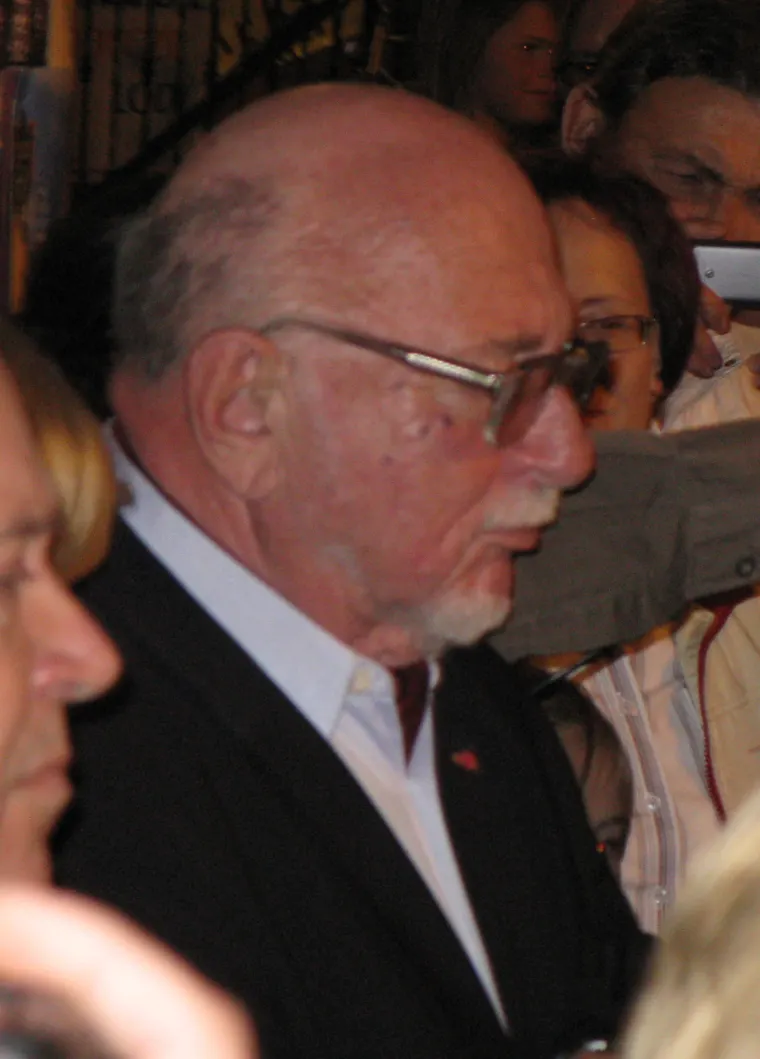
Director
Jerzy Hoffman
b. 15 III 1932
Director and co-writer of "The Deluge" (1974), who filmed all three parts of Sienkiewicz's Trilogy.
Life
Jerzy Hoffman was born on 15 March 1932 in Kraków1. According to the note in the filmpolski.pl database, in 1940 he was deported to Siberia; he returned to Poland after the war and passed his secondary-school leaving examination (matura) in Bydgoszcz in 19501. In 1955 he graduated from the directing department of the VGIK film school in Moscow, and in the same year he made his debut as a director together with Edward Skórzewski. Together they made 27 documentary films1. From 1980 to 1997 he was artistic director of the "Zodiak" Film Unit1.
The Trilogy on screen
Hoffman directed, and co-wrote the screenplays of, the adaptations of all three parts of the Trilogy: Pan Wołodyjowski (1969), The Deluge (Potop, 1973–1974) and With Fire and Sword (Ogniem i mieczem, 1999)1.
He wrote the screenplay of The Deluge together with Adam Kersten and Wojciech Żukrowski. Kersten was also responsible for the film's scholarly supervision2. In 1975 Hoffman received the Minister of Culture and Art's Award, First Class, for the film2. Forty years after the premiere, together with the cinematographer Jerzy Wójcik, he provided artistic supervision for the editing of the shortened version, "Potop Redivivus"23. The history of the production and both versions of the film are described in the article The Deluge (1974).
Why the Trilogy?
Hoffman recalled that his father sent Sienkiewicz's books to him in Siberia in 1944. Pan Wołodyjowski arrived first, followed by The Deluge; he read With Fire and Sword only after returning to Poland. He said he returned to the Trilogy repeatedly thereafter4. According to Daniel Olbrychski's recollection, Hoffman was already telling him after the premiere of Ashes that he hoped one day to cast him as Kmicic. He planned to start filming the Trilogy with Pan Wołodyjowski, because there was not yet funding for the much more expensive The Deluge5.
Making a story on this scale
In an account preserved by the National Film Archive, Hoffman said he formally proposed The Deluge only after Pan Wołodyjowski had been accepted. He began working on the screenplay with Kersten and Żukrowski in July 1969; it was accepted by December6.
Hoffman wrote the screenplay with Adam Kersten and Wojciech Żukrowski; having a historian on the team did not erase the distinction between research into the war and Sienkiewicz's fictional plot7. Production required extensive preparation and hundreds of shooting days. Hoffman recalled the shortage of foreign currency for equipment: for roughly half the shoot, the crew had one camera and one lens. Arranging extras, lighting and pyrotechnics made wide shots especially slow to prepare8. The film's spectacle depended on patient production work as much as on its scale.
Actors, action and the later cut
The director also remembered waiting for real snow: the scale of the sets made a simple artificial substitute impractical, while every lost day cost the production money. When heavy snow and frost finally came in March, the crew had only a few days for key winter scenes9.
The actors trained for more than two months for Kmicic's duel with Wołodyjowski, and spent a week filming it. Hoffman recalled a cold spring in Belarus and seven fire engines supplying water to the set10. Olbrychski remembered a director receptive to actors' ideas: he himself suggested the scene in which Kmicic cuts three candle wicks, an addition absent from the novel11. For Potop Redivivus, Hoffman and editor Marcin Kot Bastkowski removed more than two hours from the sprawling original to bring it back to cinemas with a new pace8.
A documentary filmmaker before the spectacle
In a statement quoted by Culture.pl, Hoffman connected documentary experience with attention to realities and details that make the screen world convincing12. This suggests another way of watching The Deluge: alongside charges and duels, observe crowds, servants’ gestures, worn objects and the use of space.
An ambition and political obstacles
In the 2024 anniversary broadcast, Hoffman recalled telling fellow students in his first year that he wanted to film the Trilogy. He also described nighttime interrogations during the antisemitic campaign, followed by morning filming. That second recollection concerns Pan Wołodyjowski, the film preceding The Deluge13. Keeping the productions separate reveals the long path towards his ambition without transferring events from 1968 to the later shoot.
A failure editing could not repair
Hoffman recalled discarding the Lauda return footage because of worn lenses. A technical commission confirmed the equipment fault, clearing Jerzy Wójcik14. The profiles of Wilhelm Hollender and Waldemar Prokopowicz introduce the production team’s responsibilities.
Why does the camera stay with the actors?
In his 2011 interview, Hoffman connected long takes with scarce foreign currency for equipment and limited film stock, rather than a national cinematic style15. A long take can be watched like a small theatrical scene: meaning changes as characters move, their distance from the camera changes and different people occupy the foreground. During another viewing, consider how much information arrives without a cut. Wójcik handled cinematography and Zenon Piórecki editing; these are distinct responsibilities2.
Responsibility for the film and its costs
Hoffman recalled signing a document accepting artistic and financial responsibility after another director criticised the footage. He did not name that director14.
Jasna Góra: three frames at the approval screening
Hoffman recalled officials demanding a shorter unveiling of the icon at Jasna Góra. He and Piórecki removed three frames; the next screening secured approval14. The approval screening assessed the finished film before distribution. Compare its monastery scenes with Augustyn Kordecki’s biography and the account of the 1655 siege.
Finding a landscape and a convincing object
Hoffman recalled visiting places described by Sienkiewicz within Poland’s borders, including Tykocin. He identified the Narew as the backdrop to Kmicic’s horse-riding display before Bogusław16.
In the same conversation he recalled Wawel custodians protesting when actors sat on chairs: according to him, the film’s props had been mistaken for Renaissance antiques16. Wojciech Krysztofiak’s profile introduces the film’s spaces, while Magdalena Tesławska’s discusses costume work.
Novel, history and the director’s choices
In his 2011 interview, Hoffman described fiction cinema as stories of passions and conflicts intended to move a broad audience, rejecting the treatment of films as history textbooks17.
For The Deluge, three separate questions help: what happened in the seventeenth century, what did Sienkiewicz invent, and what did the adaptation change? Kmicic is a literary character; real commanders and a real monastery do not turn his adventures into historical biography. The film guide compares these layers through specific examples, and the novel page explains the book’s context. Profiles of Adam Kersten and Wojciech Żukrowski introduce the director’s fellow screenwriters.
Returning to his own film
Potop Redivivus invites comparison of storytelling as well as image quality. Marcin Kot Bastkowski’s profile describes the later editing work. The film guide gives examples of cuts involving Braun and Bogusław, and Kmicic’s restored reunion with Wołodyjowski. Comparing versions lets readers examine how scene length affects relationships between characters, alongside the change in running time.
Where to explore the testimony
These sources allow readers to hear the director’s voice and compare recollections with documentation:
- The 2015 PAP interview: Joanna Poros’s conversation with the director14.
- The 2011 Magazyn Filmowy interview: a longer discussion of his approach to historical cinema, including passages on The Deluge18.
- Trójka’s 25 December 2024 broadcast: contributions from Hoffman, assistant set designer Andrzej Kowalczyk and documentary director Łukasz Czajka, alongside 1970s radio material19.
Recollections complement credits and film records. They can explain artistic motivation; historical details also require sources about the war itself.
Notes
- Internetowa Baza Filmu Polskiego – strony osób, Łódź: Państwowa Wyższa Szkoła Filmowa, Telewizyjna i Teatralna im. Leona Schillera w Łodzi (filmpolski.pl), hasło „Jerzy Hoffman”
- Potop, Łódź: Państwowa Wyższa Szkoła Filmowa, Telewizyjna i Teatralna im. Leona Schillera w Łodzi (filmpolski.pl)
- Potop Redivivus, Repozytorium Cyfrowe Filmoteki Narodowej, Warszawa: Filmoteka Narodowa – Instytut Audiowizualny
- Anna Bielak, „Potop jest jak panoramiczne płótno”. Rozmowa z Jerzym Hoffmanem, Magazyn Filmowy, Warszawa: Stowarzyszenie Filmowców Polskich, 2014, 40–43, p. 42
- Daniel Olbrychski, Wspomnienie o Jerzym Hoffmanie, Magazyn Filmowy, Warszawa: Stowarzyszenie Filmowców Polskich, 2022, 28–29, pp. 28–29
- Potop / Potop Redivivus, Warszawa: Filmoteka Narodowa / Google Arts & Culture, 2014, Hoffman's account of the start of production
- Potop, Łódź: Państwowa Wyższa Szkoła Filmowa, Telewizyjna i Teatralna im. Leona Schillera w Łodzi (filmpolski.pl), screenplay and scholarly supervision
- Anna Bielak, „Potop jest jak panoramiczne płótno”. Rozmowa z Jerzym Hoffmanem, Magazyn Filmowy, Warszawa: Stowarzyszenie Filmowców Polskich, 2014, 40–43, pp. 42–43
- Potop / Potop Redivivus, Warszawa: Filmoteka Narodowa / Google Arts & Culture, 2014, Hoffman's recollection of winter filming
- Anna Bielak, „Potop jest jak panoramiczne płótno”. Rozmowa z Jerzym Hoffmanem, Magazyn Filmowy, Warszawa: Stowarzyszenie Filmowców Polskich, 2014, 40–43, p. 43
- Daniel Olbrychski, Wspomnienie o Jerzym Hoffmanie, Magazyn Filmowy, Warszawa: Stowarzyszenie Filmowców Polskich, 2022, 28–29, p. 29
- Jerzy Hoffman – życie i twórczość, Instytut Adama Mickiewicza / Culture.pl, statement for Film no. 15/1975
- Michał Matus, „Potopu” powtórzyć się nie da: 50-lecie wielkiego filmu Jerzego Hoffmana, Polskie Radio / Trójka, 2024, published excerpts
- Joanna Poros, Jerzy Hoffman: nie żegnam się z kinem, Polska Agencja Prasowa / dzieje.pl, 2015
- Konrad J. Zarębski, Opowiadać o ludzkich namiętnościach. Rozmowa z Jerzym Hoffmanem, Stowarzyszenie Filmowców Polskich, 2011, 8–15, p. 15
- Beata Kwiatkowska; Jakub Kukla, Jerzy Hoffman: Narew wywarła na mnie ogromne wrażenie, Polskie Radio / Dwójka, 2021
- Konrad J. Zarębski, Opowiadać o ludzkich namiętnościach. Rozmowa z Jerzym Hoffmanem, Stowarzyszenie Filmowców Polskich, 2011, 8–15, p. 12
- Konrad J. Zarębski, Opowiadać o ludzkich namiętnościach. Rozmowa z Jerzym Hoffmanem, Stowarzyszenie Filmowców Polskich, 2011, 8–15
- Michał Matus, „Potopu” powtórzyć się nie da: 50-lecie wielkiego filmu Jerzego Hoffmana, Polskie Radio / Trójka, 2024
Related
Directed
- The Deluge (1974): Jerzy Hoffman's film Documented
Wrote
- The Deluge (1974): Jerzy Hoffman's film scenariusz wspólnie z Adamem Kerstenem i Wojciechem Żukrowskim Documented
Sources for this page
- Internetowa Baza Filmu Polskiego – strony osób, Łódź: Państwowa Wyższa Szkoła Filmowa, Telewizyjna i Teatralna im. Leona Schillera w Łodzi (filmpolski.pl) (Reference work)
- Potop, Łódź: Państwowa Wyższa Szkoła Filmowa, Telewizyjna i Teatralna im. Leona Schillera w Łodzi (filmpolski.pl) (Reference work)
- Potop Redivivus, Repozytorium Cyfrowe Filmoteki Narodowej, Warszawa: Filmoteka Narodowa – Instytut Audiowizualny (Institution)
- Anna Bielak, „Potop jest jak panoramiczne płótno”. Rozmowa z Jerzym Hoffmanem, Magazyn Filmowy, Warszawa: Stowarzyszenie Filmowców Polskich, 2014, 40–43 (Primary source)
- Daniel Olbrychski, Wspomnienie o Jerzym Hoffmanie, Magazyn Filmowy, Warszawa: Stowarzyszenie Filmowców Polskich, 2022, 28–29 (Primary source)
- Potop / Potop Redivivus, Warszawa: Filmoteka Narodowa / Google Arts & Culture, 2014 (Academic study)
- Jerzy Hoffman – życie i twórczość, Instytut Adama Mickiewicza / Culture.pl (Institution)
- Michał Matus, „Potopu” powtórzyć się nie da: 50-lecie wielkiego filmu Jerzego Hoffmana, Polskie Radio / Trójka, 2024 (Primary source)
- Joanna Poros, Jerzy Hoffman: nie żegnam się z kinem, Polska Agencja Prasowa / dzieje.pl, 2015 (Primary source)
- Konrad J. Zarębski, Opowiadać o ludzkich namiętnościach. Rozmowa z Jerzym Hoffmanem, Stowarzyszenie Filmowców Polskich, 2011, 8–15 (Primary source)
- Beata Kwiatkowska; Jakub Kukla, Jerzy Hoffman: Narew wywarła na mnie ogromne wrażenie, Polskie Radio / Dwójka, 2021 (Primary source)