
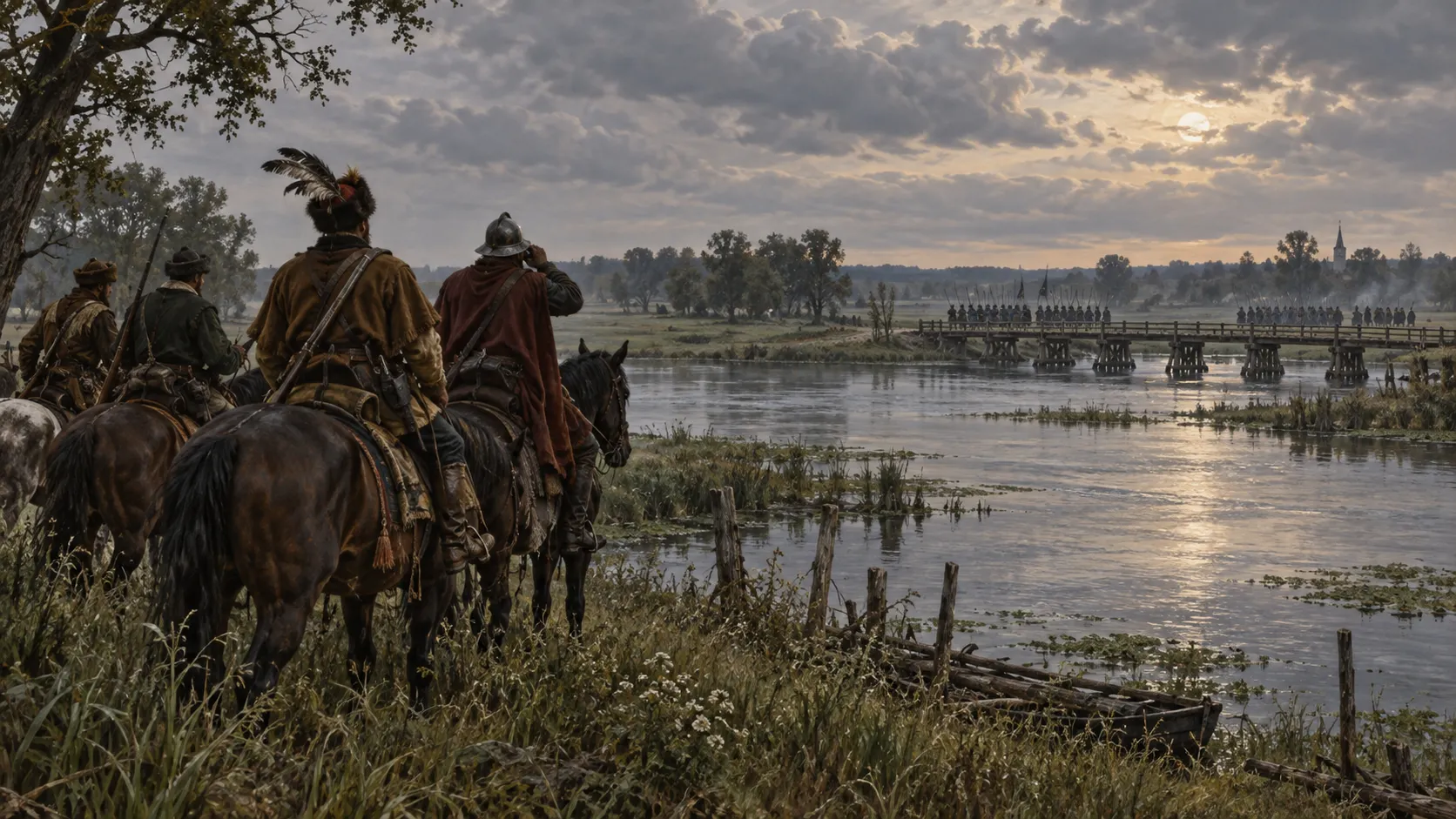
AI illustration
Imagined landscape of the 1655 invasion; smoke is an animation effect.
History
1655: a state in retreat
DocumentedFrom Ujście and Kėdainiai to Kraków and Jasna Góra, four places show why the invasion's first year was not a single story of surrender.
- Names and variants
- pl 1655: państwo w odwrocie
The first months of the Deluge are sometimes reduced to a sentence: the Commonwealth surrendered to Sweden. This is too simple. Capitulations, changes of allegiance and armed resistance occurred alongside one another; the Crown and Lithuania faced different circumstances12.
Ujście: the road into Greater Poland
In July 1655 Arvid Wittenberg's army entered the Commonwealth. The levies of the Poznań and Kalisz provinces were to defend the crossings of the Noteć. After fighting and negotiations, a capitulation was signed at Ujście on 25 July. The Museum of the Polish Army explains that the failure of this defence frustrated the plan to halt the first assault and made the occupation of Greater Poland easier1.
Kėdainiai: Lithuania's separate crisis
Lithuania faced Muscovite pressure before the Swedish advance. Hetman Janusz Radziwiłł sought Swedish protection. The declaration of submission in August and the agreement signed at Kėdainiai in October were separate acts. The agreement of 20 October broke the union with the Crown in the name of its signatories, but not all Lithuanians accepted it; opposition to Swedish power also formed in Lithuania2. See Kėdainiai.
Kraków and Jasna Góra: resistance amid defeats
In the autumn Stefan Czarniecki defended Kraków for more than three weeks before surrendering the city on agreed terms. Late in the year a Swedish corps besieged Jasna Góra but did not take the monastery. Neither case erases the extent of Swedish gains, yet together they show why “surrender” cannot describe all of 165534.
The next chapter explains how resistance began to alter the course of the war.
Notes
- Kapitulacja wielkopolskiego pospolitego ruszenia pod Ujściem, Oś czasu, Warszawa: Muzeum Wojska Polskiego w Warszawie
- Układ w Kiejdanach, Kalendarium, Warszawa: Muzeum Historii Polski w Warszawie
- Ludwik Kubala, Wojna szwecka w roku 1655 i 1656, Szkice historyczne, serya IV (Biblioteka Historyczna Altenberga), Lwów; Warszawa: H. Altenberg, G. Seyfarth, E. Wende i Sp.; E. Wende i Sp., 1913, s. 132–133
- Anna Łappo, Szwedzi odstępują od oblężenia Jasnej Góry, Warszawa: Muzeum Historii Polski w Warszawie
Explore further
Related
Related
- Capitulation at Ujście (1655) opening of the invasion Documented
Sources for this page
- Kapitulacja wielkopolskiego pospolitego ruszenia pod Ujściem, Oś czasu, Warszawa: Muzeum Wojska Polskiego w Warszawie (Institution)
- Układ w Kiejdanach, Kalendarium, Warszawa: Muzeum Historii Polski w Warszawie (Institution)
- Ludwik Kubala, Wojna szwecka w roku 1655 i 1656, Szkice historyczne, serya IV (Biblioteka Historyczna Altenberga), Lwów; Warszawa: H. Altenberg, G. Seyfarth, E. Wende i Sp.; E. Wende i Sp., 1913 (Academic study)
- Anna Łappo, Szwedzi odstępują od oblężenia Jasnej Góry, Warszawa: Muzeum Historii Polski w Warszawie (Institution)