
AI illustration
Imagined scene inspired by the biography and portrait shown below.
Commander
Arvid Wittenberg
Historical figureA veteran of the Thirty Years' War who commanded the first major Swedish army of the Deluge and later defended Warsaw.
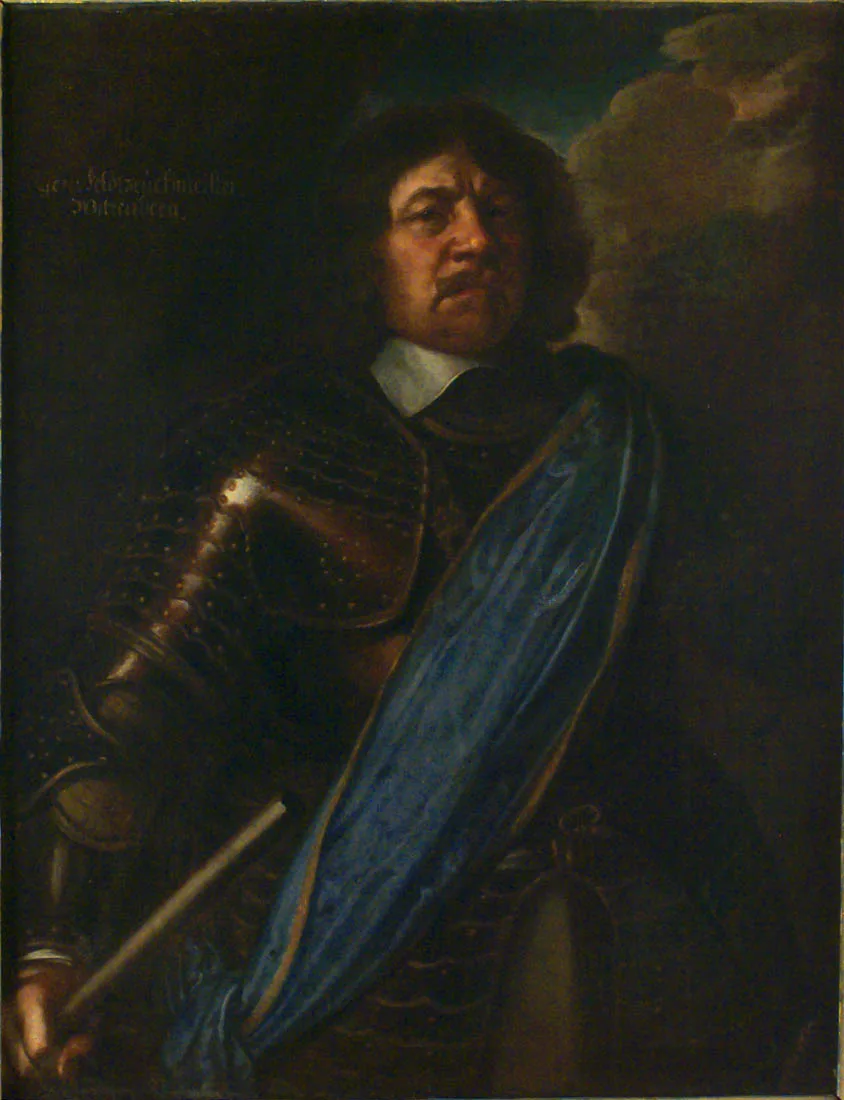
Painter: Matthäus Merian the Younger · 1649 · Wikimedia Commons · Public domain
A veteran before the invasion
Arvid Wittenberg (1606–1657) was born in the territory of present-day Finland, then part of the Swedish realm. He rose through the Thirty Years' War and became a field marshal in 1655. The Swedish History Museums' person record lists his offices, countship and family. Sweden therefore entrusted the invasion to an experienced European commander12.
Ujście and Warsaw
In July 1655 Wittenberg led a Swedish army into the Commonwealth before Charles X Gustav arrived. At Ujście he forced the surrender of the levy from the Poznań and Kalisz provinces and signed the terms on the king's behalf. This opened Greater Poland to Sweden without a major pitched battle3.
Wittenberg also took part in the campaign culminating in Kraków's capture. He later commanded the Swedish garrison in Warsaw. In 1656 it repelled four assaults before surrendering when relief failed to arrive. Despite the surrender terms, Wittenberg was detained and died in Polish captivity at Zamość in 165724.
Novel and film
In Sienkiewicz's The Deluge, Wittenberg belongs to the real Swedish military background. His career also shows how quickly the invasion's early victories could be reversed. Hoffman's 1974 film selects only some episodes of the war; no separate Wittenberg role has been verified in its cast56.
Notes
- Statens historiska museer, Wittenberg, Arvid, Sök i samlingarna, Stockholm: Statens historiska museer
- Uppslagsverket Finland, Wittenberg, Arvid, Uppslagsverket Finland, Helsinki: Svenska folkskolans vänner
- Ludwik Kubala, Wojna szwecka w roku 1655 i 1656, Szkice historyczne, serya IV (Biblioteka Historyczna Altenberga), Lwów; Warszawa: H. Altenberg, G. Seyfarth, E. Wende i Sp.; E. Wende i Sp., 1913, pp. 70–76
- Kapitulacja Szwedów w Warszawie, Oś czasu, Warszawa: Muzeum Wojska Polskiego w Warszawie
- Henryk Sienkiewicz, Potop, Fundacja Nowoczesna Polska (Wolne Lektury), 2009–2010
- Potop, Łódź: Państwowa Wyższa Szkoła Filmowa, Telewizyjna i Teatralna im. Leona Schillera w Łodzi (filmpolski.pl)
Explore further
Related
Related
- Capitulation at Ujście (1655) Documented
Sources for this page
- Statens historiska museer, Wittenberg, Arvid, Sök i samlingarna, Stockholm: Statens historiska museer (Academic study)
- Uppslagsverket Finland, Wittenberg, Arvid, Uppslagsverket Finland, Helsinki: Svenska folkskolans vänner (Academic study)
- Ludwik Kubala, Wojna szwecka w roku 1655 i 1656, Szkice historyczne, serya IV (Biblioteka Historyczna Altenberga), Lwów; Warszawa: H. Altenberg, G. Seyfarth, E. Wende i Sp.; E. Wende i Sp., 1913 (Academic study)
- Kapitulacja Szwedów w Warszawie, Oś czasu, Warszawa: Muzeum Wojska Polskiego w Warszawie (Institution)
- Henryk Sienkiewicz, Potop, Fundacja Nowoczesna Polska (Wolne Lektury), 2009–2010 (Primary source)
- Potop, Łódź: Państwowa Wyższa Szkoła Filmowa, Telewizyjna i Teatralna im. Leona Schillera w Łodzi (filmpolski.pl) (Reference work)