
AI illustration
Imagined scene; identification of the reference portrait as Wiśniowiecki is uncertain.
Commander
Jeremi Wiśniowiecki
b. 1612, d. 20 VIII 1651
Historical figureVoivode of Ruthenia and commander at Zbarazh. He died in 1651, so his military fame belongs to the years before the Deluge.
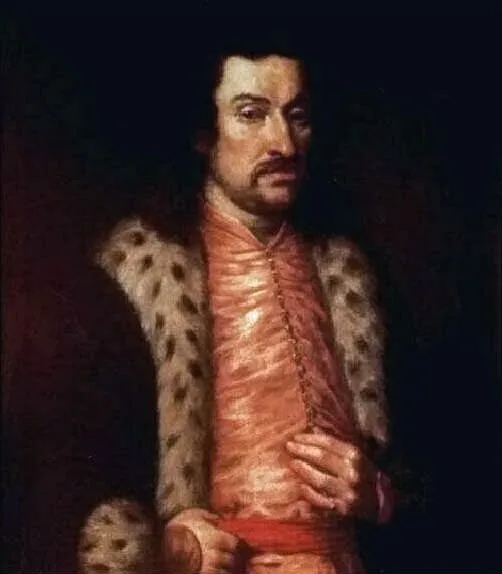
Painter: workshop of Daniela Schultza · third quarter of the 17th century · Muzeum Narodowe w Warszawie / Wikimedia Commons; portrait identification uncertain · Public domain
Who was Prince Jeremi?
Jeremi Wiśniowiecki (1612–1651) was a powerful magnate and voivode of Ruthenia. He commanded his own forces in Commonwealth wars before Sweden invaded. The Polish Army Museum records his part in the Smolensk war, campaigns against Tatars and the Khmelnytsky Uprising. He did not fight in the Deluge: he died four years before it began1.
Zbarazh and Berestechko
In 1649 Jeremi took effective command at the siege of Zbarazh, although the Sejm had appointed several temporary commanders. The camp also held Aleksander Koniecpolski and Stanisław Lanckoroński, who later took part in the Swedish war. In 1651 Jeremi commanded cavalry on the left wing at Berestechko. The museum credits him with rallying troops after earlier Crown defeats21.
Fame and context
Polish historical memory often presents him as the defender of Zbarazh. The Cossack war has other perspectives: to the insurgents, magnate power and its armed defence were part of the conflict. His military reputation belongs alongside the political and social background of the uprising, which weakened the Commonwealth before 165523.
Death, burial and portraits
Jeremi died suddenly on 20 August 1651 in the camp near Pavoloch. The Wilanów museum discusses several possible causes of death, none established. He was later buried at Holy Cross without an official funeral; studies of remains long shown as his did not confirm that identification. Surviving portraits are also uncertain likenesses. The painting on this page is attributed to Jeremi, and the header is only an interpretation inspired by it41.
Novel and film
Jeremi belongs chiefly to the historical setting of With Fire and Sword, the earlier novel in Henryk Sienkiewicz's Trilogy. The events of The Deluge and Jerzy Hoffman's film begin after his death. His actions at Zbarazh should not be confused with the Swedish war of 1655–1660456.
Notes
- W obozie pod Pawołoczą zmarł książę Jeremi Wiśniowiecki, Muzeum Wojska Polskiego w Warszawie
- Wojska Bohdana Chmielnickiego przerwały oblężenie Zbaraża, Muzeum Wojska Polskiego w Warszawie
- Bitwa pod Korsuniem, Kalendarium – Dzieje Oręża Polskiego, Warszawa: Muzeum Wojska Polskiego w Warszawie
- Hanna Widacka, Zagadki w biografii kniazia Jaremy, Muzeum Pałacu Króla Jana III w Wilanowie, 2008
- Henryk Sienkiewicz, Potop, Fundacja Nowoczesna Polska (Wolne Lektury), 2009–2010
- Potop, Łódź: Państwowa Wyższa Szkoła Filmowa, Telewizyjna i Teatralna im. Leona Schillera w Łodzi (filmpolski.pl)
Explore further
Related
Took part in
- Siege of Zbarazh Documented
- Battle of Berestechko Documented
Related
- Khmelnytsky Uprising begins Documented
Sources for this page
- W obozie pod Pawołoczą zmarł książę Jeremi Wiśniowiecki, Muzeum Wojska Polskiego w Warszawie (Institution)
- Wojska Bohdana Chmielnickiego przerwały oblężenie Zbaraża, Muzeum Wojska Polskiego w Warszawie (Institution)
- Bitwa pod Korsuniem, Kalendarium – Dzieje Oręża Polskiego, Warszawa: Muzeum Wojska Polskiego w Warszawie (Institution)
- Hanna Widacka, Zagadki w biografii kniazia Jaremy, Muzeum Pałacu Króla Jana III w Wilanowie, 2008 (Academic study)
- Henryk Sienkiewicz, Potop, Fundacja Nowoczesna Polska (Wolne Lektury), 2009–2010 (Primary source)
- Potop, Łódź: Państwowa Wyższa Szkoła Filmowa, Telewizyjna i Teatralna im. Leona Schillera w Łodzi (filmpolski.pl) (Reference work)