
AI illustration
Imagined scene inspired by the biography and portrait shown below.
Monarch
Zygmunt III Waza
Historical figureKing of Poland and Sweden whose lost Swedish crown and the fortification of Jasna Góra left different legacies for the Deluge.
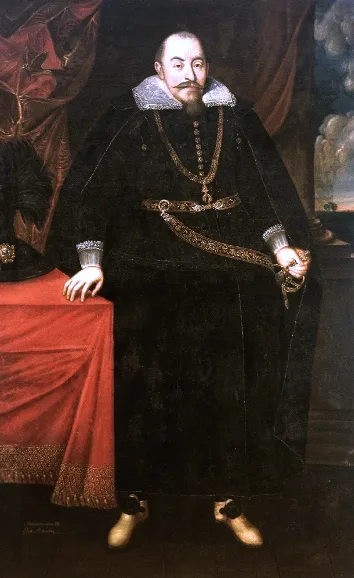
Painter: unknown · first half of the 17th century · Wikimedia Commons · Public domain
Life and reign
Sigismund was born in 1566 to John III of Sweden and Catherine Jagiellon. Elected king of the Polish–Lithuanian Commonwealth in 1587, he was also king of Sweden from 1592 until 1599. Protestant opposition removed him from power there, but he and his descendants did not abandon their claim to the Swedish crown. The dynastic dispute burdened relations between the two states long before the invasion of 1655.12
Under Sigismund the royal court settled permanently in Warsaw and the Royal Castle was enlarged. He patronised the arts. A less familiar initiative concerned the postal service: his proposed reform envisaged weekly delivery to major cities and access for every estate of society, although the plan was not completed.3
He died in 1632, more than twenty years before the Deluge. His sons Władysław IV and John II Casimir succeeded him.4
Why does he matter to the Deluge?
On Sigismund's orders, work began in 1620 on modern bastioned defences for Jasna Góra. Continued under Władysław IV until 1644, they made the monastery a small but modern fortress by the time of the 1655 siege. Sigismund did not take part in that defence: his earlier decision helped make it possible.5
The other connection is political. The Vasas' claim to Sweden remained an issue in Polish–Swedish relations, though it alone does not explain the war: Baltic interests and Charles X Gustav's immediate strategic choices mattered too.26
An unexpected trace in Warsaw
John II Casimir erected Sigismund's Column outside Warsaw's Royal Castle. One inscription described Sigismund as the rightful heir to the Swedish crown. According to a museum account, Charles X Gustav took offence at the inscription after occupying Warsaw in 1655. A city monument had become a visible reminder of a dynastic quarrel.7
In the novel and film
Sigismund died before the events of Sienkiewicz's The Deluge. He must not be confused with John II Casimir or placed in scenes of the Jasna Góra siege. His relevance to their historical setting is the dynastic legacy and the fortress whose early defences were built under his reign.85
Notes
- Zygmunt III Waza, Warszawa: Archiwum Państwowe w Łodzi
- Detronizacja Zygmunta III w Szwecji i początek sporów, Warszawa: Muzeum Wojska Polskiego w Warszawie
- Plany reformy pocztowej Zygmunta III Wazy, Warszawa: Muzeum Pałacu Króla Jana III w Wilanowie
- Zygmunt III Waza (1587–1632), Warszawa: Narodowy Bank Polski
- Oblężenie Jasnej Góry, Kalendarium – Dzieje Oręża Polskiego, Warszawa: Muzeum Wojska Polskiego w Warszawie
- Stellan Dahlgren, Karl X Gustav, Svenskt biografiskt lexikon, bd 20, Svenskt biografiskt lexikon (Riksarkivet), 1973–1975, s. 641
- Ustawienie Kolumny Zygmunta, Warszawa: Muzeum Pałacu Króla Jana III w Wilanowie
- Henryk Sienkiewicz, Potop, Fundacja Nowoczesna Polska (Wolne Lektury), 2009–2010
Explore further
History
Related
Related
- Siege of Jasna Góra (1655) Documented
Sources for this page
- Zygmunt III Waza, Warszawa: Archiwum Państwowe w Łodzi (Institution)
- Detronizacja Zygmunta III w Szwecji i początek sporów, Warszawa: Muzeum Wojska Polskiego w Warszawie (Institution)
- Plany reformy pocztowej Zygmunta III Wazy, Warszawa: Muzeum Pałacu Króla Jana III w Wilanowie (Institution)
- Zygmunt III Waza (1587–1632), Warszawa: Narodowy Bank Polski (Institution)
- Oblężenie Jasnej Góry, Kalendarium – Dzieje Oręża Polskiego, Warszawa: Muzeum Wojska Polskiego w Warszawie (Institution)
- Stellan Dahlgren, Karl X Gustav, Svenskt biografiskt lexikon, bd 20, Svenskt biografiskt lexikon (Riksarkivet), 1973–1975, s. 641 (Reference work)
- Ustawienie Kolumny Zygmunta, Warszawa: Muzeum Pałacu Króla Jana III w Wilanowie (Institution)
- Henryk Sienkiewicz, Potop, Fundacja Nowoczesna Polska (Wolne Lektury), 2009–2010 (Primary source)