
AI illustration
Imagined monastery siege; architecture and troop positions are interpretive.
Monastery
Jasna Góra
A hill in Częstochowa with a Pauline monastery which, fortified by 1655, was defended that year against General Müller's Swedish corps.
A sanctuary, archive and museum
Jasna Góra’s history extends beyond the siege. The 600th Anniversary Museum occupies the former monastery printing house and presents Pauline history, devotion to the image and artistic crafts, including devotional gorgets and coffin portraits. The Knights’ Hall retains seventeenth-century paintings of events significant to the order. The library holds early printed books and illuminated manuscripts, while its ceiling paintings date from the early eighteenth century. These distinct spaces reveal a monastery devoted to prayer, preserving knowledge and remembering its past1.
During the Deluge
Kordecki writes that his forebears called the hill Jasna ("bright") because it commands a view on every side, and that it rises from hard rock. According to his account, the church and monastery were built in 1382 by Duke Władysław of Opole, who gave them to the Paulines brought from Hungary2. Władysław IV surrounded the church and monastery with a wall and strengthened it with towers3. The National Heritage Board (NID) states that work on the fortifications began in 1624 on the initiative of Sigismund III Vasa, and that from 1639 the monastery buildings were enclosed by the walls of a four-bastion fortress known as the Fortalitium Marianum. By a decision of the Sejm of 1652 the community was obliged to maintain a permanent military garrison4. Kubala describes the fortress of 1655 as surrounded by a rampart, a moat and a wall with a single gate on the south and four towers. From the windows of the monastery one could see the surrounding country for three old Polish miles around5. The Museum of Polish History describes Jasna Góra as a fairly strong fortress with bastioned fortifications6.
The prior at the time was Augustyn Kordecki7. According to Kordecki and Kubala, the monastery then had 70 monks and a garrison of 160 soldiers85. The castellan of Kraków, Stanisław Warszycki, sent twelve guns9. Before the Swedes arrived, the prior took the miraculous image away to Lubliniec in Silesia and sank the monastery's silver in a pond5. In November and December 1655 the monastery withstood a siege by Burchard Müller's corps (Siege of Jasna Góra (1655)).
Today
The Pauline monastery complex at Jasna Góra was declared a Monument of History (Pomnik Historii) by order of the President of the Republic of Poland of 8 September 19944. In the nineteenth century the tsarist authorities dismantled the fortress and stripped the walls of their defensive features, and the complex acquired its present form during rebuilding at the beginning of the twentieth century4. In its description of the present complex the NID discusses the walls of the former four-bastion fortress with its entrance on the south, and mentions the collection of militaria kept in the monastery arsenal4.
Defence as everyday work
Kubala also describes work inside the walls. Incendiary bombardment required defenders to extinguish roofs, push bombs away with poles and cover them with wet cloth. Continuous night-time danger denied the garrison rest. Outside, attackers dug trenches and prepared artillery positions, while rocky ground hindered mining. The historian reconstructs these actions from earlier accounts; they are not observations by a contemporary reporter. Defence involved vigilance, repairs and controlling repeated fires, as well as the commanders’ courage10.
Konstancja: the story of a messenger
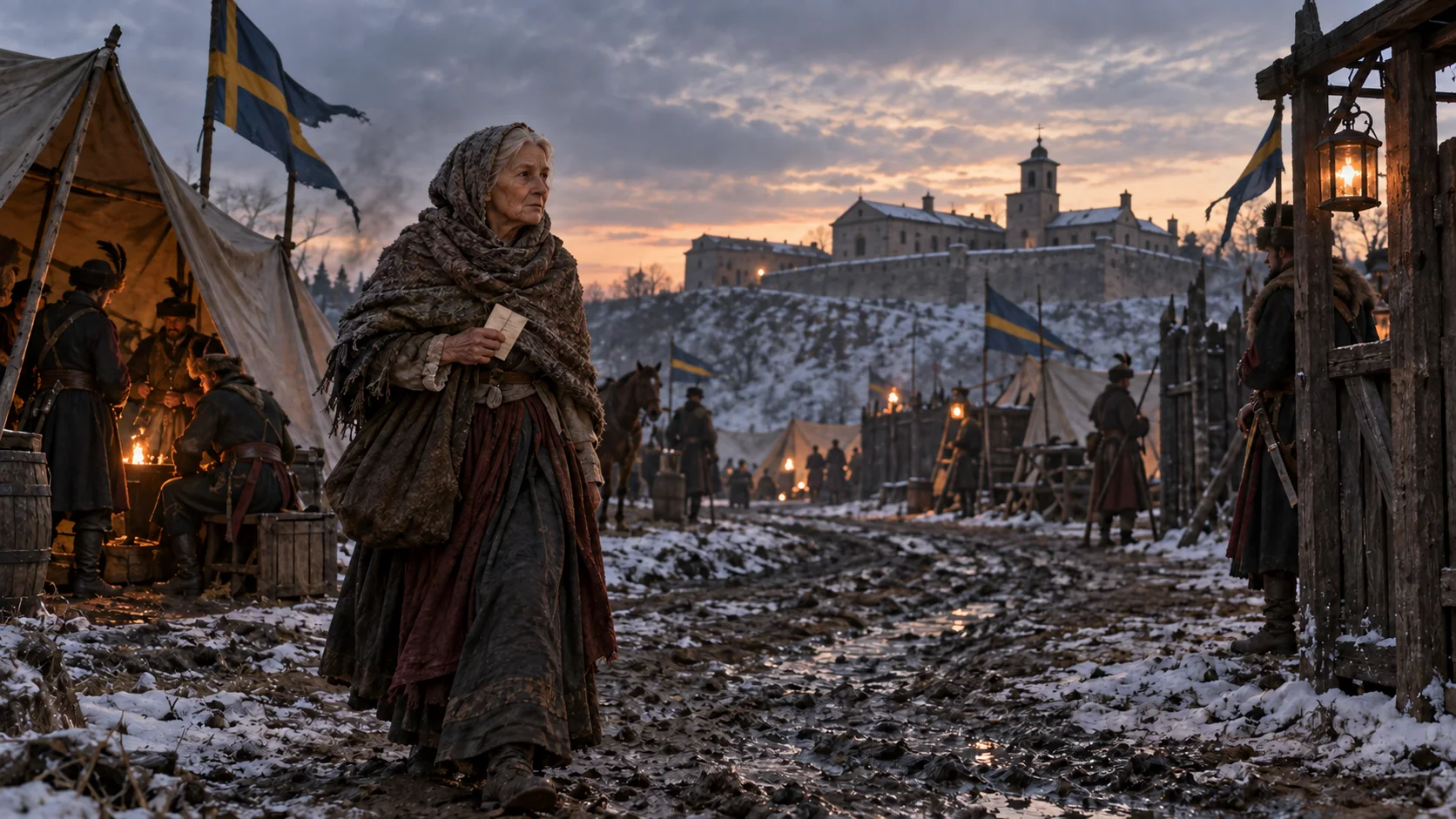
In his account of the days before Christmas, Kubala describes a poor woman named Konstancja who lived near the ramparts. She reportedly collected shot and wood and supplied provisions she could find. When no one would carry a letter to the Swedish camp, she undertook the mission in return for bread. It broadens the siege’s cast to people outside the military hierarchy11.
The treasury and pilgrimage
The treasury is the oldest part of Jasna Góra’s museum display. It holds votive gifts offered over centuries: goldsmiths’ work, jewellery, textiles, armour, and liturgical vessels and vestments. Donors included monarchs, nobles, clergy and worshippers from different countries. The objects testify to the sanctuary’s significance and its connections beyond the monastery. They are not all relics of the war of 1655. Individual donors and objects provide further stories alongside the history of the fortress12.
Notes
- Muzea Jasnej Góry, Urząd Miasta Częstochowy
- Augustyn Kordecki; przeł. Józef Łepkowski, (Nowa Gigantomachia): pamiętnik oblężenia Częstochowy roku 1655, Warszawa: S. Orgelbrand, 1858, s. 13
- Augustyn Kordecki; przeł. Józef Łepkowski, (Nowa Gigantomachia): pamiętnik oblężenia Częstochowy roku 1655, Warszawa: S. Orgelbrand, 1858, s. 14
- Narodowy Instytut Dziedzictwa, Częstochowa – Jasna Góra – zespół klasztoru oo. Paulinów, Zabytek.pl (Pomnik Historii), Warszawa: Narodowy Instytut Dziedzictwa
- Ludwik Kubala, Wojna szwecka w roku 1655 i 1656, Szkice historyczne, serya IV (Biblioteka Historyczna Altenberga), Lwów; Warszawa: H. Altenberg, G. Seyfarth, E. Wende i Sp.; E. Wende i Sp., 1913, s. 153
- Anna Łappo, Szwedzi odstępują od oblężenia Jasnej Góry, Warszawa: Muzeum Historii Polski w Warszawie
- Adam Kersten, Kordecki Klemens, imię zakonne Augustyn (1603–1673), Polski słownik biograficzny, t. 14, Wrocław: Zakład Narodowy im. Ossolińskich, 1968–1969, s. 53–55
- Augustyn Kordecki; przeł. Józef Łepkowski, (Nowa Gigantomachia): pamiętnik oblężenia Częstochowy roku 1655, Warszawa: S. Orgelbrand, 1858, s. 105
- Augustyn Kordecki; przeł. Józef Łepkowski, (Nowa Gigantomachia): pamiętnik oblężenia Częstochowy roku 1655, Warszawa: S. Orgelbrand, 1858, s. 26
- Ludwik Kubala, Wojna szwecka w roku 1655 i 1656, Szkice historyczne, serya IV (Biblioteka Historyczna Altenberga), Lwów; Warszawa: H. Altenberg, G. Seyfarth, E. Wende i Sp.; E. Wende i Sp., 1913, s. 161–162
- Ludwik Kubala, Wojna szwecka w roku 1655 i 1656, Szkice historyczne, serya IV (Biblioteka Historyczna Altenberga), Lwów; Warszawa: H. Altenberg, G. Seyfarth, E. Wende i Sp.; E. Wende i Sp., 1913, s. 177
- Skarbiec, Jasnogórskie Centrum Informacji
Explore further
Related
Related
- Częstochowa
- Jacek Brzuchański Historical figure
- Konstancja Historical figure
Events here
- Siege of Jasna Góra (1655) Documented
Sources for this page
- Muzea Jasnej Góry, Urząd Miasta Częstochowy (Institution)
- Augustyn Kordecki; przeł. Józef Łepkowski, (Nowa Gigantomachia): pamiętnik oblężenia Częstochowy roku 1655, Warszawa: S. Orgelbrand, 1858 (Primary source)
- Narodowy Instytut Dziedzictwa, Częstochowa – Jasna Góra – zespół klasztoru oo. Paulinów, Zabytek.pl (Pomnik Historii), Warszawa: Narodowy Instytut Dziedzictwa (Institution)
- Ludwik Kubala, Wojna szwecka w roku 1655 i 1656, Szkice historyczne, serya IV (Biblioteka Historyczna Altenberga), Lwów; Warszawa: H. Altenberg, G. Seyfarth, E. Wende i Sp.; E. Wende i Sp., 1913 (Academic study)
- Anna Łappo, Szwedzi odstępują od oblężenia Jasnej Góry, Warszawa: Muzeum Historii Polski w Warszawie (Institution)
- Adam Kersten, Kordecki Klemens, imię zakonne Augustyn (1603–1673), Polski słownik biograficzny, t. 14, Wrocław: Zakład Narodowy im. Ossolińskich, 1968–1969, s. 53–55 (Reference work)
- Skarbiec, Jasnogórskie Centrum Informacji (Institution)