
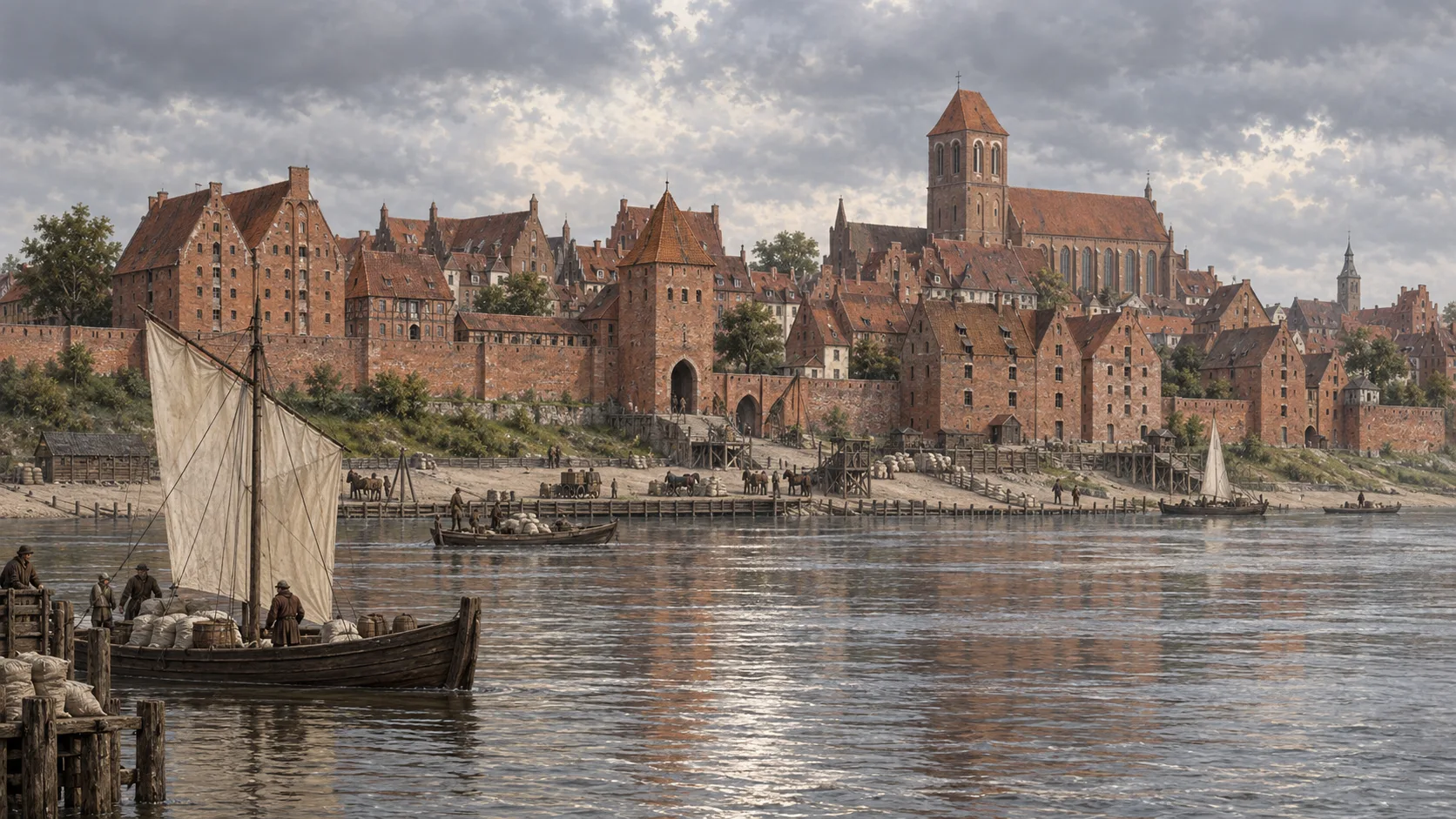
AI illustration
Imagined period town; smoke is an animation effect.
City
Toruń
A Swedish garrison held Toruń until the end of 1658. Its blockade and surrender formed part of the recovery of Royal Prussia.
A city older than the Deluge
Toruń received its foundation charter on 28 December 1233 from Hermann von Salza and Hermann Balk. It remained under the Teutonic Order until joining the Polish side in 1454. That year the townspeople demolished the Teutonic castle. This matters when imagining the city during the Deluge: the siege of 1658 should not be portrayed as a struggle for an intact medieval headquarters of the Order. The castle ruins and town had already experienced two centuries of a different political history1.
A fortress in Royal Prussia
Toruń was among the towns held by a Swedish garrison after the campaign elsewhere had begun to turn against Sweden. In 1658 Commonwealth and imperial forces began a blockade. The operation shows that recapturing fortified cities took time, supplies and allied cooperation even after earlier victories in the field2.
The siege ends
The Swedish garrison surrendered at the end of December 1658. Recovering Toruń weakened Sweden's position in Royal Prussia, but did not end the war: the Peace of Oliwa came in 166034.
On the map
The city marker aids orientation. Separate event pages distinguish the start of the blockade from the surrender so readers can follow a long siege rather than see a single date23.
Surrender, a garrison and a royal coin
According to the Regional Museum, surrender terms were settled on 4 December 1655, and Swedish troops entered through the Chełmińska Gate the next day. Liberation did not immediately end military burdens. In January 1659 John Casimir spent eighteen days in Toruń negotiating the Polish garrison, whose upkeep fell on residents. The museum holds a three-ducat presentation coin from 1659. It connects the king’s presence with the city’s minting tradition and the memory of Toruń’s recovery5.
Reading the surviving town
The UNESCO property comprises the Old Town, New Town and Teutonic castle site. Their layout and Gothic buildings recall a medieval trading centre associated with the Hanseatic League. Many buildings date from the fourteenth and fifteenth centuries, and the historic urban plan survives to an exceptional degree. Walking through the centre therefore reveals a setting older than the Deluge. Its inscription as World Heritage in 1997 recognises this whole ensemble, rather than a single church or house6.
Notes
- Krzyżacy – założyciele Torunia, Urząd Miasta Torunia
- Blokada szwedzkiej załogi Torunia, Oś czasu, Warszawa: Muzeum Wojska Polskiego w Warszawie
- Kapitulacja szwedzkiej załogi Torunia, Oś czasu, Warszawa: Muzeum Wojska Polskiego w Warszawie
- Ludwik Kubala, Wojny duńskie i pokój oliwski 1657–1660, Szkice historyczne, serja VI (Biblioteka Historyczna Altenberga), Lwów: Księgarnia Wydawnicza H. Altenberga, 1922
- Wojny Polski i Szwecji, Muzeum Okręgowe w Toruniu
- Medieval Town of Toruń, UNESCO
Explore further
Related
Related
- Blockade of the Swedish garrison in Toruń Documented
- Swedish garrison of Toruń surrenders Documented
Sources for this page
- Krzyżacy – założyciele Torunia, Urząd Miasta Torunia (Institution)
- Blokada szwedzkiej załogi Torunia, Oś czasu, Warszawa: Muzeum Wojska Polskiego w Warszawie (Institution)
- Kapitulacja szwedzkiej załogi Torunia, Oś czasu, Warszawa: Muzeum Wojska Polskiego w Warszawie (Institution)
- Ludwik Kubala, Wojny duńskie i pokój oliwski 1657–1660, Szkice historyczne, serja VI (Biblioteka Historyczna Altenberga), Lwów: Księgarnia Wydawnicza H. Altenberga, 1922 (Academic study)
- Wojny Polski i Szwecji, Muzeum Okręgowe w Toruniu (Institution)
- Medieval Town of Toruń, UNESCO (Institution)