
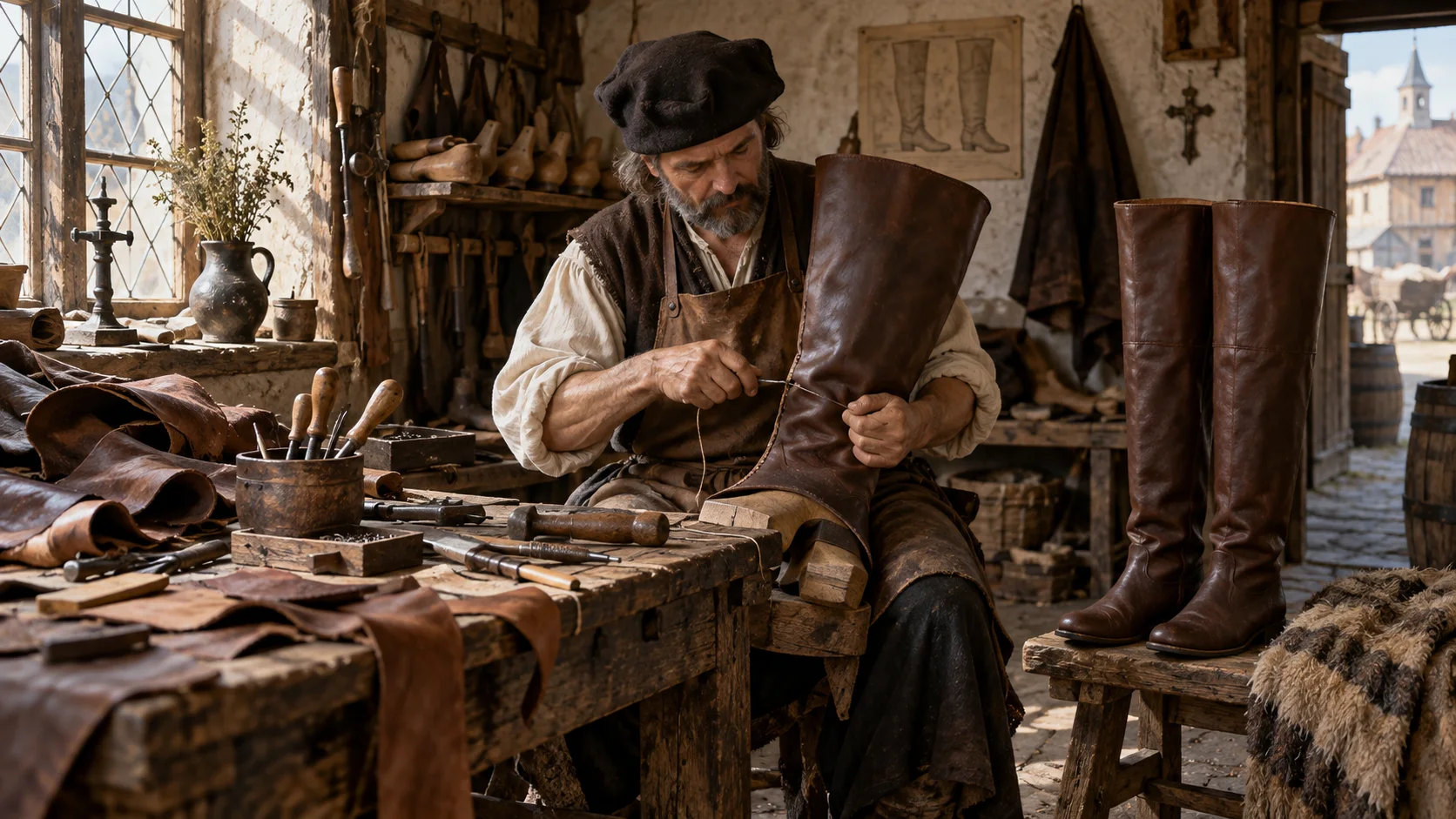
AI illustration
Imagined period town; smoke is an animation effect.
Town
Tyszowce
In this town the Crown army and nobles swore a confederation against the Swedish king in December 1655.
A royal town on the Huczwa
Tyszowce grew beside the Huczwa amid marshy ground. It became a royal town in 1462. Crafts sustained its economy: the municipal history records shoemakers’ guilds in 1563, furriers in 1578, and smiths and weavers in 1610. Warfare interrupted growth. The Cossack attack of 1648 and Crown troops’ passage the following year brought destruction before the Deluge began. The confederation’s setting therefore had its own history of trade, work and wartime losses1.
A political turning point
Tyszowce was not the scene of a major battle. On 29 December 1655 commanders, soldiers and nobles swore the Tyszowce Confederation in the local church. They renounced allegiance to Charles X Gustav and called for renewed resistance. It marked the reversal of some earlier defections to Sweden2.
In the story
John Casimir was returning to the country; he did not lead the meeting in Tyszowce. In The Deluge, Anusia Borzobohata brings news of the confederation to the fictional characters. The town thus matters in both political history and the novel34.
What the confederates resolved
Kubala reproduces the confederation’s act as a programme of mobilisation, beyond a declaration of resistance. The army agreed to defer its pay. Nobles still supporting Charles Gustav were offered an amnesty if they joined. Military obligations depended on estate size: five łans of land were to supply a soldier, while towns had to send an armed and provisioned man for every ten houses. Powder and lead were also required. These provisions show how the political reversal was intended to generate manpower, weapons and army supplies5.
Tyszowiaki: craft and legend
Local shoemakers were known for tyszowiaki: tall leather boots wide enough to accommodate a foot wrapped in cloth. Tar improved water resistance, and an identical shape allowed either boot to fit either foot. Hereditas also records a legend that Jagiełło ordered ten thousand pairs before Grunwald; this is local tradition, not a verified supply total. A boots monument was unveiled in Confederation Square in 2019. Craft heritage and remembrance of the wartime event now share the same public space6.
Notes
- Historia Tyszowiec, Urząd Miejski w Tyszowcach, 2021
- Ludwik Kubala, Wojna szwecka w roku 1655 i 1656, Szkice historyczne, serya IV (Biblioteka Historyczna Altenberga), Lwów; Warszawa: H. Altenberg, G. Seyfarth, E. Wende i Sp.; E. Wende i Sp., 1913, pp. 262–264
- Ludwik Kubala, Wojna szwecka w roku 1655 i 1656, Szkice historyczne, serya IV (Biblioteka Historyczna Altenberga), Lwów; Warszawa: H. Altenberg, G. Seyfarth, E. Wende i Sp.; E. Wende i Sp., 1913, pp. 261–265
- Henryk Sienkiewicz, Potop, Fundacja Nowoczesna Polska (Wolne Lektury), 2009–2010, vol. III, ch. XX
- Ludwik Kubala, Wojna szwecka w roku 1655 i 1656, Szkice historyczne, serya IV (Biblioteka Historyczna Altenberga), Lwów; Warszawa: H. Altenberg, G. Seyfarth, E. Wende i Sp.; E. Wende i Sp., 1913, s. 262–264
- Tyszowiaki, Fundacja Hereditas, 2021
Explore further
Related
Related
- Tyszowce Confederation (1655) Documented
Sources for this page
- Historia Tyszowiec, Urząd Miejski w Tyszowcach, 2021 (Institution)
- Ludwik Kubala, Wojna szwecka w roku 1655 i 1656, Szkice historyczne, serya IV (Biblioteka Historyczna Altenberga), Lwów; Warszawa: H. Altenberg, G. Seyfarth, E. Wende i Sp.; E. Wende i Sp., 1913 (Academic study)
- Henryk Sienkiewicz, Potop, Fundacja Nowoczesna Polska (Wolne Lektury), 2009–2010 (Primary source)
- Tyszowiaki, Fundacja Hereditas, 2021 (Institution)