
AI illustration
Imagined scene inspired by the biography and portrait shown below.
Magnate
Krzysztof Opaliński
Historical figureVoivode of Poznań, satirist and school founder at Sieraków; he signed Greater Poland's surrender at Ujście.
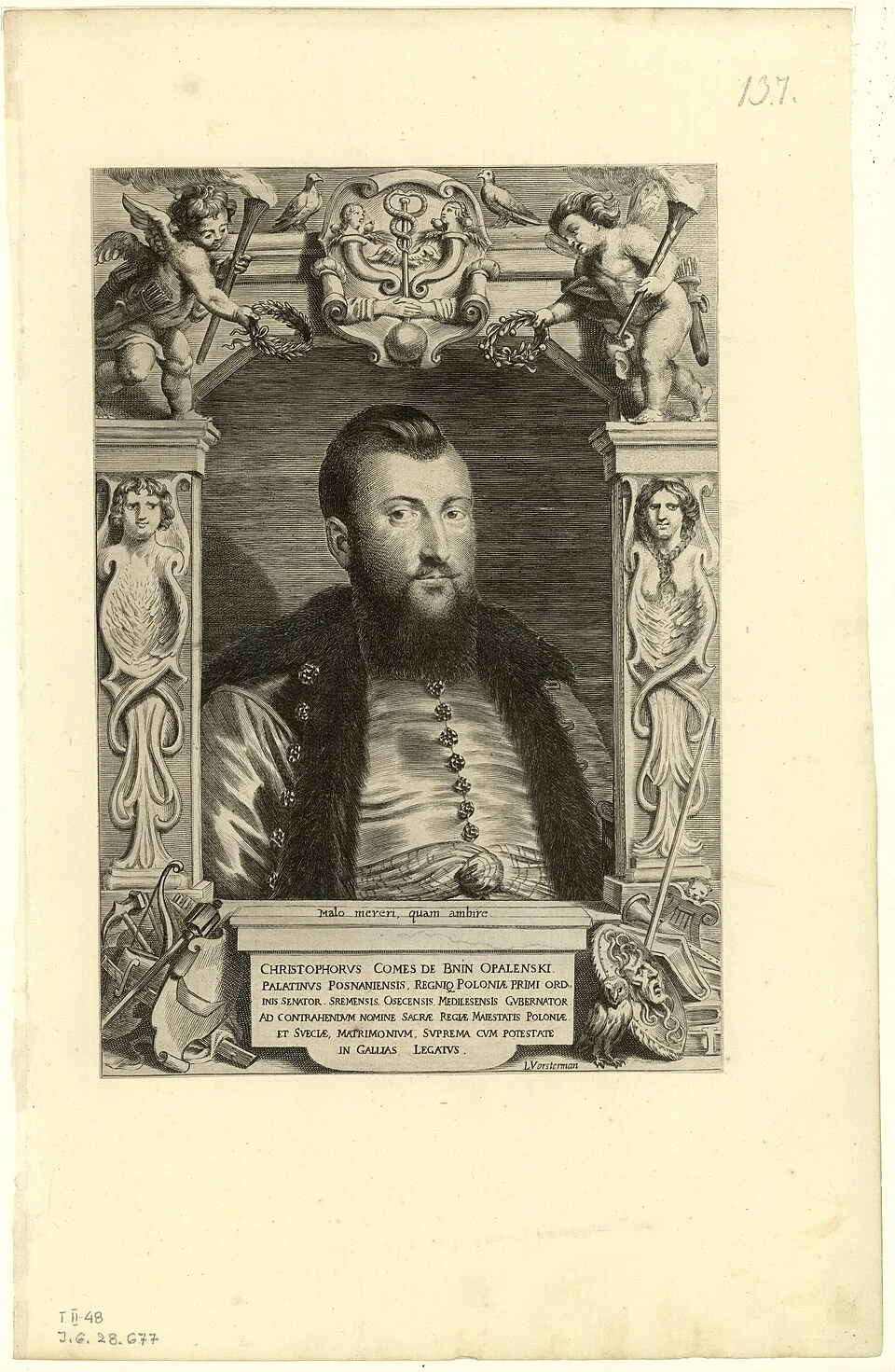
Engraver: Lucas Vorsterman · 1645 · Biblioteka Narodowa / Wikimedia Commons · Public domain
Politician and writer
Krzysztof Opaliński (1609–1655) came from Sieraków. Voivode of Poznań and a diplomat, he was also an important political satirist. In 1645 he took part in the embassy connected with Marie Louise Gonzaga's marriage to Władysław IV. At Sieraków he founded a school inspired by the teaching ideas of John Amos Comenius1.
His Satires, or Warnings for the Reform of Government and Manners attacked faults in the state and society. The first edition appeared in 1650; later editions have sometimes confused the publication date. The irony is striking: a critic of the Commonwealth's weaknesses became a symbol of its collapse in 165521.
Surrender at Ujście
Opaliński and Andrzej Karol Grudziński commanded Greater Poland's noble levy. Arvid Wittenberg's army reached Ujście only days after crossing the frontier. Polish command was divided; after Swedish manoeuvre and bombardment, it capitulated on 25 July. Opaliński signed the act accepting Swedish protection. Strategically, it opened the road into Greater Poland34.
Last months and memory
He died in December 1655, before the war's later reversal. His surrender should not erase his writing and educational work. Sienkiewicz made Ujście one of the opening images of state crisis in The Deluge. Opaliński belongs to that historical background; Hoffman's credited cast does not establish a distinct screen role for him156.
Notes
- Dariusz Rott, Krzysztof Opaliński, Staropolska online
- Satyry Krzysztofa Opalińskiego – edycja cyfrowa, Biblioteka Cyfrowa Uniwersytetu Jana Kochanowskiego
- Kapitulacja wielkopolskiego pospolitego ruszenia pod Ujściem, Oś czasu, Warszawa: Muzeum Wojska Polskiego w Warszawie
- Ludwik Kubala, Wojna szwecka w roku 1655 i 1656, Szkice historyczne, serya IV (Biblioteka Historyczna Altenberga), Lwów; Warszawa: H. Altenberg, G. Seyfarth, E. Wende i Sp.; E. Wende i Sp., 1913
- Henryk Sienkiewicz, Potop, Fundacja Nowoczesna Polska (Wolne Lektury), 2009–2010
- Potop, Łódź: Państwowa Wyższa Szkoła Filmowa, Telewizyjna i Teatralna im. Leona Schillera w Łodzi (filmpolski.pl)
Explore further
Related
Related
- Capitulation at Ujście (1655) Documented
- Jan Amos Comenius Historical figure
Sources for this page
- Dariusz Rott, Krzysztof Opaliński, Staropolska online (Institution)
- Satyry Krzysztofa Opalińskiego – edycja cyfrowa, Biblioteka Cyfrowa Uniwersytetu Jana Kochanowskiego (Institution)
- Kapitulacja wielkopolskiego pospolitego ruszenia pod Ujściem, Oś czasu, Warszawa: Muzeum Wojska Polskiego w Warszawie (Institution)
- Ludwik Kubala, Wojna szwecka w roku 1655 i 1656, Szkice historyczne, serya IV (Biblioteka Historyczna Altenberga), Lwów; Warszawa: H. Altenberg, G. Seyfarth, E. Wende i Sp.; E. Wende i Sp., 1913 (Academic study)
- Henryk Sienkiewicz, Potop, Fundacja Nowoczesna Polska (Wolne Lektury), 2009–2010 (Primary source)
- Potop, Łódź: Państwowa Wyższa Szkoła Filmowa, Telewizyjna i Teatralna im. Leona Schillera w Łodzi (filmpolski.pl) (Reference work)