
AI illustration
Imagined scene inspired by the biography and portrait shown below.
Civilian
Jan Amos Comenius
b. 28 III 1592, d. 15 XI 1670
Historical figureCzech educator and Brethren minister associated with Leszno; the war of 1656 destroyed his library and manuscripts and drove him into exile again.
- Names and variants
- la Johannes Amos Comenius
- pl Jan Amos Komeński
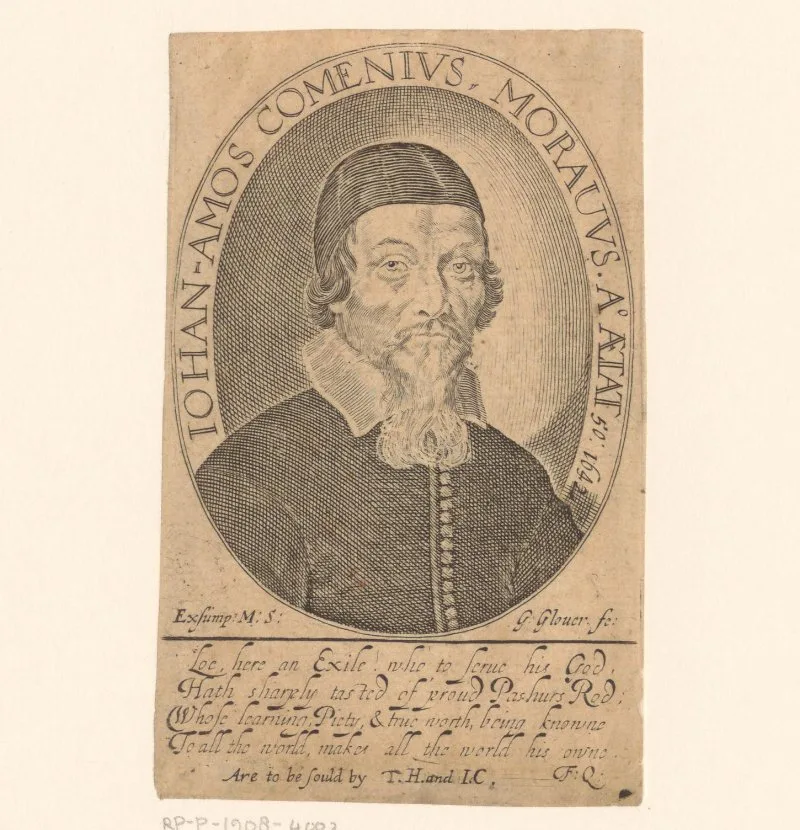
Engraver: George Glover · 1642 · Rijksmuseum, RP-P-1908-4002 · Public domain
A life of teaching and exile
Jan Amos Komenský, Latinized as Comenius, was born in Moravia in 1592. A minister of the Unity of the Brethren, he became an influential educator and textbook writer. Religious persecution brought him to Leszno in 1628. He directed its gymnasium in 1635–1642, reforming teaching, adapting books to pupils' ages and organizing school theatre.12
His educational proposal was unusual for its time: children should learn by observing and understanding the world rather than only memorizing words. He argued for broad access to education, including girls. His Janua linguarum reserata joined Latin with general knowledge; the later illustrated Orbis sensualium pictus developed this approach.12
The Deluge beyond the battlefield
Krzysztof Opaliński opened a school at Sieraków drawing on Comenius's ideas. Comenius himself lived and worked at Leszno. When the town was devastated in 1656, fire destroyed his library and valuable manuscripts. This was more than a private loss: part of a major seventeenth-century educator's work vanished. Both the city of Leszno and the Comenius Museum record that he then left for the Netherlands.3412
After Leszno
In Amsterdam he continued to write about education, peace and the reform of human knowledge. He died on 15 November 1670. He was neither a commander in the Deluge nor a character in Hoffman's film. His story shows a quieter cost of war: the destruction of books, schools and intellectual work that battle maps do not capture.21
Notes
- Śladami Jana Amosa Komeńskiego, Urząd Miasta Leszna
- Biografie: Jan Amos Comenius, Comenius Museum
- Dariusz Rott, Krzysztof Opaliński, Staropolska online
- Krzysztof Kossarzecki, Zniszczenia i rabunki dóbr kultury w Wielkopolsce w czasie potopu szwedzkiego 1655–1660, Analecta. Studia i Materiały z Dziejów Nauki, 33, z. 1, Warszawa: Instytut Historii Nauki PAN, 2024, s. 289–306, p. 296
Explore further
History
Related
Related
- Krzysztof Opaliński Historical figure
- Consequences of the Deluge Disputed
Sources for this page
- Śladami Jana Amosa Komeńskiego, Urząd Miasta Leszna (Institution)
- Biografie: Jan Amos Comenius, Comenius Museum (Institution)
- Dariusz Rott, Krzysztof Opaliński, Staropolska online (Institution)
- Krzysztof Kossarzecki, Zniszczenia i rabunki dóbr kultury w Wielkopolsce w czasie potopu szwedzkiego 1655–1660, Analecta. Studia i Materiały z Dziejów Nauki, 33, z. 1, Warszawa: Instytut Historii Nauki PAN, 2024, s. 289–306 (Academic study)