
AI illustration
Imagined scene inspired by the biography and portrait shown below.
Commander
Wincenty Gosiewski
Historical figureLithuanian field hetman, victor at Prostki, negotiator with Brandenburg and victim of a military killing in 1662.
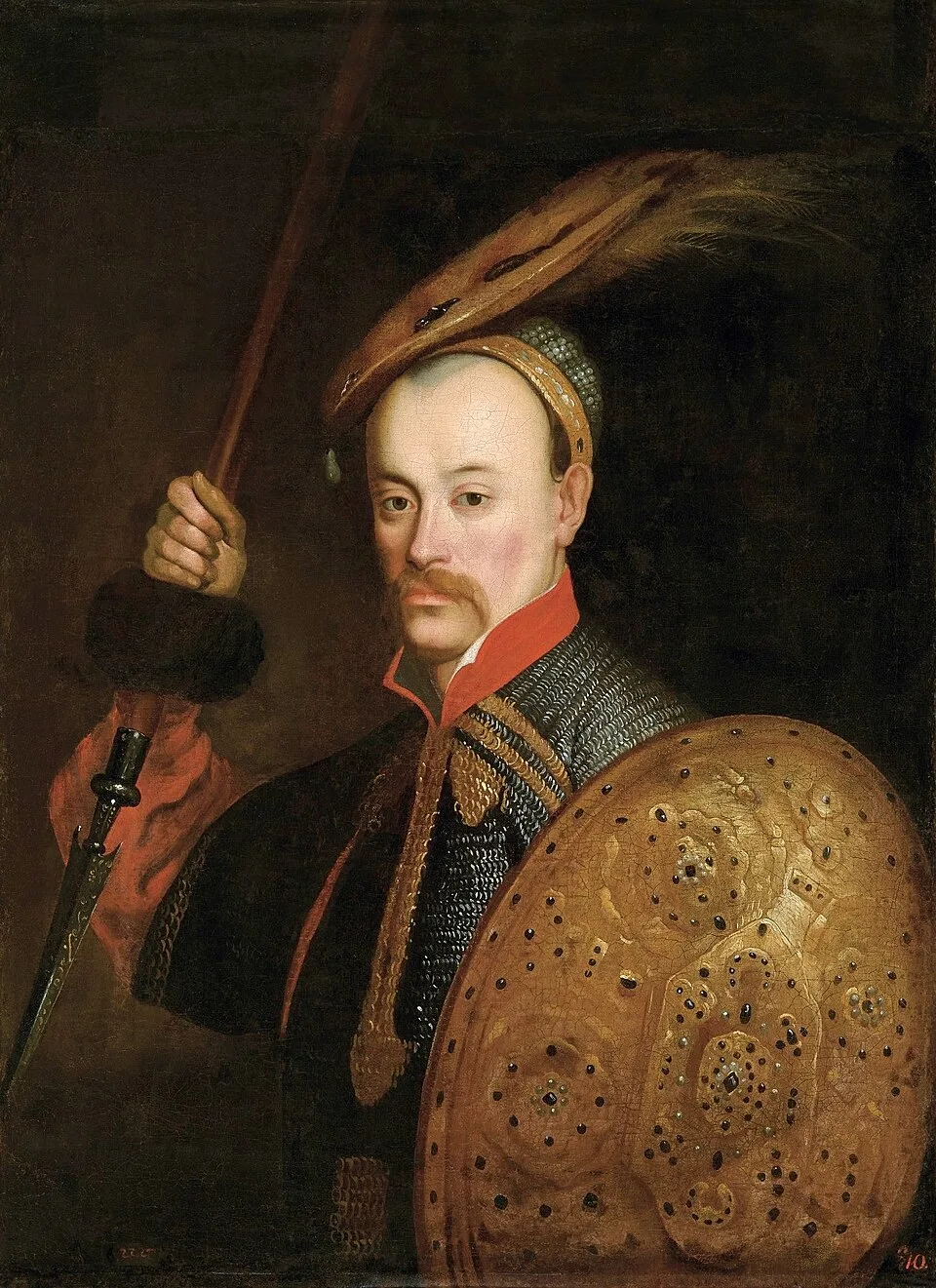
Painter: workshop of Daniela Schultza · 1650–1651 · Wikimedia Commons · Public domain
Life
Wincenty Aleksander Gosiewski came from a Lithuanian office-holding family. He studied in Vilnius, Vienna, Rome and Padua. He supported John II Casimir's election in 1648 and commanded cavalry under Janusz Radziwiłł in the war against the Cossacks. At Loyew in 1649 he led a hussar charge that helped secure a Lithuanian victory. His military career ran alongside service as grand treasurer of Lithuania.1
During the Deluge
His name appears on the 1655 Kėdainiai agreement, but this does not establish voluntary support for Sweden: Kubala says he signed under duress and was arrested after trying to leave the camp2.
In 1656 he led a Polish, Lithuanian and Tatar corps to victory at Prostki. Two weeks later he lost to Swedish and Brandenburg forces at Filipów34.
At Prostki his army captured Bogusław Radziwiłł, but Gosiewski lost this prisoner and some captured standards after the defeat at Filipów. The campaign also had a darker side: Tatar units accompanying his force carried civilians away into captivity. Its military success cannot be told without the cost borne by Prussian inhabitants.1
Gosiewski was also a negotiator. In 1657 he helped secure the Wehlau and Bromberg agreements: Brandenburg abandoned Sweden, while the Commonwealth recognised the elector's sovereignty in Ducal Prussia. On Samogitia and in Livonia, Gosiewski recovered Swedish-held strongholds, including Biržai. In 1658 Muscovite troops captured him near Verkiai.15
Captivity and death
While held in Moscow and Smolensk, he translated French moral writings; his version of The Mirror That Flatters Nobody appeared after his death. He was exchanged for five Russian governors in April 1662. Back home, he tried to settle a Lithuanian military confederation. Soldiers accused him of treason, abducted him and shot him on 29 November 1662. The end of the Swedish war had not ended the Commonwealth's military and political crisis.1
In the novel and film
Kėdainiai and the Lithuanian war matter to the world of The Deluge, but Gosiewski's life should not be conflated with that of its fictional heroes. Hoffman's film credits do not list a separate role for the hetman.67
Notes
- Wincenty Aleksander Gosiewski, Warszawa: Polski Słownik Biograficzny / Instytut Historii PAN
- Ludwik Kubala, Wojna szwecka w roku 1655 i 1656, Szkice historyczne, serya IV (Biblioteka Historyczna Altenberga), Lwów; Warszawa: H. Altenberg, G. Seyfarth, E. Wende i Sp.; E. Wende i Sp., 1913, pp. 88–90
- Bitwa pod Prostkami, Oś czasu, Warszawa: Muzeum Wojska Polskiego w Warszawie
- Bitwa pod Filipowem, Oś czasu, Warszawa: Muzeum Wojska Polskiego w Warszawie
- Układy welawsko-bydgoskie, Oś czasu, Warszawa: Muzeum Wojska Polskiego w Warszawie
- Henryk Sienkiewicz, Potop, Fundacja Nowoczesna Polska (Wolne Lektury), 2009–2010
- Potop, Łódź: Państwowa Wyższa Szkoła Filmowa, Telewizyjna i Teatralna im. Leona Schillera w Łodzi (filmpolski.pl)
Explore further
History
Related
Related
- Battle of Prostki Documented
Sources for this page
- Wincenty Aleksander Gosiewski, Warszawa: Polski Słownik Biograficzny / Instytut Historii PAN (Institution)
- Ludwik Kubala, Wojna szwecka w roku 1655 i 1656, Szkice historyczne, serya IV (Biblioteka Historyczna Altenberga), Lwów; Warszawa: H. Altenberg, G. Seyfarth, E. Wende i Sp.; E. Wende i Sp., 1913 (Academic study)
- Bitwa pod Prostkami, Oś czasu, Warszawa: Muzeum Wojska Polskiego w Warszawie (Institution)
- Bitwa pod Filipowem, Oś czasu, Warszawa: Muzeum Wojska Polskiego w Warszawie (Institution)
- Układy welawsko-bydgoskie, Oś czasu, Warszawa: Muzeum Wojska Polskiego w Warszawie (Institution)
- Henryk Sienkiewicz, Potop, Fundacja Nowoczesna Polska (Wolne Lektury), 2009–2010 (Primary source)
- Potop, Łódź: Państwowa Wyższa Szkoła Filmowa, Telewizyjna i Teatralna im. Leona Schillera w Łodzi (filmpolski.pl) (Reference work)