
AI illustration
Imagined scene inspired by the biography and portrait shown below.
Commander
Paweł Jan Sapieha
Historical figureLithuanian hetman and rival of the Radziwiłł family; an important anti-Swedish commander portrayed more warmly by Sienkiewicz than by historians.
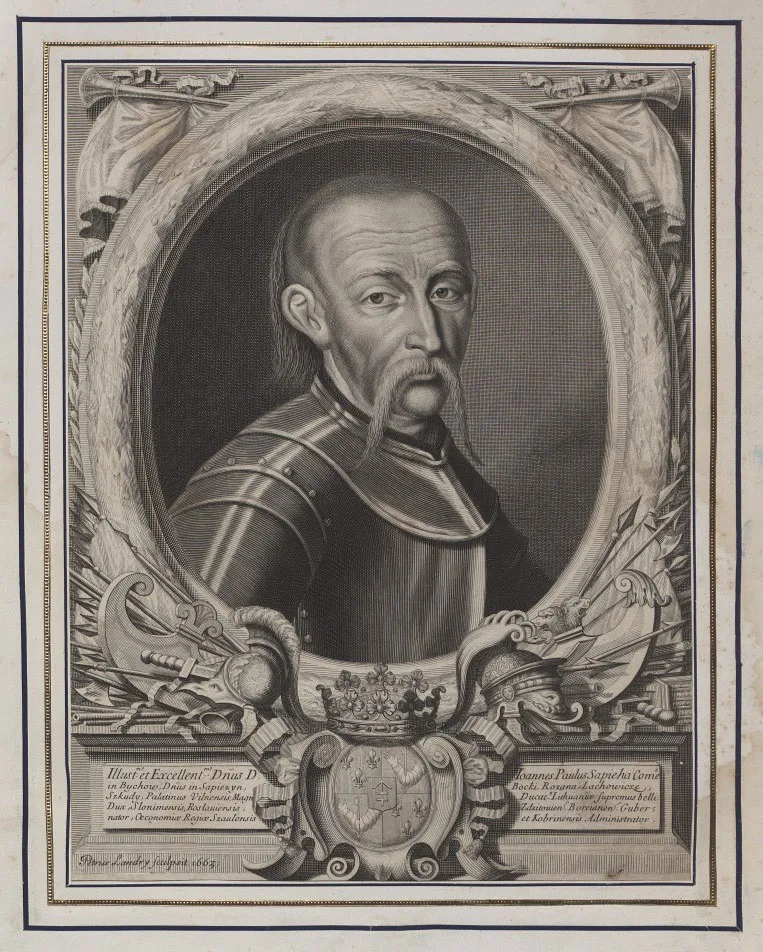
Engraver: unknown · before 1665 · Wikimedia Commons · Public domain
Before the Deluge
Paweł Jan Sapieha (1609–1665) first fought Muscovy in 1633–34 and was badly wounded at Biała. He returned to military service during the Khmelnytsky uprising. Head of a powerful magnate family, he competed with Janusz Radziwiłł. When Janusz placed Lithuania under Swedish protection, the Sapiehas raised their own troops; the Wilanów Palace Museum says they even used family silver and jewels to fund them1.
During the Deluge
After the political split in Lithuania, he commanded forces loyal to John II Casimir. At Janów he defeated troops of Bogusław Radziwiłł, who supported the Swedish king2.
As Lithuanian grand hetman he also led forces that recovered Lublin. These events show Lithuanian troops fighting well beyond Lithuania itself3.
He received the grand hetman's baton after Janusz's death. His command was mixed: he did not prevent Charles X Gustav escaping between the Vistula and San and performed poorly near Warsaw in 1656. Giving part of the Lithuanian army to Wincenty Gosiewski sparked a bitter dispute between the two hetmans. Political rivalry continued inside the Commonwealth camp1.
After Sweden
In 1660 he formally led victorious troops against Russia at Połonka and Basya, although the Wilanów museum credits much of the operational success to Stefan Czarniecki. Sapieha changed political alignments and later opposed court reforms. He died in 166514.
Sienkiewicz and the screen
In The Deluge, Sapieha offers Kmicic a favourable alternative to the Radziwiłł family. His kindly fictional persona and personal encounters with the hero are literary interpretation. The Wilanów biography explicitly cautions that the real hetman was ambitious, quarrelsome and uneven as a commander. Hoffman's film follows the novel's main arc, but the credited cast does not establish a distinct Sapieha performer156.
Notes
- Paweł Jan Sapieha (1609–1665) – przeciwko królowi i Radziwiłłom, Muzeum Pałacu Króla Jana III w Wilanowie
- Bitwa pod Janowem, Oś czasu, Warszawa: Muzeum Wojska Polskiego w Warszawie
- Odzyskanie Lublina, Oś czasu, Warszawa: Muzeum Wojska Polskiego w Warszawie
- Oś czasu – rok 1660, bitwa pod Połonką, Muzeum Wojska Polskiego w Warszawie
- Henryk Sienkiewicz, Potop, Fundacja Nowoczesna Polska (Wolne Lektury), 2009–2010
- Potop, Łódź: Państwowa Wyższa Szkoła Filmowa, Telewizyjna i Teatralna im. Leona Schillera w Łodzi (filmpolski.pl)
Explore further
History
Related
Related
- Battle of Janów Documented
- Lublin
Sources for this page
- Paweł Jan Sapieha (1609–1665) – przeciwko królowi i Radziwiłłom, Muzeum Pałacu Króla Jana III w Wilanowie (Institution)
- Bitwa pod Janowem, Oś czasu, Warszawa: Muzeum Wojska Polskiego w Warszawie (Institution)
- Odzyskanie Lublina, Oś czasu, Warszawa: Muzeum Wojska Polskiego w Warszawie (Institution)
- Oś czasu – rok 1660, bitwa pod Połonką, Muzeum Wojska Polskiego w Warszawie (Institution)
- Henryk Sienkiewicz, Potop, Fundacja Nowoczesna Polska (Wolne Lektury), 2009–2010 (Primary source)
- Potop, Łódź: Państwowa Wyższa Szkoła Filmowa, Telewizyjna i Teatralna im. Leona Schillera w Łodzi (filmpolski.pl) (Reference work)