
AI illustration
Imagined entry into Warsaw; buildings and troop movements are interpretive.
Military action
Swedish forces occupy Warsaw
8 IX 1655
DocumentedOn 8 September 1655, Warsaw surrendered to Charles X Gustav's army without a battle. Behind that brief notice lies a story of a municipal decision, occupation taxes and a map bearing two dates.
- Names and variants
- pl Szwedzi zajmują Warszawę
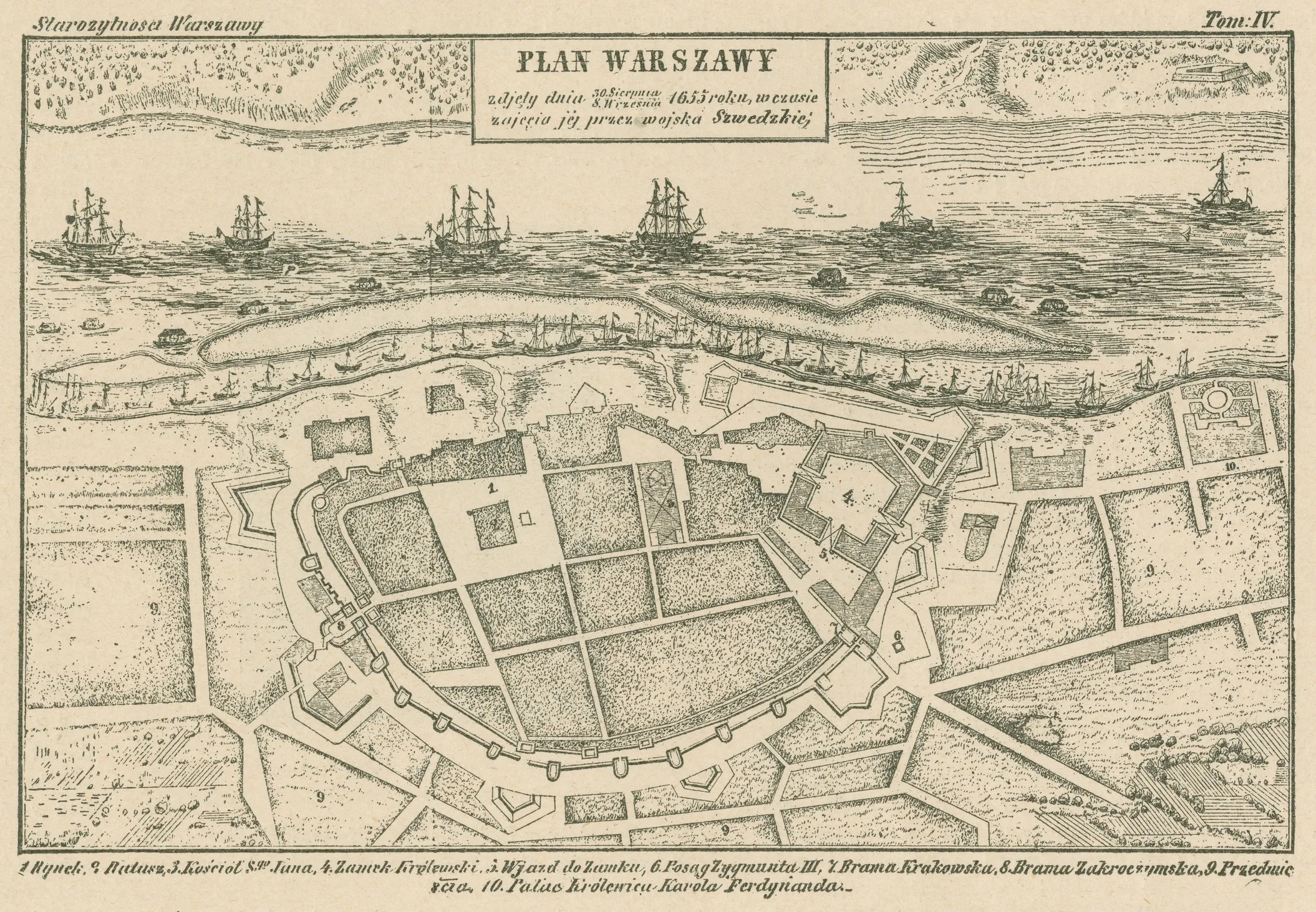
Map authorship: Według planu Erika Jönssona Dahlbergha; reprodukcja „Wędrowiec” (1900) · 1900 · Mazowiecka Biblioteka Cyfrowa / Wikimedia Commons · Public domain
The map shows the town or area of the event; it does not reconstruct troop positions.
The city before the Swedes arrived
Warsaw housed the court and central offices of the Commonwealth. By the mid-seventeenth century its castle, churches and palaces were being expanded, while the new Sigismund Column made Krakowskie Przedmieście a ceremonial setting for royal power. The city mattered far beyond the strength of its walls1.
News of the Swedish advance reached Warsaw in July. Concern grew after Poznań was lost. Queen Marie Louise left in early August, and John II Casimir departed on 18 August. Before leaving, he instructed the citizens to keep watch and relieved them of the obligation to raise a noble levy. The city council strengthened the walls and organized a civic guard, but Warsaw had no field army able to confront the approaching force2.
A morning at the New Town Gate
Charles X Gustav marched from Łowicz towards Warsaw. On the morning of 8 September, two trumpeters appeared outside the New Town Gate: one spoke for the Swedish king, the other for his ally Hieronim Radziejowski. That same day the city council surrendered, hoping to spare Warsaw the destruction of a battle. There was no storming of the gates. This was a civic decision taken under pressure from an army34.
What does the city plan show?
The Museum of Warsaw describes Erik Jönsson Dahlbergh’s work as the earliest known printed plan of the capital. A scene along its lower edge depicts the keys to the city being handed to Charles X Gustav. It is evidence of how the surrender was represented, not a snapshot made on the day: Dahlbergh joined the Swedish staff only in 16565.
The later reproduction of the plan shown above prints two dates in its title: 30 August and 8 September 1655. Historical records of this campaign do not always use the same dating convention. The timeline follows 8 September, the date used by historian Katarzyna Wagner and the Polish Army Museum; the map retains the wording of its published title63.
Occupation at street level
Swedish troops plundered palaces, churches and monasteries, and Warsaw became a storehouse for arms and spoils. Residents had to pay for occupation. Historian Katarzyna Wagner studied the surviving tax registers: assessments were negotiated with the city council and took account of a building's position and type, and whether the taxpayer owned or rented it. The Market Square and Świętojańska Street paid more than outer streets7.
Two lesser-known traces of the invasion
Sigismund Column. It commemorated a king who also claimed the Swedish crown. According to the Museum of Warsaw, Charles X Gustav planned to move the column farther along Krakowskie Przedmieście. Nobody agreed to carry out the difficult job, and the monument remained in place9.
The Royal Castle. The worst destruction followed the occupation, particularly from spring 1656. Paintings, furniture, floors, fireplaces and fountains were removed; rooms served as hospitals and stables. When the royal couple returned to Warsaw in October 1657, the castle was unfit to live in. The court moved to Villa Regia, later called Kazimierz Palace1.
What happened next?
Charles X Gustav left Warsaw for Royal Prussia on 19 November 1655. Commonwealth forces recovered the city when its Swedish garrison surrendered on 1 July 1656, but a three-day battle with the Swedish-Brandenburg army took place outside the city later that month. In 1657, Transylvanian and Swedish troops occupied Warsaw again. The surrender of 8 September therefore began a succession of occupations and struggles over the capital31.
Notes
- Zamek Wazów i królów rodaków (1587–1696), Historia Zamku Królewskiego, Warszawa: Zamek Królewski w Warszawie
- Katarzyna Wagner, „Potop” a wielka wojna północna w Warszawie w świetle rejestrów podatkowych – przyczynek do porównania dwóch szwedzkich okupacji, Saeculum Christianum, Warszawa: Uniwersytet Kardynała Stefana Wyszyńskiego, 2013, 109–119, pp. 110–111
- Katarzyna Wagner, „Potop” a wielka wojna północna w Warszawie w świetle rejestrów podatkowych – przyczynek do porównania dwóch szwedzkich okupacji, Saeculum Christianum, Warszawa: Uniwersytet Kardynała Stefana Wyszyńskiego, 2013, 109–119, p. 111
- Król Szwecji Karol X Gustaw zajął bez walki Warszawę, Oś czasu, Warszawa: Muzeum Wojska Polskiego w Warszawie
- Plan Warszawy 1655, Seria Plany Warszawy, Warszawa: Muzeum Warszawy, 2021
- Plan Warszawy zdjęty dnia 30 sierpnia : 8 września : 1655 roku w czasie zajęcia jej przez wojska szwedzkie, Wędrowiec, R. 38, 1900, nr 28, s. 556, Warszawa: Mazowiecka Biblioteka Cyfrowa, 1900
- Katarzyna Wagner, „Potop” a wielka wojna północna w Warszawie w świetle rejestrów podatkowych – przyczynek do porównania dwóch szwedzkich okupacji, Saeculum Christianum, Warszawa: Uniwersytet Kardynała Stefana Wyszyńskiego, 2013, 109–119, pp. 109, 111
- Katarzyna Wagner, „Potop” a wielka wojna północna w Warszawie w świetle rejestrów podatkowych – przyczynek do porównania dwóch szwedzkich okupacji, Saeculum Christianum, Warszawa: Uniwersytet Kardynała Stefana Wyszyńskiego, 2013, 109–119, p. 114
- Kolumna Zygmunta, Kolekcje Muzeum Warszawy, Warszawa: Muzeum Warszawy
Explore further
Related
Related
- Charles X Gustav Historical figure
- John II Casimir Vasa Historical figure
- Warsaw
Sources for this page
- Zamek Wazów i królów rodaków (1587–1696), Historia Zamku Królewskiego, Warszawa: Zamek Królewski w Warszawie (Institution)
- Katarzyna Wagner, „Potop” a wielka wojna północna w Warszawie w świetle rejestrów podatkowych – przyczynek do porównania dwóch szwedzkich okupacji, Saeculum Christianum, Warszawa: Uniwersytet Kardynała Stefana Wyszyńskiego, 2013, 109–119 (Academic study)
- Król Szwecji Karol X Gustaw zajął bez walki Warszawę, Oś czasu, Warszawa: Muzeum Wojska Polskiego w Warszawie (Institution)
- Plan Warszawy 1655, Seria Plany Warszawy, Warszawa: Muzeum Warszawy, 2021 (Institution)
- Plan Warszawy zdjęty dnia 30 sierpnia : 8 września : 1655 roku w czasie zajęcia jej przez wojska szwedzkie, Wędrowiec, R. 38, 1900, nr 28, s. 556, Warszawa: Mazowiecka Biblioteka Cyfrowa, 1900 (Institution)
- Kolumna Zygmunta, Kolekcje Muzeum Warszawy, Warszawa: Muzeum Warszawy (Institution)