
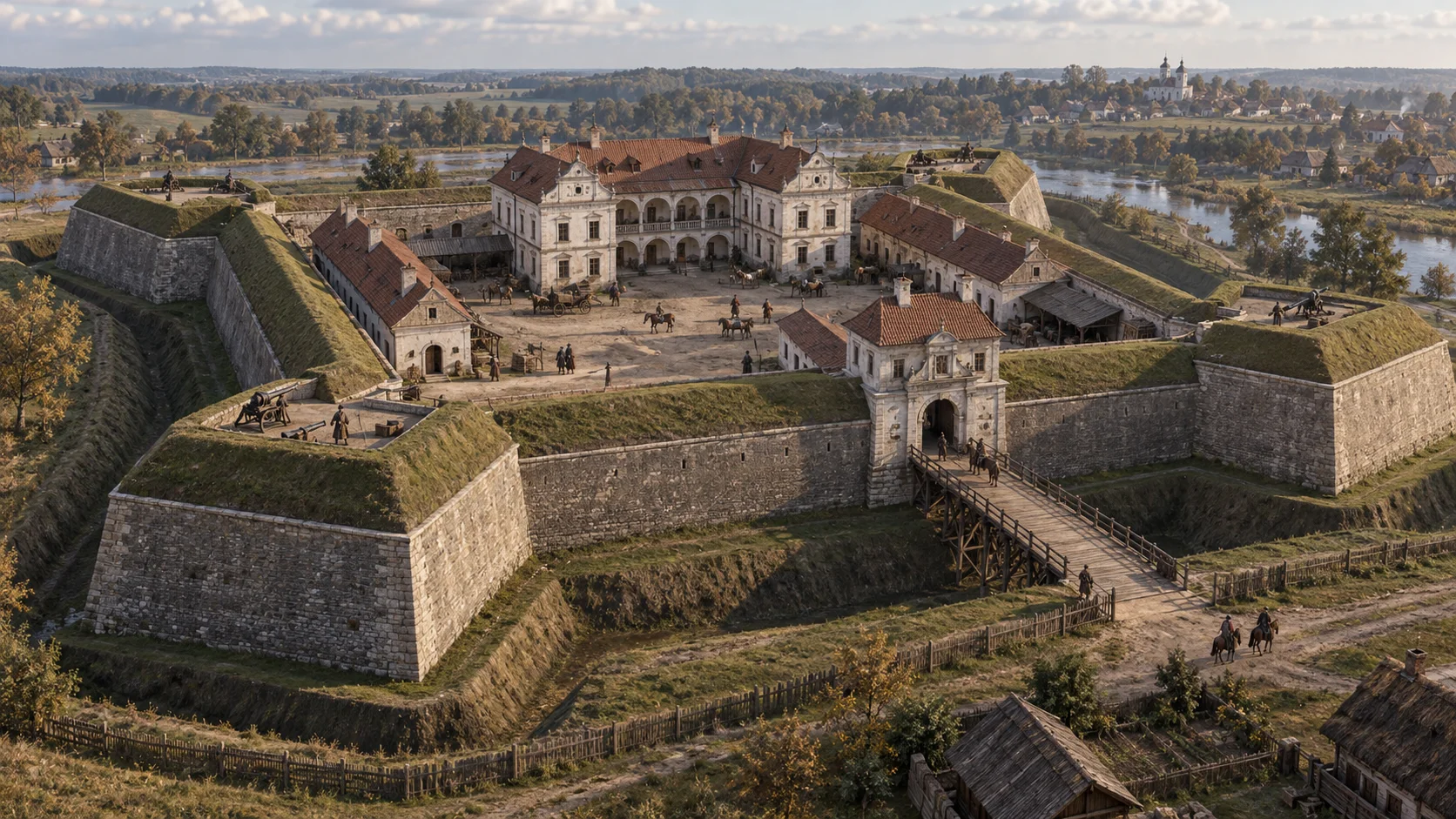
AI illustration
Imagined period town; smoke is an animation effect.
Town
Zbarazh
A town in present-day Ukraine where the Crown army withstood a Cossack and Tatar siege in 1649.
- Names and variants
- pl Zbaraż
A palace within the fortifications
Zbaraż denotes both the town and a fortified residence enclosing a palace. The two-storey Late Renaissance building combined residential and ceremonial functions. A two-storey gate tower with a drawbridge guarded entry, and casemates lined the perimeter. Under the Wiśniowiecki family, bastions, casemates and palace wings were developed in 1631–1649. The monument now houses the Castles of Ternopil Region reserve, established in 1994. Its architecture helps explain its suitability for prolonged defence1.
Before the Deluge
Zbarazh is now in Ukraine. In 1649 it was the site of a siege of the Crown army's fortified camp. Its defenders included Aleksander Koniecpolski and Stanisław Lanckoroński, who later took part in the Swedish war. This was not a battle of the Deluge, but it shaped commanders and strained the Commonwealth before 165523.
Reading the map
The marker locates historical Zbarazh. The siege involved a fortified camp and its surroundings, not a single point in the modern town centre. The event page follows the commanders, a cavalry sortie and the relief attempt2.
Italian design and military needs
Architectural research identifies the Italian “palazzo in fortezza” concept: a ceremonial residence inside a fortress. Vincenzo Scamozzi’s design provided a starting point, but military requirements brought changes. Corner defensive works and earth reinforcement were particularly significant. The ensemble combined a magnate’s residence with protection against artillery, rather than simply reproducing a medieval castle with tall walls. Its changing design records the effort to reconcile domestic comfort, display and military defence4.
What archaeology uncovered
The reserve’s 2019 report describes excavation of the south-eastern bastion. Later earth fills contained remains of an earlier rectangular tower. Finds included finger-marked bricks and Crown copper solidi dated 1659–1666, evidence of use after the siege of 1649. Researchers interpreted some filling of earlier structures as reconstruction following the Ottoman–Tatar capture of 1675. This is an archaeological interpretation. The defences therefore conceal several phases of construction and repair, beyond the traces of a single siege5.
Notes
- Збаразький замок, Національний заповідник «Замки Тернопілля»
- Wojska Bohdana Chmielnickiego przerwały oblężenie Zbaraża, Muzeum Wojska Polskiego w Warszawie
- Aleksander Koniecpolski h. Pobóg (1620–1659), Polski Słownik Biograficzny / Instytut Historii PAN
- Архітектурні особливості палацу Збаразького замку у контексті ренесансного стилю XVII століття, Національний заповідник «Замки Тернопілля»
- Звіт Національного заповідника «Замки Тернопілля» за 2019 рік, Національний заповідник «Замки Тернопілля», 2019
Explore further
History
Related
Related
- Siege of Zbarazh Documented
- Siege of Zbarazh Documented
Sources for this page
- Збаразький замок, Національний заповідник «Замки Тернопілля» (Institution)
- Wojska Bohdana Chmielnickiego przerwały oblężenie Zbaraża, Muzeum Wojska Polskiego w Warszawie (Institution)
- Aleksander Koniecpolski h. Pobóg (1620–1659), Polski Słownik Biograficzny / Instytut Historii PAN (Institution)
- Архітектурні особливості палацу Збаразького замку у контексті ренесансного стилю XVII століття, Національний заповідник «Замки Тернопілля» (Institution)
- Звіт Національного заповідника «Замки Тернопілля» за 2019 рік, Національний заповідник «Замки Тернопілля», 2019 (Institution)