
AI illustration
Imagined period town; smoke is an animation effect.
Town
Mir
A town in present-day Belarus beside the Radziwiłł castle. Samuel Kmicic took the castle after the Battle of Polonka in 1660.
- Names and variants
- be Мір
From the Ilinicz family to the Radziwiłłs
Jerzy Ilinicz began the castle in the early sixteenth century. Five towers were connected by thick walls; each could defend itself and cover neighbouring approaches. Mikołaj Krzysztof Radziwiłł “the Orphan” added residential wings, a barbican, earthworks and a moat, combining defence with the functions of a magnate’s home1.
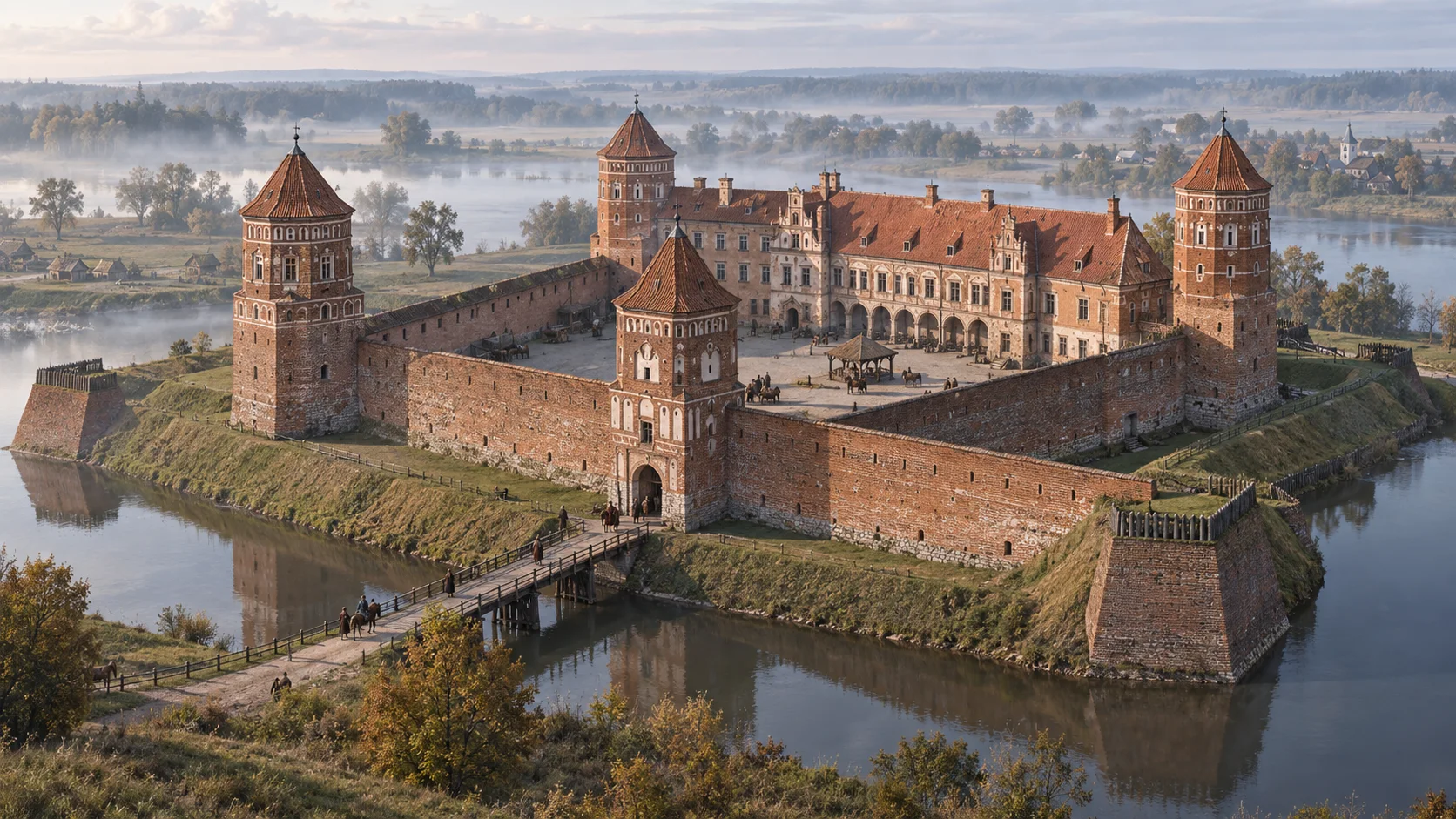
Town and castle
Mir is in present-day Belarus. The small town and the nearby castle were distinct parts of the historic settlement. UNESCO describes a fortress begun around the turn of the sixteenth century and later expanded by the Radziwiłł family. Its Gothic, Renaissance and Baroque elements reflect successive building and reconstruction campaigns.23
What did Kmicic take?
After the Battle of Polonka on 28 June 1660, Samuel Kmicic pursued Muscovite troops. Historian Tadeusz Wasilewski says he defeated 1,500 infantrymen and occupied Mir Castle. The shorthand “took Mir” obscures the distinction: the source names the castle and does not separately describe the capture of the whole town.4
The castle had already suffered during the fighting of 1655. Today the complex is on the UNESCO World Heritage List.32
Destruction in different wars
The museum attributes Mir’s devastation in 1655 to Ivan Zolotarenko’s Cossacks and Alexei Trubetskoi’s Russian soldiers: a different front from the Swedish invasion of the Crown. Katarzyna Radziwiłł began rebuilding in 1680, but Charles XII’s troops destroyed that work in 1706. Today’s castle also incorporates subsequent alterations and restoration1.
The castle and its surroundings
The ensemble stands where a stream joins the Miranka. Beyond the walls and towers it includes surviving defensive earthworks, a landscape park, traces of a formal garden and an artificial lake with an island. Foundations and an outbuilding of the later Sviatopolk-Mirsky palace also survive. The museum distinguishes these historic elements from additions made during modern restoration, including a barbican fragment and visitor infrastructure. The landscape reveals the castle’s transformations, but not every visible feature dates from the Deluge5.
A seal and reconstructed interiors
In 2011 a local resident donated a metal seal matrix to the museum. Researchers date it to the first half of the sixteenth century and attribute it to Jerzy Ilinicz; this identification is an interpretation of the object. It is a rare artefact associated with the earliest owners. Other rooms reconstruct much later Sviatopolk-Mirsky interiors using photographs and recollections. The library, for example, draws on a photograph from the 1930s. Visitors can distinguish an original object, historical documentation and a modern museum reconstruction6.
Notes
- Общая история, Музей «Замковый комплекс «Мир»
- Mir Castle Complex, UNESCO World Heritage Centre
- Mir Castle Complex: evaluation, ICOMOS / UNESCO World Heritage Centre, p. 39
- Tadeusz Wasilewski, Kmicic Samuel h. Radzic odm. (zm. 1692), Polski słownik biograficzny, t. 13, Wrocław–Warszawa–Kraków: Zakład Narodowy im. Ossolińskich – Wydawnictwo Polskiej Akademii Nauk, 1967–1968
- Элементы территории I часть, Музей «Замковый комплекс «Мир»
- Экспозиции, Музей «Замковый комплекс «Мир»
Explore further
Related
Related
- Samuel Kmicic capture of the castle after Polonka Historical figure
- Battle of Połonka Documented
Sources for this page
- Общая история, Музей «Замковый комплекс «Мир» (Institution)
- Mir Castle Complex, UNESCO World Heritage Centre (Institution)
- Mir Castle Complex: evaluation, ICOMOS / UNESCO World Heritage Centre (Institution)
- Tadeusz Wasilewski, Kmicic Samuel h. Radzic odm. (zm. 1692), Polski słownik biograficzny, t. 13, Wrocław–Warszawa–Kraków: Zakład Narodowy im. Ossolińskich – Wydawnictwo Polskiej Akademii Nauk, 1967–1968 (Reference work)
- Элементы территории I часть, Музей «Замковый комплекс «Мир» (Institution)
- Экспозиции, Музей «Замковый комплекс «Мир» (Institution)