
AI illustration
Imagined scene inspired by the biography and portrait shown below.
Commander
Paul Würtz
Historical figureGerman officer in Swedish service and governor of occupied Kraków until its surrender in 1657.
- Names and variants
- pl Paweł Wirtz
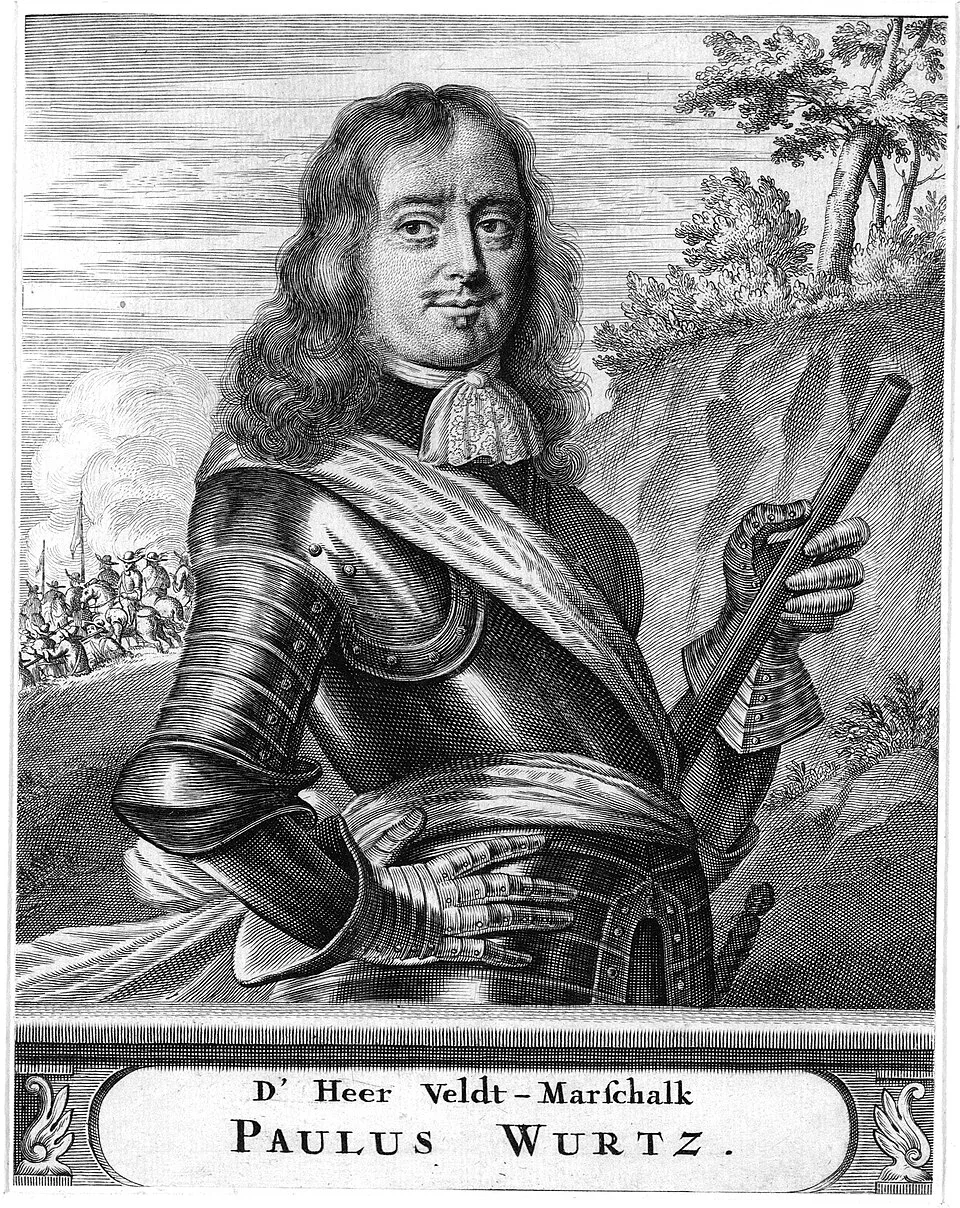
Engraver: unknown · 17th century · Stadsarchief Amsterdam / Wikimedia Commons · Public domain
A career across armies
Paul Würtz, also rendered Paweł Wirtz (1612–1676), was a German professional officer who served several European powers, including Sweden. His career shows that seventeenth-century armies recruited experienced foreign commanders; an officer's birthplace and the state he served need not coincide1.
Occupied Kraków
Würtz took part in the early invasion. Kraków then remained under occupation for nearly two years. From 1656 Würtz governed the city for Sweden. When George II Rákóczi's troops arrived in 1657, a Transylvanian representative, János Bethlen, also exercised authority there. Kraków's own presentation of historical city plans thus shows two allied occupying commands rather than a single administration21.
Polish and imperial troops besieged the city in summer 1657. After the Transylvanians withdrew, Würtz accepted terms allowing his garrison to leave. Wilanów Palace Museum dates the surrender to 25 August; sources vary according to whether they date the signing or the actual departure. The result is clear: Kraków returned to the Commonwealth and the Swedish garrison escaped destruction in an assault321.
Later life, novel and film
Würtz continued his military career outside the Commonwealth, including service as governor of Stettin. Occupied Kraków forms part of the historical background of Sienkiewicz's The Deluge, but the novel is not a full Würtz biography. No distinct Würtz role has been verified in Hoffman's film cast145.
Notes
- Würtz, Paul, Deutsche Biographie / Bayerische Staatsbibliothek
- Historyczne widoki i plany Krakowa – plany z XVII i XVIII wieku, Urząd Miasta Krakowa
- Starcie na Błoniach Mogilskich, Muzeum Pałacu Króla Jana III w Wilanowie
- Henryk Sienkiewicz, Potop, Fundacja Nowoczesna Polska (Wolne Lektury), 2009–2010
- Potop (1974), Filmoteka Narodowa – Instytut Audiowizualny
Explore further
History
Related
Related
- Siege of Kraków (1655) Documented
Sources for this page
- Würtz, Paul, Deutsche Biographie / Bayerische Staatsbibliothek (Institution)
- Historyczne widoki i plany Krakowa – plany z XVII i XVIII wieku, Urząd Miasta Krakowa (Institution)
- Starcie na Błoniach Mogilskich, Muzeum Pałacu Króla Jana III w Wilanowie (Institution)
- Henryk Sienkiewicz, Potop, Fundacja Nowoczesna Polska (Wolne Lektury), 2009–2010 (Primary source)
- Potop (1974), Filmoteka Narodowa – Instytut Audiowizualny (Institution)